
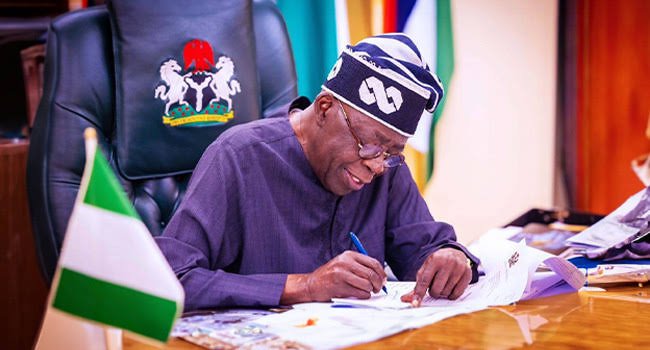
President Tinubu has recently signed the 2025 Appropriation Bill into law, amounting to N54.99tn. This act took place during a small ceremony in the State House, Abuja, with the presence of key National Assembly officers and government officials. The budget received approval after Tinubu requested an increase from the initial proposal of N49.7tn. The adjustments were made to accommodate additional expected revenues from various government agencies.
The budget for the fiscal year includes allocations for crucial sectors like security, infrastructure, education, and health. Notably, $200m has been set aside to counter the effects of reduced U.S. health aid. The budget is built on optimistic economic forecasts, including a crude oil production target of 2.06 million barrels per day at $75 per barrel. The government also targets an exchange rate of ₦1,500 to the U.S. dollar and aims to lower inflation from 34.8% to 15%.
Tax reforms are a key part of the fiscal strategy, aiming to bolster revenue generation and economic stability. These reforms involve raising the value-added tax to 12.5% by 2026 while excluding essential items like food and medicine to ease the financial burden on households. There is also a proposal to redistribute VAT revenues to benefit states with higher revenue generation, sparking discussions on regional economic gaps.
Compared to the 2024 budget of N27.5tn, the 2025 Appropriation Act marks a significant 99.96% increase. Further details on the budget are expected to be released in due course.