
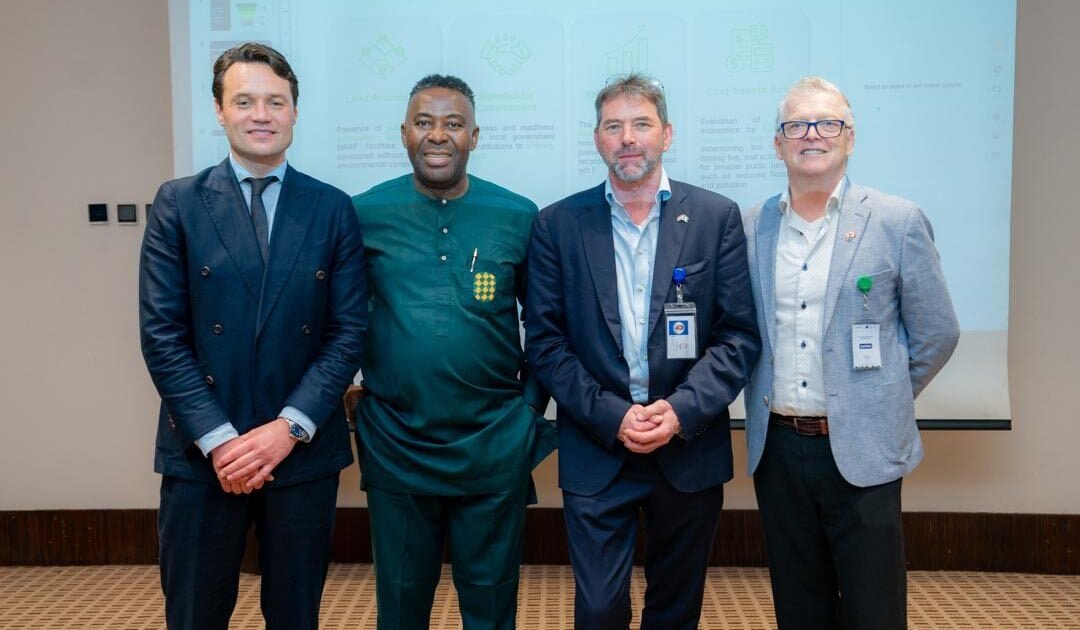
Stakeholders in the waste management value chain have called for strong government backing, policy stability and investment to unlock the country’s waste-to-wealth potential at the ongoing Nigeria Circular Economy Week.
The Nigeria Circular Economy Week began on Monday and will end on Thursday at the Lagos Continental Hotel.
In a working group session covered by our correspondent on Tuesday, which brought together local operators, foreign investors, academics and development partners, discussions centred on building a viable business model for large-scale mixed waste processing in Nigeria.
Founder and Director of SweepSmart, a Dutch waste management firm, Mr Niels van den Hoek, said the session focused on understanding Nigeria’s waste ecosystem and exploring how to turn existing opportunities into a sustainable enterprise.
He revealed that his company was partnering with Nigerian government on advanced waste management.
“Today’s session was about getting to know the existing ecosystem of collectors, recyclers and potential buyers for recycled materials, and to see if we can turn all the opportunities into a viable business model.
“We believe we can only process and manage waste at scale once there is a viable business model,” he said.
Van den Hoek noted that while the opportunities are significant, financial viability remained a core challenge.
“We can create over 300 jobs in a smaller-scale facility and turn mixed waste into valuable resources.
“But our main challenge is whether we can make it financially viable. To do that, we need land in a strategic position and a contribution per tonne of dumped waste at our facility — the tipping fee,” he said.
According to him, current tipping fees are low, making it difficult to scale operations.
“At the moment, the contribution we get is not a lot, but that’s what we need to make the model financially viable and expandable across Nigeria.”
He painted a grim picture of the current waste situation, stating that about 70 per cent of waste in Nigeria is not collected, while 30 per cent is collected — and most of that ends up at dumpsites.
“At these dumps, waste is rotting, decomposing, catching fire and leaking into the environment. It’s smelling — it’s a huge environmental and human disaster.
“If you process waste properly, you can turn it into revenue, create decent jobs and prevent hazardous materials from entering the environment. What we can bring is a clean Nigeria. Otherwise, you are drowning in waste.”
Van den Hoek added that SweepSmart was currently raising funds to conduct a detailed feasibility study.
“We can finalise the study within a year. After that, we can raise funding and be operational within two years, depending on investors and the outcome of the study,” he said.
Also speaking, Dr Abdul-Ganiyu Adelopo, an environmental chemist, described the discussions as a move towards establishing an advanced material recovery facility.
“The summary of the discussion is developing an advanced material recovery system that ensures waste comes straight from homes and value is added to it.
“From waste, you can generate refuse-derived fuel for energy, compost, biogas and black soldier fly protein. Each of these becomes a business model,” he said.
He explained that the Dutch firm is partnering with a Nigerian company, with support from the Dutch consulate, to design a workable investment framework tailored to Nigeria’s waste profile.
However, Adelopo stressed that no investment can thrive without a stable policy environment.
“There is no investment without an enabling environment.
“Investors are hearing Nigerians complain about thelack of government support in making products accessible to the market. Once you practise the circular economy, you will have new, environmentally friendly materials. The onus is on both the producer and the government to create an enabling environment,” he said.
He warned that inconsistent policies, particularly around tariffs and tipping fees, could derail long-term investments.
“For this kind of project, you need a stable waste management policy. A change in administration should not change the tariffs or the nitty-gritty of the business. One wrong policy can throw the investor off the business line.”
Adelopo added that government incentives would be crucial. “This is a long-term investment. It may not break even in five or seven years, but it has huge environmental and social benefits. Government should consider tax incentives and support with equipment importation to ensure the business grows and its products penetrate the Nigerian market.”
On the local front, President of SWEEP Foundation Nigeria, Mr Obuesi Phillips, said his organisation was keen on establishing a large-scale mixed waste processing facility in Ogun State, targeting over 300 tonnes of waste daily.
“We are looking at processing mixed waste into refuse-derived fuel, recyclables, compost and black soldier fly products.
“The project will have financial, environmental and social impacts. It will help make our communities cleaner and more sustainable while guaranteeing returns for investors,” he said.
Phillips acknowledged operational challenges, including unreliable electricity and logistics bottlenecks.
“Electricity is going to be a major factor. It is not constant in the country.
“Logistics will also be an issue because of road congestion and the distance between facilities and collection centres. Beyond that, we face the normal economic difficulties every business in Nigeria faces. But we are Nigerians; we are survivors, and we will overcome,” he said.
He urged the government to expand waste management structures and increase support for private operators.
“In Lagos, we have a single waste management structure. I encourage the government to broaden its horizon and allow more agencies to operate.
“We are asking for increased government support, especially funding, and for the government to take an interest in the project to provide oversight. For corporate organisations, we need additional investment because funding is critical,” he said.
As deliberations continue at the Nigeria Circular Economy Week, stakeholders agreed that transforming Nigeria’s mounting waste crisis into a profitable and sustainable industry will depend not only on technology and innovation, but on strong partnerships, policy consistency and shared commitment from government and investors alike.