
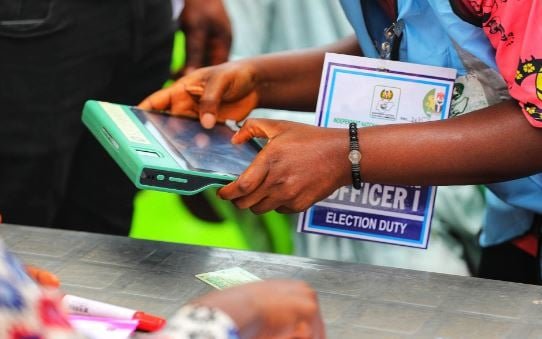
The Centre for Contemporary Studies and the Nigeria Diaspora Coalition for Change have said electronic transmission of election results cannot stop electoral fraud.
The groups argued the interplay between technology and democracy, maintaining that the former could succeed in commerce but fail in democracy.
This was contained in a statement jointly signed by the Chief Executive Officer, Centre for Contemporary Studies, Mr Yusuf Musa and the Chairman of Nigeria Diaspora Coalition for Change, Prof Adenike Grange, a copy of which was obtained by our correspondent on Friday.
This is against the backdrop of the recent controversy surrounding the amendment of the Electoral Act of 2022, specifically regarding electronic transmission of election results.
According to them, without institutional independence, transparent auditing, and rapid judicial resolution, technology becomes threatened and every other reform would still collapse at the collation stage.
According to them, “We make these statements recognizing that our democracy is still young and going through a growing phase. The integrity of our elections can go a long way to establishing us as the true giants of the black race. Our intervention focuses on our technical responsibility to ensure we can trust the systems.
“To be clear, election data is not the same as POS, WAEC or JAMB traffic. Those systems process transactional or institutional records whose failure causes inconvenience; electoral data carries constitutional authority whose compromise affects sovereignty.
“So the issue is not merely whether data can move electronically, but whether it can move with forensic integrity.
“Knowing that data is vulnerable during its lifecycle – Data At Rest, Data In Use, Data In Motion; a credible electoral architecture must address all three simultaneously, otherwise electronic transmission relocates distrust instead of eliminating it.
“We understand that those who favor electronic transmission do not believe that the public internet is inherently safe, but rather that verifiability is safer than discretion. A dedicated or hybrid network (private backbone with public redundancy) would indeed be more
appropriate, combined with layered protections: device-level signing, end-to-end encryption, hash verification, mirrored servers, and immutable audit logs. The goal is not secrecy of the data, but immutability of the record. Even if seen, it must not be alterable without detection.
“Also, of importance in this conversation is to consider the national-security dimension–election data is attractive to state and non-state actors. True. Yet history shows the greater vulnerability in Nigeria has not been a remote cyber intrusion but human interception during physical collation. The question, therefore, becomes comparative risk: centralized cyber manipulation versus distributed human manipulation. Neither is impossible; one is easier to prove.
“Beyond the “making electronic transmission almost a do or die slogan,” electronic transmission alone will not cure electoral distrust. Without institutional independence, transparent auditing, and rapid judicial resolution, technology becomes theatre. But
without verifiable transmission, every other reform still collapses at the collation stage.
“Perhaps the real path is this: not mandatory blind adoption, and not indefinite hesitation —but mandatory demonstrable assurance. Let INEC publicly test, certify, and expose the system before the election, not defend it after.
“In other words, the argument should shift from “trust the technology” to “verify the evidence.”
Meanwhile, Tinubu on Wednesday signed the Electoral Act 2026 (Amendment) into law, just days after the Independent National Electoral Commission released the timetable for the 2027 general elections.
The signing took place at the Presidential Villa, Abuja, around 5pm with principal officers of the National Assembly in attendance.