
The Federal Government has quietly revised the implementation framework of Executive Order 9 of 2026 on oil revenue remittances, with royalties and taxes to remain under the collection of the Nigerian National Petroleum Company Limited and paid into a newly created account domiciled at the Central Bank of Nigeria, The exclusively gathered on Monday.
The adjustment follows high-level deliberations at an implementation committee meeting held last Wednesday, where stakeholders examined practical challenges linked to the order mandating direct remittance of all oil-related revenues into the Federation Account.
Two senior officials involved in the talks, who spoke on condition of anonymity because they were not authorised to comment publicly, said the government was unlikely to rescind the directive but had begun modifying its execution to reflect industry realities.
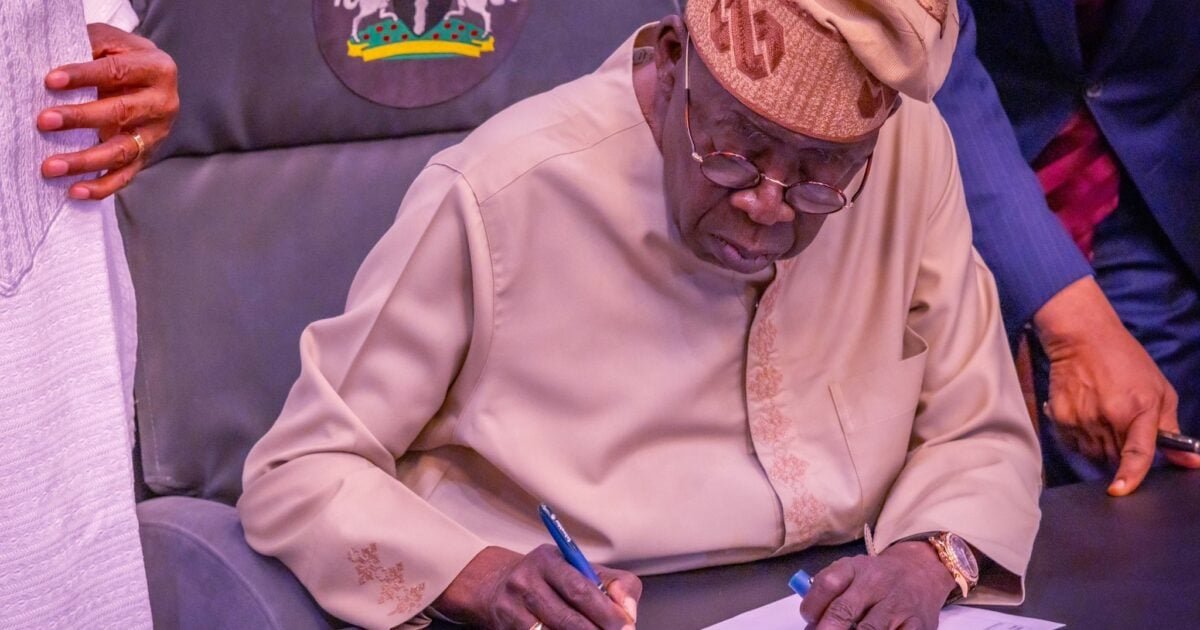
Last month, President Bola Tinubu issued an executive order directing that royalty oil, tax oil, profit oil, profit gas, and other revenues due to the Federation under production sharing, profit sharing, and risk service contracts be paid directly into the Federation Account.
The order also scrapped the 30 per cent Frontier Exploration Fund under the PIA and discontinued the 30 per cent management fee on profit oil and profit gas retained by the NNPC. Effective February 13, 2026, the directive is intended to safeguard oil and gas revenues and strengthen remittances to the Federation Account.
According to the directive, the President invoked Section 5 of the Constitution of the Federal Republic of Nigeria (as amended), anchored on Section 44(3), which vests ownership and control of all minerals, mineral oils, and natural gas in the Government of the Federation.
Tinubu said excessive deductions, overlapping funds, and structural distortions in the oil and gas sector had weakened remittances to the Federation Account and warned that the practice must end to protect national revenue.
“For too long, excessive deductions, overlapping funds, and structural distortions in the oil and gas sector have weakened remittances to the Federation Account. When revenues meant for federal, state, and local governments are trapped in layers of charges and retention mechanisms, development suffers. That must end,” he said on his verified X handle.
He also approved the constitution of a joint project team to execute integrated petroleum operations, with the commission serving as the interface with licensees and lessees where upstream and midstream operations are fully combined.
Members of the committee include the Minister of Finance and Coordinating Minister of the Economy; the Attorney-General of the Federation and Minister of Justice; the Minister of Budget and National Planning; and the Minister of State, Petroleum Resources (Oil). Other members are the Chairman, Nigeria Revenue Service; a representative of the Ministry of Justice; the Special Adviser to the President on Energy; and the Director-General, Budget Office of the Federation, who serves as secretary.
Following last week’s meeting, the government allowed the NNPC to continue commercialising crude barrels before remitting proceeds to the Federation Account, instead of the Nigerian Upstream Petroleum Regulatory Commission handling the process.
One source said the modification became necessary because royalties and taxes are typically settled in barrels of crude oil rather than cash, making direct remittance impractical.
“The government is not looking likely to reverse the order on oil revenue remittance, but they are likely to change the mode of implementation. That is what the situation is currently looking like.
“So the implementation now is that they may not come to read any executive order on the issue. But the implementation is that the order said taxes and royalties should be paid to the federation account directly. But now they have realised that this has already been done and royalties and taxes are not paid in dollars or naira but with barrels of crude oil, which must first be lifted and commercialised before revenue can be realised,” the official said.
He added, “So the implementation now is that the NNPC will continue to lift and sell the crude on behalf of the government and then remit proceeds accordingly. That is the likely operational framework going forward.”
Under the evolving structure, royalties and taxes would pass through the new CBN account, supervised by the Office of the Accountant-General of the Federation, rather than existing regulatory channels.
The official said discussions on profit oil remittances were still ongoing, but cautioned that the framework could undermine reforms introduced under the Petroleum Industry Act, which granted the national oil company commercial autonomy.
“That is the new mode of implementation. But the 30 per cent that comes from profit oil. Instead of the NNPC collecting it and then remitting to the government, the government will collect everything, and then the government will pay back the amount spent on the cost of operations. So those are the level of discussions and the kind of discussions that are ongoing.
“This new funding style will still affect operations at the NNPC and take us back to what was happening before the Petroleum Industry Act. And that was what the PIA tried to cure. During that period, it led to a backlog of issues, and the NNPC couldn’t fulfill its responsibilities. It was subjected to the government budget and the likes, and it is difficult to take back refunds from the government,” he said.
He recalled that the previous arrangement created severe financial strain. “The industry ran into a problem that period, and the system owed national traders and companies over $6bn in cash call arrears.
“Government was also taking everything during that period, and the company would be waiting for cash calls and our own operations. Then the PIA solved all the issues. But the new order is now bringing back the issues. Now that the PSC has been attacked, the government will still come to joint ventures. Discussions are ongoing now on what the company is spending per month. So an amount would be released every month to run operations,” he added.
Another official confirmed the revised implementation but warned that tighter government control could weaken regulatory independence and efficiency.
“Regulatory agencies are supposed to operate independently and should not depend on government funding. But what we are seeing is increasing interference. This could condition the NNPC to rely on government releases to meet its obligations,” he said.
Drawing parallels with past refinery policies under former President Olusegun Obasanjo, he noted that dedicated turnaround maintenance funds were once diverted with reimbursement promises that never materialised, contributing to refinery decline.
He also warned that removing frontier exploration funding could undermine long-term energy security.
“Frontier exploration is a government responsibility because private companies do not take those risks. If the funds are removed, exploration activities will decline. That means we will only produce from existing discoveries, and once those reserves are depleted, Nigeria’s future as an oil-producing country could be threatened,” he said.
On operational sustainability, he cautioned that uncertainty over funding could have labour implications.
“The current expectation is that the government will begin to fund operational costs, including salaries and emoluments, as promised. But if this does not happen, it is only a matter of time before companies begin to consider difficult decisions. Job losses could occur if the funding structure is not sustainable,” he warned.
He added that another high-level meeting had been scheduled later in the week, involving the Nigerian Upstream Petroleum Regulatory Commission, the Federal Ministry of Finance, and industry operators.
Confirming the phased approach in a statement on Monday, the Minister of Finance and Coordinating Minister of the Economy, Wale Edun, said a structured transition would ensure that direct payments by contractors into the Federation Account do not disrupt existing agreements.
“With respect to Section 2, Sub-section 3 of Executive Order 9 on direct payments by contractors into the Federation Account, the committee agreed that this transition must be implemented in a manner that respects existing contractual and financing arrangements, and maintains investor confidence,” the statement said.
Edun added that “until the committee issues detailed guidelines, contractors will continue to remit under the current process. During the transition period, the committee will issue clear, standardised guidance to ensure an orderly changeover.”
He said a Technical Subcommittee would develop detailed guidelines within three weeks and commence a review of the Petroleum Industry Act to address fiscal anomalies.
“The committee will continue to provide coordinated guidance and timely updates as implementation progresses. We commend the cooperation of all stakeholders in advancing the President’s efforts to ensure that Nigeria’s petroleum resources deliver tangible, measurable benefits to citizens across the Federation,” the statement concluded.
Meanwhile, an NNPC official warned that the directive could disrupt production sharing contract operations and affect between 400 and 500 personnel dedicated to such activities.
“It will affect us to a great extent because we have staff who are dedicated to these lines of activity. We have no fewer than 400 to 500 staff whose daily work is focused on production sharing contracts. These are professionals working on rigs, platforms, seismic operations, and cost monitoring. We are talking about personnel across 39 PSC sites, out of which 14 are producing, and about five major sites contribute nearly 80 per cent of output under these arrangements.”
Commenting earlier, a Professor of Economics at Babcock University, Sheriffdeen Tella, said the directive could increase funds available to governments but warned about utilisation.
“It means there would be more money to share for development, although they have not been using it to develop the states. They have been sharing for some states, but we haven’t seen improvement. Some states have done well, but many others haven’t done much.
But the new order simply means that more money will be available to the federation account and more allocation for what the government wants to use it for.”