
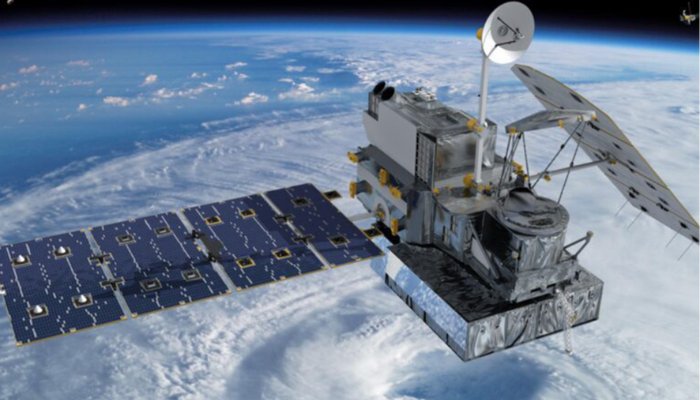
A dispute over $11.4 million in unpaid fees has put Nigeria’s only operational communications satellite at risk of losing the technical support keeping it in orbit and revealed that the country has lacked direct control of the spacecraft for nearly seven years.
Documents and interviews seen by TechCabal reveal that the NigComSat-1R satellite has reportedly been controlled from a ground station in China since 2018, after lightning destroyed Nigeria’s primary control facility in Abuja.
The arrangement, originally designed as a temporary backup, became fixed, and the Chinese contractor running it, China Great Wall Industry Corporation (CGWIC), says it has not been paid for the service since 2019.
In a February 28, 2026, email to Jane Egerton-Idehen, the managing director of Nigerian Communications Satellite Limited (NIGCOMSAT), obtained by TechCabal, CGWIC noted that the outstanding debt had reached $11,442,335.89 as of December 31, 2025.
“I wrote about the outstanding payment in December 2025 and did not get any feedback from NIGCOMSAT,” stated Liu Lan, CGWIC’s head of Africa, who has worked on the project since its inception.
The debt, the email noted, rose from technical control services that CGWIC continues to provide for years without payment.
The dispute has raised broader questions about how the country manages critical infrastructure. NIGCOMSAT’s managing director, Jane Egerton-Idehen, insists that the agency retains full control of the satellite’s strategic direction, even as it relies on external technical expertise.
“Like every other complex infrastructure, you have a support contract,” she told TechCabal in an interview on Friday, March 20. “It doesn’t mean the vendor now controls the equipment. “You can take your car back for servicing. It doesn’t mean the manufacturer now owns or drives the car. It is still your car.”
While the dispute is commercial, two telecom industry executives, who asked not to be named, noted the sensitive nature of the matter and said the consequences could quickly escalate into a national infrastructure crisis if the relationship breaks down further.
“Should the Chinese corporation execute standard commercial responses to a seven-year delinquency by cutting the feed, Nigeria would suffer an immediate, unrecoverable loss of control over its satellite,” one of the executives told TechCabal in February.
Nigeria’s satellite ambitions
Nigeria entered the space race in 2007 when the government launched its first communications satellite in partnership with China. The spacecraft, NigComSat-1, was built by CGWIC and launched on a Long March rocket from China.
The project was financed largely with a $200 million preferential loan from the Export-Import Bank of China, covering most of the satellite’s estimated $311 million cost. At the time, it was celebrated as a milestone in Nigeria’s push to expand broadband connectivity, television broadcasting, and digital infrastructure across the country and the wider African region.
However, the original satellite failed just over a year after launch in 2008 due to technical problems. Alhassan Zaku, then Nigeria’s minister of state for science and technology, said the failure was due to the solar panels, which malfunctioned on the Chinese-manufactured satellite.
Following negotiations, China replaced it with NigComSat-1R, a new satellite launched in December 2011 and formally handed over to Nigeria in 2012.
Under the new agreement, Nigeria retained operational control of the satellite while CGWIC provided technical support services.
“The commitment at that time was that China would replace the satellite without adding any financial burden to Nigeria,” Liu told TechCabal in a virtual interview on March 6, 2026.
“When we delivered the satellite in 2012, the control right of the satellite was transferred to Nigeria,” Liu added. “NIGCOMSAT, as the national operator, had the right to control it.”
How China came to “control” the satellite
The debt dates back to 2018, when Nigeria’s ground control infrastructure malfunctioned.
In satellite operations, control is maintained through Telemetry, Tracking, and Command (TT&C) systems that monitor the spacecraft’s health, determine its position in orbit, and send commands to adjust its orientation and orbital slot.
If the TT&C link is lost, a geostationary satellite can quickly drift out of its designated position due to gravitational and solar forces. When that happens, services such as broadcasting, internet connectivity, and military communications can be disrupted.
Nigeria’s primary TT&C facility, also known as the Obasanjo Space Centre, is located at a ground station in Lugbe, Abuja. According to CGWIC, the facility was severely damaged by lightning in 2018.
“Lightning destroyed the Abuja ground station,” Liu said. “After that, they could not control the satellite, so the control was transferred to our station in Kashgar.”
The Kashgar Ground Station, also known as the Kashi Ground Station, is located in Xinjiang, China.
“We have controlled the satellite from 2018 until today,” Liu said.
That arrangement was originally allowed under a 2014 technical support agreement that established China’s ground station as a backup control facility. But once the Abuja system stopped functioning, CGWIC became the primary maintenance provider,
Under the 2014 agreement, Nigeria was required to pay CGWIC for both backup services and full operational control, according to Liu. NIGCOMSAT declined to confirm the agreement, but admitted it had a support contract in place with the vendor.
Primary control service alone costs more than $1 million annually, according to CGWIC, while additional charges apply for backup operations and other technical services like equipment repair and purchase.
According to Liu, since 2019, the company has received no payment.
Over seven years, the unpaid fees accumulated into the $11.4 million debt now at the centre of the dispute. Despite the growing arrears, Liu says that CGWIC continued providing services to avoid jeopardising the satellite.
“As a commercial company, we have incurred financial loss,” Liu said. “But we did not want this project to damage the relationship between China and Nigeria.”
NIGCOMSAT declined to confirm the amount being owed as debt, because according to Egerton-Idehen, the agency is very careful about how “it throws numbers.”
Nigeria was the company’s first international satellite customer, and Beijing viewed the project as a symbol of South-South cooperation.
For years, the company hoped the debt would eventually be settled or recovered through future contracts, according to Liu.
What happens if control services stop
Since the satellite is currently operated via China’s ground station, CGWIC said it manages the communication link used to transmit commands to the spacecraft.
“If the control link is severed, a geostationary satellite will drift out of its orbital position,” one satellite engineer familiar with the system said. “Once that happens, you lose the satellite.”
CGWIC acknowledges that it has the technical capability to stop services but insists it has deliberately avoided doing so.
“We can stop the service, but we never threatened to do that,” Liu said. “We see NIGCOMSAT as a partner.”
However, the company is now exploring ways to recover the debt.
“We will write to government agencies and stakeholders, including the National Assembly, the communications ministry and the space agency, to explain the situation,” Liu said.
A damaged ground station
According to CGWIC, repairing the Abuja ground station would allow Nigeria to resume direct control of the satellite.
“We proposed a solution to recover the ground station for about $1.5 million,” Liu said. “For the past two or three years, there has been no effort to fix the station. Without that station, they cannot control the satellite.”
Responding to concerns about the repairs, Egerton-Idehen explained that the agency implemented temporary measures after the lightning incident to keep services running.
“Around 2018, before this administration, the ground station experienced a lightning strike that affected some of the servers,” Egerton-Idehen said. “In response, the team adopted a standard recovery approach: they virtualised the affected services. In simple terms, instead of relying on the damaged physical servers, the services were moved to a virtual environment, similar to cloud computing, so operations could continue. At the same time, repairs were being carried out.”
“Many of those issues had already been addressed before we came in,” she said. “When our leadership took over, the focus was on reviewing the entire system, identifying any remaining gaps in the infrastructure and fixing them.”
“We also identified areas where the infrastructure lacked redundancy, which is critical for service quality and business continuity, and worked with our partners across equipment and power systems to strengthen those weak points,” she said.
Still in orbit, still in use
Despite the controversy, NIGCOMSAT insists the NigComSat-1R has been operational and more commercially active than ever.
“When we came in, utilisation on our Ku-band was about 35%,” Egerton-Idehen said. “Today, it is over 90%.”
The Ku-band is the standard for most “everyday” satellite technologies and is used extensively for high direct broadcast because it supports high data rates and clear picture quality.
The satellite currently supports a wide range of services, including television broadcasting, enterprise connectivity, and government communications.
NIGCOMSAT claims it now supports more than 50% of Nigeria’s broadcast traffic, with nearly 150 broadcasters on its platform, up from around 45 when the current management took over.
Beyond broadcasting, the satellite is used to extend connectivity to rural areas, support defence communications, and backhaul traffic for telecom operators operating in underserved regions.
“If you can see the sky, we can connect you,” she said.
Yet these gains highlight only part of the picture. In August 2025, Egerton-Idehen acknowledged that the satellite’s broadband capacity remains largely untapped, with just 7% of its Ka-band in use and more than 90% sitting idle.
The Ka-band is critical for high-speed internet services, making its underutilisation a key constraint on the satellite’s broader commercial potential.
According to Liu, the issue is not a lack of market demand but weak commercial operations.
“There is no problem with the market,” Liu said, citing examples from other countries.
In Bolivia, she noted, TKSat-1, the country’s first communications satellite, built at an estimated cost of around $300 million, similar to NIGCOMSAT-1R, generates between $10 million and $20 million annually. By 2020, it had earned more than $80 million over its first four years, averaging roughly $20 million annually.
In South Africa, the South African National Space Agency (SANSA) and local partners such as CubeSpace, Simera Sense, and Astrofica generate revenue from satellite-based Earth-observation data, hardware components, and downstream applications. In 2023, these companies were part of Africa’s broader commercial space sector, which included 327 firms collectively earning US$309 million.
Communications satellites are typically operated from domestic control facilities because the ground station determines who can send commands to the spacecraft. In Nigeria’s case, the failure of the Abuja control station has meant that operational control has been exercised from China for several years.
In contrast, many Nigerian broadcasters and telecommunications operators still rely on foreign satellites for their services, leaving much of NIGCOMSAT-1R’s capacity unused.
“That shows the market exists,” Liu added. “The problem isn’t demand; it’s that NIGCOMSAT has struggled to commercialise the asset.”