
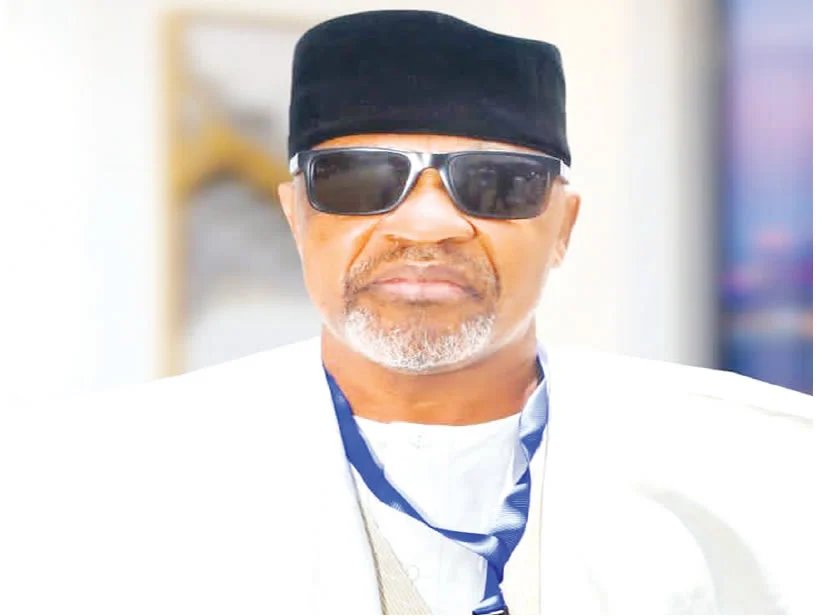
Former Secretary to the Bauchi State Government and governorship aspirant of the Nigeria Democratic Congress, Ibrahim Kashim, speaks with UMAR SANI on his political ambition, reasons for leaving the PDP and SDP, his vision for Bauchi State, and the political permutations ahead of the 2027 general elections
Having observed the political atmosphere in Bauchi and at the national level, which has been plagued by litigations and conflicts in political parties, what is your assessment of the political environment ahead of the 2027 general elections?
I will say two things. There is a Hausa proverb that says, ‘If a rat is known for stealing, the food must also have a smell.’ The point is that while people often blame the APC for destabilising political parties, you cannot ignore the internal weaknesses within those parties themselves. The truth is that most political parties are responsible for their own crises. Apart from the NDC, which is still trying to maintain internal discipline, many parties are controlled by individuals who believe they own the structure and can override constitutional provisions and internal rules. No matter how powerful you are, anyone can go to court and challenge irregular actions, and the courts will rule accordingly. That is the reality facing most political parties today, including the PDP, SDP, Labour Party, ADC and others. The core issue is the lack of respect for internal democracy. Where party leaders act arbitrarily, aggrieved members will inevitably seek legal redress. In politics, once you give your opponent an opportunity, he will take it. Looking at the wider picture, I believe the era of dominant political parties is gradually fading. Even within the APC, once primaries are concluded, internal tensions will likely emerge. Injustice cannot endure indefinitely — it may persist for a while, but it will eventually give way. What we are witnessing is the consequence of internal contradictions within the political system. And this will not be limited to one party alone. Increasingly, politics is becoming candidate-driven rather than party-driven, especially in places like Bauchi State, where voters are more interested in individuals and their ideas than party labels. We have seen this pattern before — governorships and Senate seats changing hands despite incumbency advantages, simply because the electorate wanted change. At the end of the day, we will all present ourselves before the people, explain our records and intentions, and allow them to decide.
How would you rate the chances of NDC ahead of the general election?
When people become dissatisfied, they naturally begin to search for alternatives and hope. Over the past one and a half years, many political actors have been searching for such a platform, and increasingly, they see the NDC as that alternative. Every day, we are witnessing prominent figures joining the party, including lawmakers at the national level. This gives us confidence that our prospects are strong. The party has also zoned its presidential ticket to the South, which I consider a matter of fairness and political balance. After the years of northern leadership under President Buhari, it would not be justifiable to immediately insist on another northern Presidency after only four years. If Nigerians genuinely desire change, then such balance is necessary. That imbalance was one of the factors that weakened the PDP over time. At the state level, we remain confident because we are engaging citizens with clear policy ideas — pension reform, civil service reform, education, healthcare, and social welfare initiatives such as the Zakat and Waqf framework. We are not relying on political godfathers or endorsements. We are presenting ideas, and I believe the electorate will respond positively.
In your resignation letter as the Secretary to the Bauchi State Government in 2024, you mentioned that it was based on a directive by the governor. Can you clarify why he directed you to resign?
You see, the week I was appointed Secretary to the State Government, I understood clearly that it was a political appointment made at the pleasure of His Excellency. So, I wrote my resignation letter that same week. I actually showed it to him and asked him to keep it, so that anytime he felt dissatisfied with my performance, he could simply sign and date it and I would leave office. He declined and asked me to keep it, which I did. On one or two occasions, I had already decided to leave. I even invited some close associates — this can be verified. The current Emir of Alkaleri, the Chairman of the Bauchi State Project Monitoring Commission, Arc Muhammad Dadi, and Alhaji Musa Jibir all came to my residence at the SSG House, where I told them of my intention to leave. They advised me against it. On another occasion, the then state party chairman, Hamza Akuyam, also intervened and informed His Excellency. The governor called me, we discussed, and he asked me to stay on. That was the situation. Eventually, when it became difficult for me to continue, I met him on December 12 at his residence and we discussed it. He agreed that I should leave office. That is why I wanted people to understand that it was not a unilateral decision or an act of disrespect, but something mutually agreed upon.
There was a circulating rumour that you fell out with the governor, which led to him directing you to resign…
Honestly, I know nothing about that — absolutely nothing. If there is anything of such nature, then those making the claim should state it clearly, or perhaps the governor himself can clarify. But as far as I am concerned, I am not aware of any fallout.
Can we say you requested to leave office?
No, it is not just a matter of requesting to leave. It is something that was discussed and mutually agreed upon. You must also understand the context. I was not part of the governor’s 2019 campaign team. Yet in 2021, he brought me in and appointed me SSG. That is a gesture I deeply respect. There were initial challenges, especially from some stakeholders who felt I was an outsider. But over time, we worked through those issues and developed understanding. So, it would not have been appropriate to simply walk away. We sat down and reached a consensus.
What informed your decision to contest the governorship election?
I am not a typical politician. Development is not just about infrastructure. Infrastructure is important, but it is not sufficient for economic development. Many other factors determine whether people actually prosper. For example, after nearly 50 years of statehood, parts of Bauchi metropolis still lack pipe-borne water. The state also has one of the highest numbers of out-of-school children in the country and remains among the poorest in the North-East. That should not be the case. Bauchi has the means of production — land and people. It has a population of over 10 million, yet there is no fully functional industry providing mass employment. Economic activity remains largely petty trading, despite huge potential. The state is also rich in solid minerals and is among the largest in Nigeria by landmass. There is no reason we cannot achieve year-round agriculture through irrigation and improved planning. These are the issues that must be addressed through deliberate policy direction. For instance, when I came in, Bauchi Mining Synergy and Exploration Limited was being run like a department within the ministry. That structure could not attract investors. So, we properly registered it with the Corporate Affairs Commission, along with Yankari Corporation. That reform allowed Yankari to access private sector financing for vehicles and operations. We also reorganised mining licences, revoked unused ones, and reassigned them to BAMCEL. Before I left, we had secured about 12 licences. The goal was to attract investors and expand mining activities in the state to boost employment and revenue. Agriculture is another key sector. Bauchi has enormous agricultural potential, yet lacks functional irrigation infrastructure and dams. With proper investment, the state can achieve year-round farming across its ecological zones. My vision includes establishing government-owned farms in all 20 local government areas, while also encouraging local governments, emirate councils, and institutions to engage in agriculture as was done in the past. Government will also serve as a buyer of last resort for farm produce to stabilise prices and reduce post-harvest losses. This will encourage production, reduce poverty, and create jobs. We also plan to support agro-based industries, such as tomato processing in Jama’are and similar ventures across the state, to strengthen value chains.
Considering that you served under Governor Bala Mohammed administration and your former principal is now in the APM, why do you not think aligning politically with him is the best option? Also, why do you believe the NDC is a better choice compared to other parties?
On the issue of politics, I am a student of history and sufficiently informed to recognise contradictions when they exist. Even while I was in government, I could see that there were contradictions within the PDP that would eventually become problematic. Different blocs were pulling the party in different directions — governors’ forum, stakeholders, the Board of Trustees, interest groups and other tendencies. It was only a matter of time before these contradictions came to the surface. So, immediately after leaving government, I resigned from the PDP. As you know, I was once a member and even secured the governorship ticket in 2023 before stepping down for His Excellency. After leaving, I sought a platform that aligned with my vision — one free from internal contradictions, money politics and undue influence. That was why I joined the SDP. For about one and a half years, we worked to build the SDP in Bauchi State. However, the challenge we encountered was that the national leadership was not aligned with our mission at the state level. While we were focused on building structures and preparing for elections, the leadership at the centre appeared more interested in personal gains than party development. I say this with responsibility. That disconnect led to constant internal conflicts. As a result, I left and once again searched for a platform without such structural contradictions. That was what led me to the NDC. As it stands, my assessment has been vindicated because the NDC is one of the few parties without factions, court cases or deep internal crises. It is a platform where candidates can operate freely without godfathers or competing power blocs controlling the process. You can engage the electorate directly, present your ideas and seek their mandate. That is why I am in the NDC today. As for why I did not align with my former principal, politics allows individuals to take different paths. If I had not already exited my previous party, perhaps I would have been in APM today. But my concerns about the PDP have already been validated, given the fragmentation it is currently experiencing. Ultimately, politics is about differing choices among friends. My former principal is concluding his tenure and, naturally, has his own political direction and preferred successor. We now know who has emerged as the APM candidate. By the grace of God, we will meet on the field and present our programmes to the people for them to decide.
You mentioned that the person he wanted to succeed him has been given the mandate. Did you earlier have a belief or indication as to who Bala Mohammed wanted to succeed him?
Most definitely. I think only someone being deliberately dishonest would claim not to have known. For the past year, it has been common knowledge in Bauchi politics who the preferred candidate is.
How do you hope to transform Bauchi State in four years if elected governor?
Everything is contained in my manifesto. From the outset, we will fully implement local government autonomy in line with constitutional provisions and Supreme Court pronouncements. The current structure that undermines local government independence will be reviewed. Local governments will be empowered to engage in agriculture, commerce and service delivery based on their capacities, while the state provides oversight. We will also reform the health sector using a performance-based system, where workers are rewarded according to productivity. This will help retain skilled professionals and improve service delivery. Nursing schools will be upgraded into degree-awarding institutions to address manpower shortages, and more health personnel will be trained and deployed across the state. We will also revive scholarship programmes for outstanding students to study in Nigeria and abroad, as was done in the past. On pensions and welfare, we will prioritise the payment of outstanding entitlements and ensure retirees receive timely support and access to healthcare. Agriculture and industrial development will be central to our economic strategy, including government-supported farming schemes in all local government areas and agro-processing industries to create jobs and reduce poverty. We also plan to revitalise dormant state-owned enterprises through privatisation and private-sector partnerships to stimulate economic activity. In education, we will focus on practical skills development, ICT training, and vocational education to prepare young people for employment and entrepreneurship. Ultimately, our goal is to build a self-sustaining economy driven by productivity, inclusion and opportunity for all citizens of Bauchi State.