
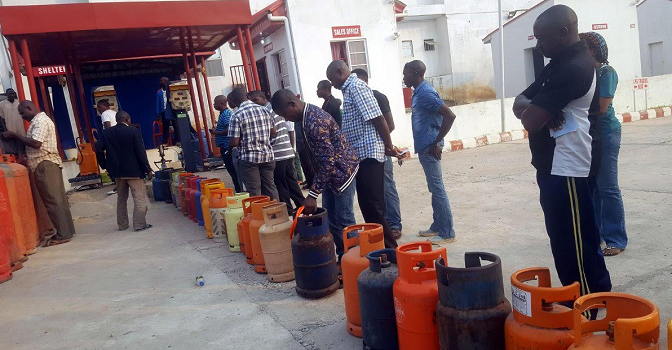
THE last two weeks of May brought fresh misery to millions of Nigerian households as the price of cooking gas soared to alarming levels. The surge coincided with preparations for Eid al-Kabir, compounding the hardship of citizens already grappling with a crushing cost-of-living crisis.
Earlier this year, cooking gas sold for about N1,050 per kilogramme. Today, the price ranges between N2,000 and N2,200 per kilogramme, depending on location.
This means that refilling a standard 12.5kg cylinder now costs more than N25,000. Such a situation is indefensible in a country where the minimum wage is N70,000 per month, and millions earn far less.
At 210.54 trillion cubic feet, Nigeria is ranked ninth by gas reserves in the world, says the Policy Center for the New South, based in Morocco.
A country so richly endowed with gas resources should not remain dependent on imports for half of its cooking gas needs.
Data from the Nigerian Midstream and Downstream Petroleum Regulatory Authority indicate that the daily local supply of cooking gas ranges between 3,300 and 4,500 tonnes. Yet despite this volume, consumers are facing soaring prices and growing fears of scarcity.
The prospect of a shortage is particularly troubling because it could force many households back to firewood, charcoal, and kerosene. Such a regression would not only worsen poverty but also accelerate deforestation, desertification, and environmental degradation.
According to the Voice of Nigeria, more than 160 million of Nigeria’s estimated 237 million people still lack access to clean cooking solutions. Consequently, millions depend on traditional fuels such as firewood, charcoal, and kerosene for their daily cooking needs.
This dependence has devastating health implications. VON reports that between 80,000 and 95,000 Nigerians die prematurely every year from illnesses linked to toxic indoor air pollution caused by dirty cooking fuels.
Indeed, unsafe cooking smoke has become Nigeria’s third-largest silent killer after malaria and HIV/AIDS. Any development that pushes citizens away from cleaner cooking energy should therefore be viewed as a national emergency.
The current crisis is rooted in supply disruptions that began in October 2025 following the dispute between the Dangote Petroleum Refinery and the Petroleum and Natural Gas Senior Staff Association of Nigeria, which triggered shutdowns across parts of the oil and gas sector.
The Nigerian Association of Liquefied Petroleum Gas Marketers had long warned about erratic supply and rising costs, cautioning that the trend could lead to scarcity and deepen hardship forconsumers.
According to the association, marketers currently pay between N25.2 million and N26.2 million for 20 metric tonnes of LPG, depending on location.
The National President of NALPGAM, Edu Inyang, and its Executive Secretary, Bassey Essien, aptly described the situation as “sad and rather very pathetic.”
The soaring cost of cooking gas has imposed severe hardship on households, food vendors, small businesses, restaurants, and low-income families whose livelihoods depend on affordable cooking energy.
More worrisome is the fact that the crisis threatens years of progress made through government policies designed to expand cooking gas adoption and promote clean cooking.
NALPGAM has rightly warned that failure to act decisively could accelerate food inflation, destroy small-scale LPG retail businesses, lead to job losses, discourage investment, and undermine Nigeria’s climate and clean-energy commitments.
Rising international energy prices, geopolitical tensions, including the ongoing US-Israel-Iran conflict, and disruptions in global supply chains have all exerted pressure on cooking gas prices.
However, external factors alone do not explain Nigeria’s predicament.
The country remains unnecessarily vulnerable because it still imports about 50 per cent of its cooking gas requirements despite possessing some of the largest natural gas reserves in the world.
This dependence places enormous pressure on foreign exchange demand and exposes consumers to fluctuations in the naira exchange rate.
Cooking gas imports come mainly from the United States and Equatorial Guinea, with additional supplies sourced from Argentina, Ghana, and India. Every depreciation of the naira translates directly into higher cooking gas prices for consumers.
Logistics constitute another major challenge, as most imported cooking gas arrives through Lagos ports before being trucked across the country. The result is a costly and inefficient supply chain vulnerable to poor roads, traffic congestion, insecurity, vehicle maintenance costs, and rising diesel prices.
Under the National LPG Expansion and Implementation Plan of 2022, the Federal Government projected investments of about $2 billion in cooking gas production facilities and another $2 billion in distribution and marketing infrastructure. Yet progress has been far too slow to shield consumers from recurring price shocks.
Therefore, the government must take practical steps to address the crisis sustainably, starting with an aggressive boost in domestic LPG production by ensuring that more gas from Nigeria’s natural gas streams is processed and dedicated to the local market.
Regulators should establish clear domestic supply obligations for gas producers and processors to guarantee consistent local availability before export commitments are prioritised.
Investment in coastal and inland marine distribution should be accelerated. Moving cooking gas by barges and coastal vessels to riverine and coastal depots would significantly reduce dependence on expensive road haulage and lower distribution costs nationwide.
Also, strategic cooking gas storage facilities should be developed across the six geopolitical zones to cushion supply disruptions and prevent panic-induced price spikes.
Crucially, the government should eliminate regulatory bottlenecks, excessive levies, and multiple taxation along the LPG value chain, all of which ultimately find their way into the final retail price paid by consumers.
In addition, the authorities should encourage private investment in cylinder manufacturing, bottling plants, and regional distribution hubs to deepen market competition and reduce logistics costs.
Finally, regular maintenance shutdowns at depots and critical facilities must be better coordinated to minimise supply disruptions.
While transporting cooking gas through pipelines may offer long-term benefits, concerns over vandalism and security make such infrastructure difficult to implement immediately. More practical solutions exist and should be pursued without delay.
The Federal Government and its agencies must therefore move beyond rhetoric and urgently implement the national gas plan if cooking gas is to remain affordable and accessible to ordinary Nigerians.
The price of cooking gas should not compound the existing woes of high food, petrol, diesel and electricity prices.