
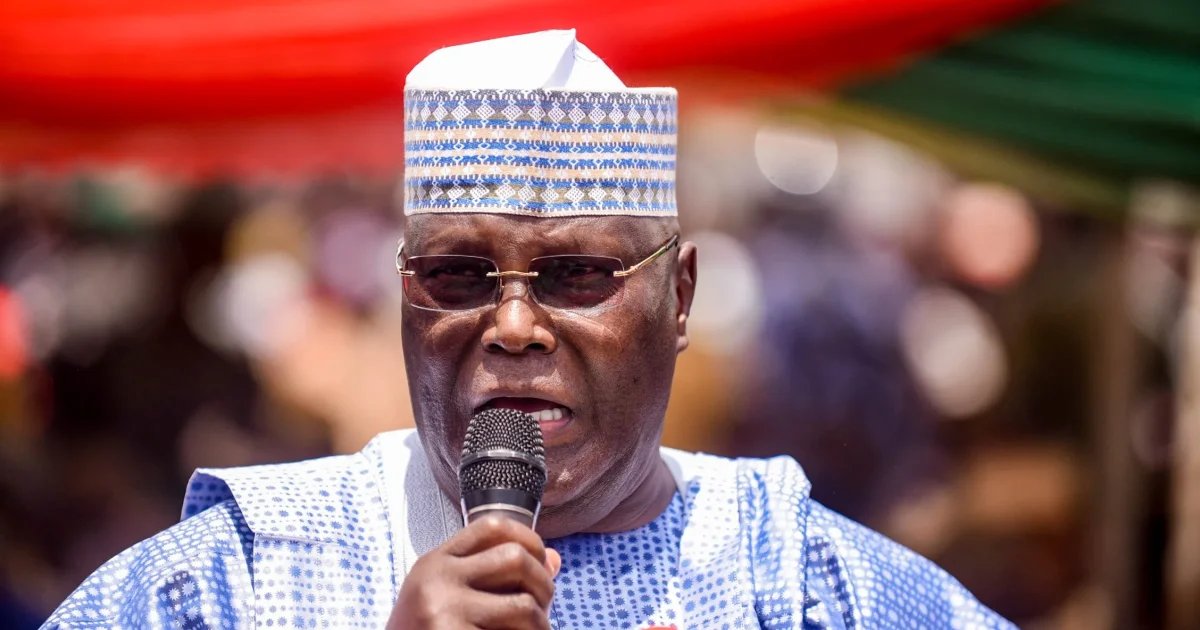
Former Vice President and presidential candidate of the African Democratic Congress, Atiku Abubakar, on Sunday launched a blistering response to former Secretary to the Government of the Federation, Babachir Lawal, accusing him of promoting ethnic prejudice, peddling conspiracy theories and deepening divisions at a time Nigeria requires unity to confront its mounting challenges.
In a statement issued by his Senior Special Assistant on Public Communication, Phrank Shaibu, Atiku said Lawal’s recent public attacks were devoid of facts and evidence and instead relied on what he described as ethnic profiling and inflammatory rhetoric aimed at discrediting political opponents.
Atiku said the most troubling aspect of Lawal’s interventions was what he called a persistent effort to associate an entire ethnic group with the actions of a few criminal elements.
“It was both dangerous and irresponsible to suggest that any Nigerian should be judged, condemned, or held accountable for crimes committed by individuals simply because they share a common ancestry,” Atiku said.
According to him, such reasoning threatens national cohesion and could further widen existing fault lines in a country already grappling with insecurity, economic hardship and political tensions.
“By such flawed reasoning, every ethnic nationality in Nigeria could be collectively blamed for the actions of a few criminal elements within their communities, a mindset that has historically fuelled division and undermined national unity,” he added.
The exchange marks the latest chapter in the growing political realignments ahead of the 2027 general election, where opposition figures are increasingly positioning themselves against both the ruling establishment and rival political actors.
Atiku also pointed to what he described as contradictions in Lawal’s public posture, noting that the former SGF had, on the same day he criticised him, reportedly granted media interviews highlighting his political relevance and claiming that several governors were interested in bringing him back into the All Progressives Congress.
“Nigerians are entitled to ask a simple question: which Babachir should they believe? The Babachir who claims to be a victim of political conspiracies and ethnic domination, or the Babachir who boasts that governors are scrambling for his services?” Atiku queried.
“One moment, he presents himself as a lonely patriot standing against an imagined threat to Nigeria. The next moment, he portrays himself as a prized political asset being courted by powerful governors. Such contradictions expose a man struggling to reconcile personal disappointment with political reality”, he said.
Atiku further accused Babachir of attempting to stigmatise the Fulani ethnic group despite having served under former President Muhammadu Buhari, who is of Fulani extraction.
The former vice president recalled that Buhari appointed Lawal as Secretary to the Government of the Federation, describing it as the highest office he occupied in public service.
“At no point did Mr Lawal object to receiving such trust and elevation from a Fulani President. He accepted the office, the privileges, and the prestige that came with it. It is therefore difficult to understand why he now seeks to stigmatise an entire ethnic group merely because another Fulani man seeks the presidency through democratic means,” he stated.
The ADC presidential candidate also rejected suggestions that he had remained indifferent to victims of violence across the country, insisting that his record demonstrated consistent engagement with communities affected by terrorism, banditry, kidnappings and communal conflicts.
Citing the attacks on Kagoro in Southern Kaduna, Atiku said he personally attended a church thanksgiving service in solidarity with victims and their families.
“When tragedy struck the people of Kagoro in Southern Kaduna, I did not ask whether the victims were Christians or Muslims, northerners or southerners, Fulani or non-Fulani. Instead, I attended a church Thanksgiving service to identify with the grieving community, commiserate with families affected by the violence, and demonstrate solidarity with fellow Nigerians in their moment of pain.
“Leadership is not about counting tribes or measuring faith. It is about standing with people in moments of difficulty, regardless of their ethnic or religious identity. That has always been my approach, and it will continue to be,” he stated.
Seeking to reinforce his credentials as a nation-builder, Atiku highlighted his investments in education and human development, particularly his intervention following the abduction of the Chibok schoolgirls by Boko Haram insurgents.
He recalled facilitating scholarships for some of the released girls at the American University of Nigeria, Yola, noting that many had since graduated and rebuilt their lives.
“Those young women are living proof that compassion is more powerful than bitterness and that nation-building requires action, not merely rhetoric. While some people chose to exploit national tragedies for political narratives, others chose to invest in healing and hope,” he said.
He also defended his record as an entrepreneur, describing attempts to question his business credentials as “amusing and detached from reality.”
“The American University of Nigeria stands as a visible and enduring monument to what private initiative can achieve. Thousands of graduates and their families are beneficiaries of that vision. No amount of political bitterness can erase those facts,” he added.
The former vice president did not hide his displeasure with Lawal’s comments, saying they reflected a man increasingly consumed by resentment.
“His heart appears full of bitterness, and his public utterances increasingly reflect anger rather than reason, grievance rather than evidence. While we do not share his hostility, we genuinely pity him. Politics should not reduce a man to a permanent state of outrage.
“Mr Lawal would be better served by stepping away from the politics of hate and embracing the kind of reflection and personal healing that can restore perspective and balance. Nigeria needs statesmen, not merchants of bitterness,” he added.
The latest war of words comes against the backdrop of growing political manoeuvring ahead of the next electoral cycle, with opposition figures seeking to redefine alliances and influence national conversations on leadership, security and governance.
Atiku used the occasion to reiterate his vision for a united Nigeria, warning against ethnic and religious stereotyping in political discourse.
“Nigeria deserves a conversation about the future, not endless bitterness about the past. Our people deserve leaders who unite rather than divide, heal rather than inflame, and build rather than destroy,” he said.
Atiku noted, “Babachir may see tribe. I see Nigerians. Babachir may see division. I see a nation that must come together if it is to overcome its present challenges. That is the difference between politics driven by resentment and leadership driven by purpose.”
He reaffirmed his commitment to building a country where every citizen, regardless of ethnicity, religion, region or social status, enjoys equal opportunity, protection and dignity under the law.
Atiku’s shot at Babachir is coming against the backdrop of a Facebook post made by the former SGF where he chided the ex-Vice President.
In the post titled Kachalla II, Babachir said of Atiku, “It is my right to interrogate the character and competence of someone who seeks to be my President. He is free to step down his ambition if he does not want to be so queried.
“I will urge ADC to replace this man with a more qualified candidate if they want to have any hope of winning the presidential election before the Independent National Electoral Commission timetable runs out on them,” he noted.