
I was sitting on my three-seater chair with its peeling leather in my 2-by-2-metre apartment when I heard a voice: “Egbon, ba yi si?” Looking up, I discovered it was Saheed Olugbon, a serial award-winning photographer, who plies his trade with the most widely read newspaper headquartered in a gigantic white edifice along the Lagos-Ibadan Expressway. I answered, “Ba wa,” with the same Egba dialect he used to greet me, the language of the most urbane Yoruba nation?
I went back into my shell, deep in thought, without offering him a seat. With our lovely fraternity, he did not need to be offered one, as he took a seat in the dining area, opened his laptop, and buried his head in it.
After a long silence, I asked, “Omo, kini o sele ti o kan dake sibe?” — meaning, what is happening, why are you silent? As I moved closer, I noticed he was captioning photographs.
I stayed glued, watching the spectacle in every shot. I saw people in different colours of Aso-Oke; men in Agbada and women in iro and buba. I also saw coral beads, well-dressed horses, different shades of designer sunglasses, and anklets.
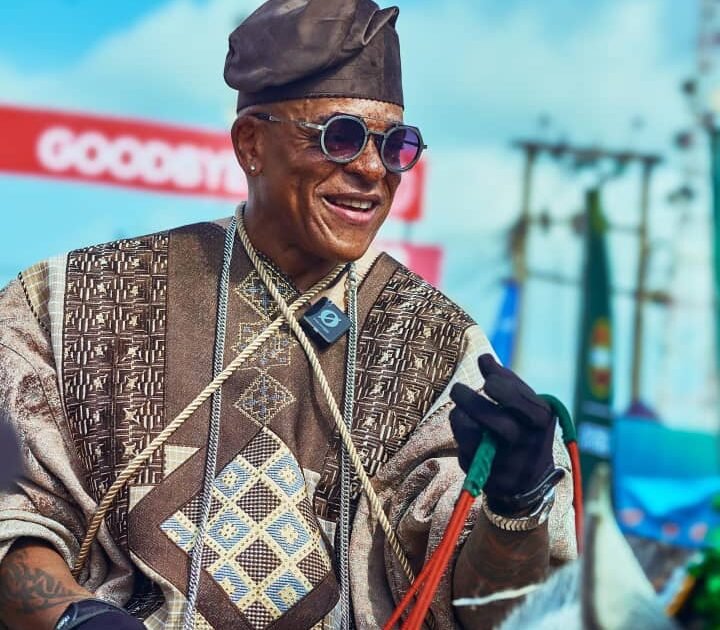
I was about to move back to my seat when a particular shot caught my attention: a sidestream enveloping a man on a horse. My attention immediately shifted from the perfunctory. I saw a man with a porcelain complexion punctuated with freckles, wearing an agbada, badass sunglasses, layers of coral beads around his neck, a tattooed hand, and a cigar in his mouth.
While still enjoying my feat of deconstructing the horseman enveloped in the sidestream, I felt a touch and heard a voice: “Se ki se tea e?” — meaning, should I prepare your tea? That was my wife speaking.
I opened my eyes.
So, all I have described was a reverie? No, it was not. Rather, they were real images of Farooq Oreagba and Ojude Oba 2024 etched in my memory.
With full consciousness regained, I remembered it was Friday, May 29, 2026, the day of Ojude Oba 2026. No wonder the real me had travelled back to 2024.
I finished sipping my milkless tea and went online to enmesh myself in the full drama unfolding at Ojude Oba 2026. All I saw were the same things etched in my memory since 2024, but with sophistication in 2026. The Aso-Oke were more bespoke; the hand fans, bags, walking sticks, and small umbrellas were artisanal. For the horses, the embroidery of their dress was beautiful; their ankles were dressed in bells that produced rhythmic music as they trotted or galloped. What I saw could rival any equestrian society.
I also saw many men holding cigars, but not the porcelain-complexioned man with freckles. I wondered: Is the myeloma ailment back? Then, suddenly, perhaps to calm my nerves, another slide appeared — a replica of his 2024 entry and characteristics — and he emerged in a white agbada with purple embroidery.
Looking at him, one can see the freckles that dot his complexion are representations of the rumbustious moments in his journey.
Though his body was ravaged by an unequal fight, his will to live remained unshaken.
For those familiar with cancer, the fight against it is like the proverbial dog that went to the lion’s den and came back alive.
In 2014, Farooq had a tough joust with myeloma, a cancer that attacks plasma cells in the bone marrow. A report published in the International Journal of Blood Research and Disorders by O.C. Nwabuko et al. (2017) put the survival rate in the Niger Delta, Nigeria, at 7.6 per cent over five years. With 8 chemotherapy sessions, his story and helluva spirit tessellate well with powerful lines:
“Good timber does not grow with ease. The stronger the wind, the stronger the trees. The further sky, the greater length. The more the storm, the more the strength. By sun and cold, by rain and snow, in trees and men, good timbers grow.” — from Good Timber by Douglas Malloch
The same fortitude and stoicism that prevented him from hitting the canvas are now receiving daffodils from the advertising and branding profession that thrives on differentiation.
From the moment that unusual photo hit our screens, it brought not only travails but the will to live to brand managers.
As a callow in marketing years back, I learnt from Philip Kotler, one of the respected figures in marketing, the 4 Ps of marketing. Over time, the Ps in the marketing ecosystem evolved, with Seth Godin adding another P in Purple Cow, one that revolves around doing something unusual and remarkable that stands out from everyone else.
In a world where the same-of-same mentality thrives, and everyone wants to keep up with the Joneses, Oreagba, a finance executive with his porcelain complexion dotted by freckles in green and lemon agbada, holding a cigar, became a posture that stood out from the motley crowd. Many expected somebody of his status to be calm, wear a colour that mixed with the crowd. But no, Farooq flipped things; he became a bohemian indeed and appearance. He stood apart from all at Ojude Oba 2024.
Isn’t it differentiation that sells?
In a crowded marketing space with many damaged reputations, brands are in search of that purple cow that transforms their visibility and perception.
His disruptive appearance at Ojude Oba 2024 made him a purple cow that the world and brands immediately noticed. His differentiation bestowed on him “Mr Steeze”, which earned him a prominent role in Airtel’s “Live Limitless” campaign and recognition as a cultural ambassador by the National Council for Arts and Culture in 2024.
For Ojude Oba 2026, Oreagba took off from where he stopped. This time, he was in a white agbada with purple embroidery and a purple cap to match, his cigar and a purple flag with FCMB inscribed on it fluttering as the horse galloped. Such a scene is not a pantomime but a deliberate plan by the custodians of FCMB to leverage Farooq’s cultural visibility to deepen the brand awareness and equity.
Looking at Oreagba’s story of becoming the beautiful bride of brands from the angle of standing out alone is like gulping the froth of a beer and leaving the liquid. The liquid is in Bill Bernbach’s 1959 masterclass “Think Small” advert for Volkswagen. DDB was given a brief to turn the fortune of Volkswagen, a German car associated with Hitler that no American wanted to touch with a long pole.
What did Bill Bernbach do? Using the car’s smallness, cheap pricing, and lower petrol consumption as a pivot, he changed its fortune at the expense of more exotic cars.
Nobody in this wild world would expect an executive in the C-suite, managing an ailment, with tattoos, and holding a cigar at Ojude Oba. Many in such a situation would be on the fringe of such an event, but not him. He switched all perceived problems to something positive.
Every situation in life presents to us a tabula rasa; it is left for us to say: “I am the master of my fate, I am the captain of my soul.” — Invictus — William Ernest Henley (1875)
For Oreagba, the world and brands are seeing the calligraphy of differentiation. It has shattered playing at the fringe and upped the ante for influencers and brand ambassadors whose backstories are either scandalous or weightless.
Toluwalope Shodunke, a media practitioner, writes via [email protected]