
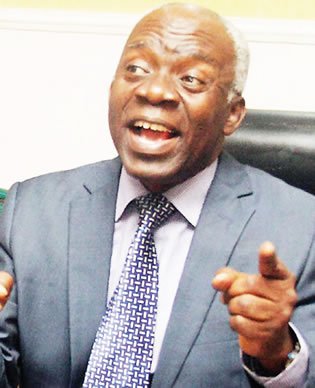
Senior Advocate of Nigeria, Mr Femi Falana, and top Lagos State government officials have called for stronger respect for constitutional rights, improved police accountability, adequate funding of security agencies, and deeper collaboration between youths and law enforcement to strengthen democratic governance and public safety.
The calls were made last week at a youth-police engagement summit on community safety and social reform organised by the Lagos State Bureau of Public Defender, in collaboration with the Office of Political, Legislative and Civic Engagement.
The event brought together senior government officials, police representatives, legal practitioners, civil society actors, and youth groups.
Speaking at the summit, Falana urged security agencies to uphold citizens’ constitutional rights, especially the right to peaceful protest, while stressing that proper funding and reform of policing structures remained essential to national security.
“Once citizens notify the police of an intended protest as required by law, the police are obligated to provide adequate security for the protesters,” Falana said, referencing legal precedents affirming the constitutional right to peaceful assembly.
He recalled that Nigerian courts had struck down the requirement for police permits for public protests, describing it as inconsistent with democratic freedoms.
Falana, however, lamented that while authorities often tolerate protests against criminality, they are less receptive when demonstrations target government policies or economic hardship.
He also criticised inadequate funding of the police, noting that systemic deficiencies undermine effective law enforcement.
“You cannot effectively police a society without investing substantial resources in investigation, prosecution, and maintenance of law and order,” he said.
The human rights lawyer further condemned the practice of complainants funding police investigations, describing it as a driver of corruption and inefficiency within the justice system.
Falana also called for the adoption of modern technology in policing, including surveillance tools, to combat rising insecurity, such as kidnapping.
He maintained that security agencies could be more effective if properly trained and equipped, adding that “advances in technology could significantly improve rescue operations and tracking of criminal gangs.”
On police accountability, Falana strongly condemned extrajudicial killings and excessive use of force, urging authorities to ensure accountability and psychological evaluation for erring officers.
“There is no way a normal human being would publicly execute another person without any form of trial or investigation,” he said.
He also reminded officers that citizens have the legal right to request identification and to record police activities in public spaces, provided such actions do not obstruct law enforcement duties.
Falana further stressed compliance with the Administration of Criminal Justice Act, noting that suspects must be informed of their rights and granted access to legal representation.
Where suspects cannot afford counsel, he said, institutions such as the Legal Aid Council and public defender offices must be engaged.
He warned that failure to record confessional statements in accordance with the law had led to the collapse of several criminal prosecutions.
Falana also condemned the indiscriminate use of handcuffs and leg chains, describing such practices as degrading and incompatible with modern justice standards.
He urged regular oversight of detention facilities and mandatory reporting of arrests to magistrates to ensure transparency in policing.
The SAN further advocated reforms benefiting police personnel themselves, recalling successful legal challenges against outdated regulations restricting female officers’ personal freedoms.
He called for continued collaboration between law enforcement agencies, civil society, legal practitioners, and citizens to strengthen human rights protection and institutional accountability.
“Enforcing existing laws and safeguarding the rights of both citizens and police officers will contribute significantly to justice, security, and democratic governance in Nigeria,” Falana said.
Also speaking at the summit, the Lagos State Solicitor-General and Permanent Secretary, Mr Hameed Oyenuga, described the summit as “urgent and necessary,” noting that Nigeria’s security challenges require coordinated legal and institutional responses.
“In our country, security is a serious matter that requires urgent attention.
“The police are a crucial component of our security architecture, and we must continue to strengthen them through training and engagement.
“I commend the organisers of this programme. It is so crucial. What is happening in our country today requires an urgent and compelling need to discuss security issues,” Oyenuga said.
He noted that youths constitute more than half of Nigeria’s population and frequently interact with law enforcement agencies, making police-youth relations critical to national stability.
“Considering that youths constitute over 50 per cent of the population, taking care of them is essential. On a daily basis, they are in contact with law enforcement agencies, so the relationship between the police and young people is very important,” he said.
Oyenuga praised the Nigerian Police Force, describing it as one of the best in the world, while stressing the need for continuous training and retraining.
“We have a very viable police force that I can vouch for. They are among the best in the world. There is nothing wrong with training and retraining, and I am sure this programme will further sharpen their knowledge and improve their capacity,” he said.
Oyenuga also emphasised the importance of regulated protests, disclosing that the government had designated specific areas in Lagos where demonstrations could be safely held.
“We recognise the constitutional right to protest, but it must not obstruct public order or endanger lives and property,” he said. “Designated protest zones help balance civic expression with public safety.”
“Protest is recognised by the Constitution, but when you protest, you must also consider the rights of other citizens. Where your right stops is where another citizen’s right begins,” he said.
Dr Babatunde Omotayo, who represented the Special Adviser to the Governor on Political, Legislative and Civic Engagement, Dr Afolabi Tajudeen, stressed that security should not be viewed as the responsibility of law enforcement agencies alone.
“Security can no longer be deemed solely as the responsibility of one law enforcement agency alone. Rather, it is a collective responsibility that requires the involvement of government, communities and, particularly, our youth,” Tajudeen said.
He explained that the summit reflected the Lagos State Government’s commitment to inclusive governance and civic participation.
“This gathering reflects Lagos State’s commitment to promoting inclusive governance, strengthening public trust through collaboration and civic participation in today’s rapidly evolving society,” he stated.
Tajudeen added that empowering young people and creating platforms for dialogue would strengthen community safety and social cohesion.
“The programme has been designed to create a platform for constructive dialogue, strengthen relationships between the youth and law enforcement agencies, and advance policy directions that empower community-led solutions to safety and security challenges,” he said.
The Lagos State Commissioner of Police, Fatai Jimoh, represented by the Assistant Commissioner of Police in charge of Finance and Administration, Vicky Mulero, reaffirmed the command’s commitment to building trust with young people and promoting justice-oriented policing.
“It is a privilege to be here this morning among all the important dignitaries gathered for this summit, which focuses on police engagement with youth in Nigeria in line with global standards,” Mulero said.
She noted that the summit would help improve understanding between law enforcement officers and youths.
“This summit will no doubt strengthen trust and understanding between Nigerian youths and law enforcement agents,” she said.
According to her, the engagement would also equip police officers with the skills needed to address issues that often create tensions between security agencies and young people.
“It will also prepare our officers on how to handle issues causing tensions between the police and the youth, thereby moving the order towards restorative justice rather than punitive punishment,” she stated.
In a keynote presentation on citizens’ rights and electoral participation, retired Chief Superintendent of Police, Dr Yetunde Cardoso, urged Nigerians to take advantage of voter registration opportunities and participate actively in the democratic process.
“Voting is not only our right; it is our power. What gives you that power is your registration and your voter card,” she said.
Cardoso explained that while citizens have the constitutional right to vote, such rights can only be exercised after proper registration.
“If you do not register and obtain your voter card, you cannot claim that anyone is depriving you of your right to vote,” she stated.
She also outlined the role of police officers during elections, stressing the need for professionalism and neutrality.
“The duty of the police is to protect the electorate, secure election materials, and maintain order. Police officers must not participate in the voting process or assist in filling out forms or ballots.
“Police should monitor polling locations from a reasonable distance and remain impartial throughout the electoral process.
“One of the major powers that police officers have is the power of arrest. But the question is: how do you exercise this power? Is it arbitrary or within the confines of the law?” she asked.
Delivering a paper on police powers of arrest and citizens’ rights, Director of the Bureau of the Public Defender, Mrs Olubunmi Adesomoju, warned against abuse of arrest powers and unlawful profiling.
Adesomoju reminded officers that arresting individuals over civil disputes such as debt recovery or breach of contract was unlawful.
“A person shall not be arrested merely for a breach of contract. The police have no business getting involved in matters that do not disclose criminal offences,” she said.
She further stressed that suspects must be informed of the reasons for their arrest and treated with dignity.
“A suspect shall be accorded humane treatment and should not be subjected to torture, cruel, inhuman or degrading treatment,” she said.
The BOPD Director also condemned profiling based on appearance.
“You cannot conclude that someone has committed a crime simply because they have dreadlocks, tattoos, a laptop, or drive an expensive vehicle. Those are not grounds for reasonable suspicion,” she said.
Adesomoju reiterated that police bail remains free under Nigerian law.
“Police bail is strictly free. Paying money to secure release from a police station is illegal and amounts to extortion,” she stated.
She also stressed the importance of recording confessional statements electronically and in the presence of legal representatives.
“When a suspect volunteers a confessional statement, it is not enough to write it down. It must be recorded and obtained in accordance with the law,” she said.
Also speaking, Permanent Secretary of the Bureau of Public Defender, Dr Babajide Martins, emphasised the need to balance constitutional freedoms with public order.
“You have the right to protest, but you must not exercise your rights in a way that infringes on the rights of others,” Martins said.
According to him, protesters are only required to notify the police of their activities rather than obtain police permits.
“Police cannot stop people from protesting because they disagree with the government. Their duty is to provide security and ensure that hoodlums do not hijack the protest,” he stated.
Martins, however, warned that criminal conduct during protests remains punishable.
“The fact that you are protesting does not give you the right to commit crimes. If you destroy property or incite violence, you can be arrested and prosecuted,” he said.
He also urged police officers to properly document evidence during demonstrations and criminal investigations.
“When suspects make confessional statements, those statements must be recorded. If they are not recorded, the courts may reject them,” he cautioned.
Participants at the summit agreed that strengthening youth-police engagement, improving police accountability, protecting human rights and encouraging active civic participation remain critical to building safer communities and deepening democratic governance in Lagos State.