
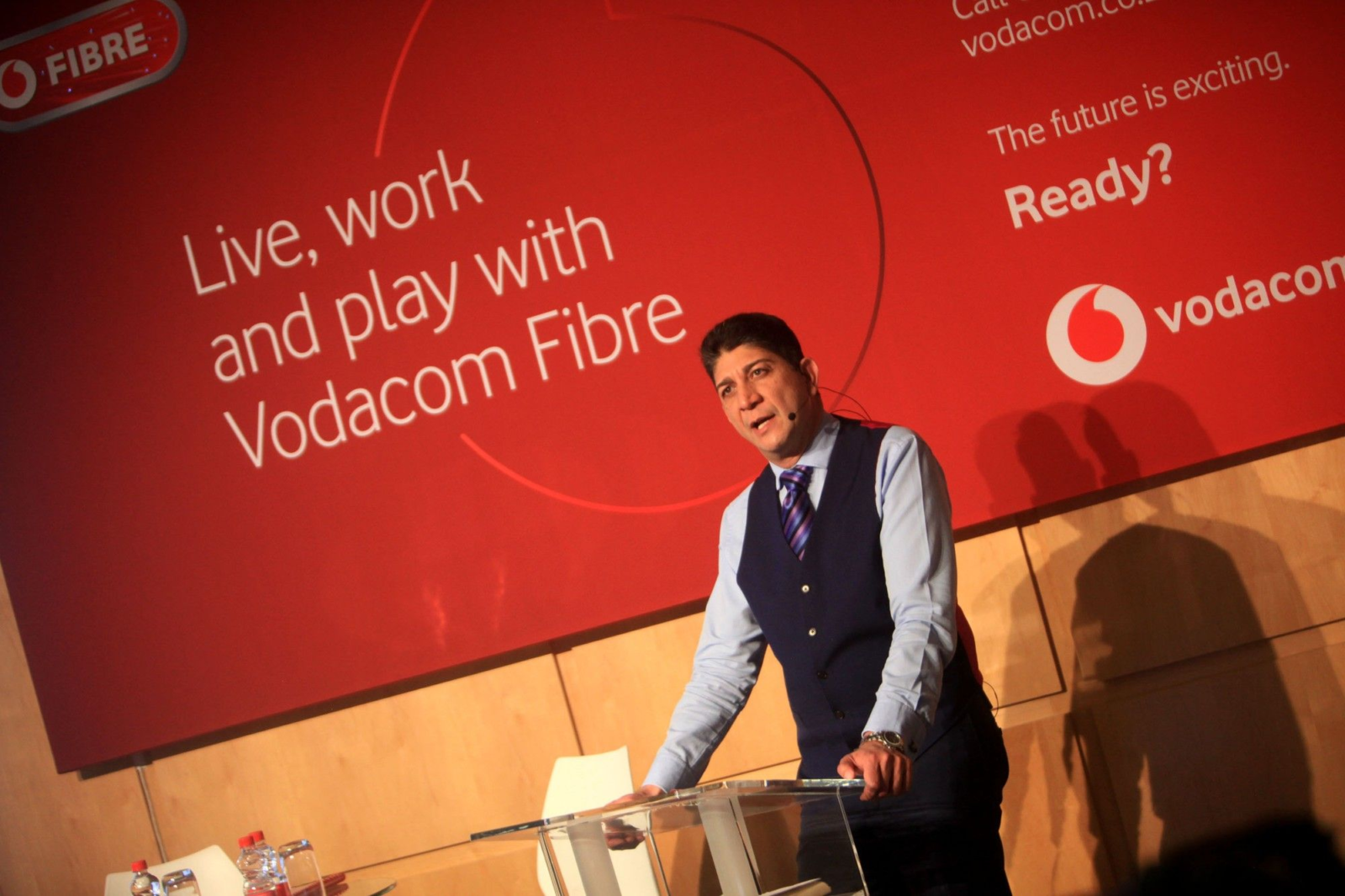
Vodacom, a pan-African technology group, is now generating growth beyond its South African home market, with Egypt, Kenya and other international markets outpacing its more mature domestic business.
The acquisition of a controlling stake in Safaricom, East Africa’s biggest telco, brings M-Pesa, Safaricom’s mobile money platform, and its vast financial services ecosystem into the group, strengthening Vodacom’s ambition to evolve beyond traditional mobile connectivity.
Vodacom reported revenue of R102.5 billion ($6.2 billion) for the six months ended 30 September 2026, a 25.6% year-on-year increase, boosted partly by the consolidation of Safaricom, according to its interim financial results on Tuesday
The results reveal a relatively mature South Africa, where growth is harder to extract, and faster-expanding markets where mobile connectivity and financial services are opening new revenue opportunities.
Egypt delivered 36.3% service revenue growth in local currency, while Safaricom grew service revenue by 13.1%. Tanzania, the Democratic Republic of Congo (DRC) and Lesotho also recorded strong performances. Vodacom’s international business achieved normalised service revenue growth of 13.7%, with Earnings before interest, taxes, depreciation and amortisation (EBITDA) increasing 15.9%.
In South Africa, Vodacom returned its prepaid business to growth, supported by higher data consumption, while cost optimisation lifted its EBITDA margin to 37.4%, its highest level in several years.
Shameel Joosub, Vodacom’s chief executive officer, said the group had delivered one of its strongest six-month performances. “We exceeded our medium-term growth target on service revenue, EBITDA, and operating free cash flow, while also reaching the milestone of serving a quarter of a billion customers across Africa,” he said.
Vodacom added 26 million customers over the past 12 months, taking its total customer base to 250 million across Africa.
The Safaricom acquisition is becoming central to Vodacom’s ambition to diversify beyond traditional mobile connectivity and accelerate its financial services business. Vodacom increased its shareholding to 55%, consolidating Safaricom as a subsidiary from June 30. The transaction gives it greater exposure to Kenya’s mobile money ecosystem and one of the continent’s most established fintech platforms.
Vodacom and Safaricom both generated pro-forma financial services revenue of R43.1 billion ($2.6 billion) over the last 12 months. Their platforms served 108 million financial services customers, who accessed and initiated more than $575.5 billion in transaction value over the same period.
Financial services revenue grew 99% to R15.9 billion ($966 million) in the reported half-year, although that figure reflects Safaricom’s consolidation for only one quarter. On a pro-forma basis, including Safaricom in the comparative period, growth was 19.2%.
Joosub said M-Pesa is key to Vodacom’s ambition to build a business that earns money from more than calls, data and connectivity. Beyond payments, the opportunity includes savings, investments, credit and other digital financial products.
“The combination of Vodacom and Safaricom creates one of the continent’s largest FinTech platforms,” he said, adding that the platforms are expanding access to formal financial services and enabling greater economic participation for millions of people and businesses.
Financial services, fixed connectivity, digital and Internet of Things (IoT) services now account for 27.4% of Vodacom’s service revenue. Following the Safaricom acquisition, the group has raised its 2030 target for these businesses from 30% to more than 32%, demonstrating how central diversification has become to its growth strategy.
For shareholders, the interim performance has brought a handsome payout. Vodacom declared an interim dividend of 355 cents per share, up 7.6%, supported by headline earnings per share growth of 25.7% to 587 cents. Headline earnings rose 25.6% to R11.3 billion ($685 million).
The group also invested R13.3 billion ($806 million) in capital expenditure during the half, up 41%, expanding network capacity and adding infrastructure to support rising data consumption and digital services.
Joosub said Vodacom was on track to exceed its medium-term growth targets as it pursues its Vision 2030 ambitions.