
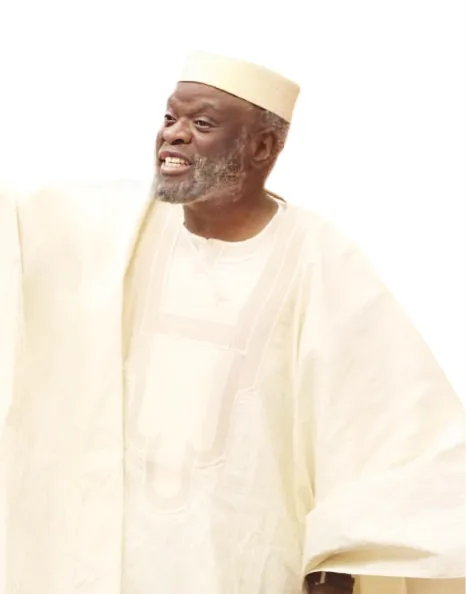
The Director of Electioneering Planning of the All Progressives Congress 2027 Presidential Campaign Council in the South-West, Prof Sola Adeyeye, speaks with Ismaeel Uthman on President Bola Tinubu’s record on federalism, the President’s adoption of a rainbow coalition, and efforts to reconcile Tinubu with former Osun State governor, Ogbeni Rauf Aregbesola
In 2022, you opposed President Bola Tinubu’s presidential ambition, but today, you are coordinating his re-election campaign in the South-West. What has changed?
In the particulars that are relevant, nothing has changed. I did not oppose Tinubu as a candidate. That’s the mistake many people make. I opposed Tinubu as an aspirant within the primary of my own party, APC, in good conscience. I exercised the right as a party man and as a citizen to endorse the person I thought would be the best candidate for my party, Yemi Osinbajo. Once ‘aspirant Tinubu’ became the candidate of the party, not one day did I say anything against his candidacy. The contest for candidacy within a party is a sibling rivalry, an in-house affair. Each member of that house should be free to choose whomever they want.
Tinubu and I shared things in common. I know some things about Tinubu in the strictest of confidence. He also knows some things about me in the strictest of confidence. Things that neither of us should ever betray. However, when I endorsed Osinbajo, those who wanted Tinubu began to malign him in ways that I thought were offensive, unfair, and wicked. They called him Akintola (the former premier of the Western Region, Samuel Ladoke Akintola). I did not see the parallelism between Osinbajo and Akintola.
What kind of parallelism do you mean?
Akintola and Awolowo (the first premier of the Western Region and federal commissioner for finance) never contested for the same position. When Awolowo was premier, Akintola did not seek to be a premier. He was in the House of Representatives, leading Awolowo’s party. When Awolowo decided to be Prime Minister, Akintola did not say, ‘You cannot come; I’m already here.’ He and Awolowo exchanged positions, and Awolowo did not stop Akintola from becoming a premier.
Ordinarily, what should have happened at that time was either that Anthony Enahoro, who was the deputy leader of the Action Group, should have become the leader of the party in Western Region. The Midwest at that time was part of the Western Region. But, given that Enahoro and Awolowo were both in the House of Representatives, perhaps Enahoro should have been the leader. But that couldn’t happen because they felt that it might be more difficult in an ethnocentric society like Nigeria for Enahoro to hold the Western Region against the opposition of the NCNC (National Convention of Nigerian Citizens) at that time.
Yes, things fell apart between Awolowo and Akintola, but it wasn’t the same thing with Osinbajo. The images that were being evoked about Osinbajo being Judas Iscariot were offensive to me. Judas Iscariot took money to betray his leader. Nobody has shown any way in which Osinbajo took money to betray his leader. So, when they would not stop, I felt that all of us were pulling our punches, and all is fair in war and politics. If you want to punch, we can punch also. So, I said a few things, which maybe I should not have said.
What has changed? The man has won the primary and become the President. That has changed.
Are you now proud to have him as the President?
I will tell you some of the things that Tinubu has done that have evoked great enthusiasm and admiration in me. Anybody who follows my political career knows that I’m a passionate advocate for a federal system in Nigeria. Tinubu has done what no president had done since 1999 to erect the foundations of a federal system. Most presidents would like to keep as much money as possible for the federal government because of what they perceive as the ponderous duties that require money by the federal government. But Tinubu has made some nominal increase in the portion that is kept by the states, and that has allowed most of our states to have a measure of economic viability. Without economic viability, there’s nothing any government can do.
Tinubu began the process of giving the states the right to police authority, which we had at independence, but which the military government of the past took away. If he does nothing else but to restore authentic federalism to Nigeria, in my opinion, he will go down in history as a very great and consequential President.
There are roughly 195 countries in the world, and only about 25 of them run a federal system. The 25 who run a federal system are either very big, complex, pluralistic, heterogeneous, multilingual, or multinational. Nineteen of the countries have state or provincial or regional police.
Does that make Nigeria an abnormal country?
Of all the other countries that are federal, the worst case of over-centralisation of the security apparatus and police power is in Nigeria. The worst, by far. When you get to England, which is not a federal system, you find that, despite being a unitary system, it has what they call territorial police: police formations in different parts, not just of England but of the UK. But here in Nigeria, we have an abnormal situation.
When I was the Chairman of Ifedayo Local Government in Osun, the divisional police officer in charge of my local government was a man from Otukpo in Benue State. He did not speak Igbomina, our dialect. How could he effectively police a community whose language he did not speak? That is the kind of nonsense that we have. In the name of national unity, so many people who did not even speak Yoruba have become commissioners of police in Osun State, and the same thing happens in other states.
These are the kinds of problems that I believe Tinubu will permanently end. When you say sovereignty belongs to the people, but you deny that sovereignty the power to enforce its will, you are creating anarchy, which is what the unitarisation of a federal entity causes. That is why I’m extremely pleased that Tinubu has taken this step to give us a federal system. When I was in the Senate, I was a strong advocate of state police. I canvassed and argued on everything to ensure that there would be police powers for the states.
Is the state police the only thing you admire Tinubu’s administration for?
One of the things that has also impressed me about Tinubu is his fidelity to the ideas we all fought for when we were struggling for democracy. We had a congress in Maryland, USA, at which Chief Anthony Enahoro was chairman and I headed one of the four committees at that congress, where we made a few decisions. One of them was that if we ever achieved victory and any of us became president, that person must first work diligently to restore federalism. That person must as soon as possible remove the anthem that the military gave to us.
I never thought it would be an easy thing, but see the speed with which Tinubu removed that anthem that came as an imposition from the military. Even the constitution we have, they (military) tinkered with it and published their own white paper. They removed items they did not like. So, the constitution was not ‘we the people.’ It was we the military, pretending to be the people. So, the fact that Tinubu retained the crucial memory of decisions that the pro-democracy movement made that time, honestly, I doff my hat to him.
Many Nigerians have been asking that, considering the economic situation of the country, why should they trust Tinubu with another four years?
What’s the economic situation of the country?
Some of them complain about hunger, insecurity, inflation and a reduction in purchasing power….
(Cuts in, then smiles.)
You know, Jesus Christ said, “the poor you will always have among you.” We pray to God that we will soon have a Nigeria where we can reduce the ratio of the poor people in our country. Our people are not just poor; they are abjectly poor, and they have long been abjectly poor. People have a way of glorifying the past, as if it was golden.
People talk about purchasing power: when you look at Nigeria’s budget from 1999 to date, divide it by the population of the country, you will discover that there has not been any year since 1999 that the Federal Government allocated one dollar to spend on every Nigerian per day. We have always been very, very poor. Check the 2025 budget, you will see that the amount of money the Federal Government has to spend on every Nigerian in a year is less than $150. So, you are talking about, at best, 45 cents for a Nigerian per day.
Let’s talk about our external reserve: we are all happy now that it is now at $57bn. Honestly, I applaud Tinubu for that. But it is a pathetic figure. The endowment of Harvard University, an institution with about 8,000 undergraduates, is the same thing as the entirety of the external reserve of Nigeria. That is a university in the US. When you look at that, you see how poor Nigeria is. But when we hear N31tn, we feel that this is a rich nation. Nigeria ought to be a rich nation if it were well administered.
The budget of Norway, a country like Ondo or Oyo state in population size, is on a geometric scale in comparison with that of Nigeria. Norway has about $32,000 to spend for every Norwegian this year. In Nigeria, whether it is Tinubu, Atiku Abubakar or Peter Obi, the government has less than $200 to spend on a Nigerian in a year. I think maybe it was either Yar’Adua or Jonathan under whose administration the figure came close to $268.
The truth is that we are pathetically poor and we need to find a way to face that reality. We need to find a way to grow our economy. We need to find a way to cut our coat not according to our size but the fabric we have in hand.
The APC emerged from a merger of different political parties and political tendencies. However, it has consistently presented itself as a progressive party, drawing on the political legacies of Chief Obafemi Awolowo and other progressive political leaders. Would you say the party has remained faithful to the ideological principles upon which it was founded?
We abuse terminology in Nigeria. To be progressive means that you seek the well-being and the progress of the individual as the most important factor for your government. If that’s the case, how do you do so? Will you, because you are progressive, buy petrol from France without paying for it? The truth is, if we want to shout ideological labels alone, we will fail. One of the things we must do is what Awolowo always did. When Awolowo introduced the free education system in Western Nigeria, he collected taxes for three years. That’s what made him lose a federal election in the 1950s. It was his government alone that ever lost an election in this region in a free and fair election, because the people were complaining that he was taxing them and they were not seeing the benefit. But when the free education began three years later, in 1955, the Eastern Region, led by Dr. Nnamdi Azikiwe tried to copy him. But free education collapsed in eastern Nigeria within two years because they hadn’t gone through the pain that Western Nigeria went through in preparing for the programme. So, whether we like it or not, growth is a painful process.
Awolowo was known for his insistence that progressive politicians should maintain ideological clarity and distinguish themselves from conservative political tendencies. Does Tinubu’s adoption of a rainbow coalition, which brings politicians from different ideological and political backgrounds together, represent a departure from that tradition?
No, because running a government is different from winning an election. You cannot, no matter how elegant, beautiful, adorable your ideology is, implement it until you get to power. First, you must wrest power.
It was not a surprise that even Awolowo’s party formed a coalition with the NCNC in 1964, with the United Progressive Grand Alliance. They, however, made the mistake of boycotting that election. People have forgotten that when Awolowo was alive, there was a coalition called the Progressive Party Alliance in 1980. They were called progressive only in name, because whereas you could say that the PRP (People’s Redemption Party) of Aminu Kano and the UPN (Unity Party of Nigeria) were progressive, the GNPP (Great Nigeria People’s Party) and MPP (Movement of the People Party) were not in the same mould ideologically. But they knew that they had a bigger enemy in the NPN (National Party of Nigeria) that they had to confront.
The PPA, as a coalition, was in the majority, and had its members been smart enough to act as one, they would have beaten Shehu Shagari in 1983. So, I can’t blame anybody who says, because I want to prevent a greater evil, let me form whatever alliance is necessary to prevent it.
Would you say that Awolowo will be happy with Tinubu’s style of politics now?
I would not speak for Awolowo. The last time I spoke with Awolowo was in 1980. Anything I say on that would be speculative.
Awolowo was a man who respected data. In fact, his opponents always complained that all he knew was to quote figures. But part of the problem we have in Nigeria is that we despise figures. We don’t contemplate enough the figures necessary to run our republic. Therefore, we postulate ideas that in the long run will be unsustainable.
People are complaining about the price of petrol right now. Is there any commodity in the world that can enjoy a liberal price if the supplier is a monopoly? In Nigeria, the supply of petrol is from a monopoly. We have only Dangote Refinery. That company borrowed money to establish itself. We call him (Alhaji Aliko Dangote) the richest man in Africa, and yes, he is. But he owes billions of naira and other currencies. So, do people expect him to borrow and not pay back? Do people expect him not to make a profit on the money he has borrowed? The reason our petrol is expensive is because the last petrol refinery that Nigeria established was in the first coming of Muhammadu Buhari. We have not had any new refinery in over 40 years. The existing refineries that belong to the government are functioning at zero capacity.
I’m praying that when Tinubu wins, whatever else he does, he will establish a new and modern refinery. Why should a country with nearly 250 million people have only one refinery? I’m praying Tinubu will take the matter of energy and electricity as the highest priority. If we have petrol at affordable prices, and electricity is affordable, our people are not lazy. Their ingenuity, their creativity will be unleashed. The companies that are leaving Nigeria are not leaving because Nigerians are lazy. Nigerians are hardworking. But many of the companies are leaving because you cannot sustain a factory on diesel. That’s the problem.
You have maintained close relationships with both Tinubu and former Osun State governor, Ogbeni Rauf Aregbesola, who are now on opposing sides of the political divide. What, in your understanding, went wrong between them?
Honestly, I don’t know. They both liked each other. I just pray that the time will come when they will be together again. That’s my prayer.
Naturally?
Well, some people have to facilitate it.
What have you done to bring them together?
I have done everything expected of me, but I won’t talk more than that. My prayer is that they will come together again.
Is there any conspiracy frustrating your efforts to bring the two sides together?
I don’t think so. Even if there is, I won’t be surprised, it doesn’t bother me. I know there are those who derive pleasure from disputations. But at the end of the day, the two people must bear responsibility for the fact that they were both very close friends, and now the relationship has soured. But I believe God will heal it. By the grace of God, they will come together again.
How soon will that be?
I cannot tell. It doesn’t depend on me. It depends on the two of them.
Has there been any time the two of them met since the commencement of the crisis?
I know that they’ve met about three times since the rift between them started. And I know that when people have deep affection for one another and feel betrayed, the hurt is deeper than usual. But time is an instrument of divine healing, and I’m confident that healing, even as we speak, is under way.
People like former governors of Ekiti and Ogun states, Dr Kayode Fayemi and Ibikunle Amosun, respectively, who were actively involved in Tinubu’s campaign in 2023, are now taking a back seat. Have you met them on this re-election project?
I was with Amosun at a meeting on Wednesday, November 4. I was with Fayemi the following day, Thursday, November 5. Fayemi gave me a ride from the airport in Lagos. We flew on the same flight. We sat next to each other. We spoke at length. Fayemi is a member of my party. In politics, things happen. Sometimes people offend you, people say things you don’t like. Because you are a human being, you’re hurt and you frown. Fayemi is a brilliant man. He knows that what is at stake in this election is beyond the differences of being hurt because of one thing or the other.
What is important is that we defend our party’s right to seek the mandate of the people in a free and fair election and do our best to ensure that our party emerges victorious on January 16, 2027. That’s all that matters.