
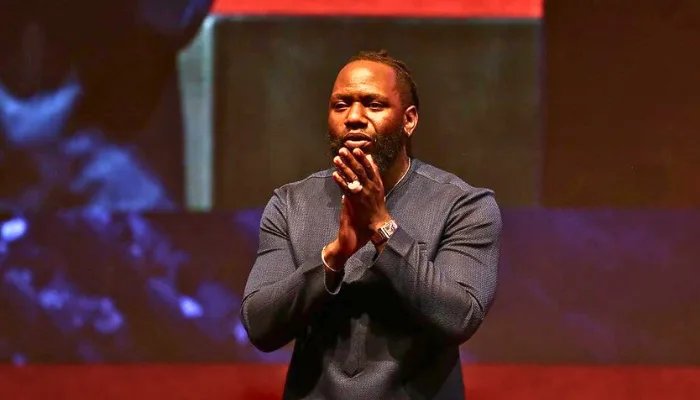
In my short time on earth, I have noticed common features in founder-led churches and independent ministries. Many of their founders are doing remarkably well in their ministries and making their mark. At some point, the immutable truth expressed in Psalm 89:48 (KJV: “What man is he that liveth, and shall not see death? Shall he deliver his soul from the hand of the grave? Selah.”) catches up with every mortal; death comes, burial follows, and next is the succession contest among followers (disciples).
The same theme and pattern are now playing out at The Fountain of Life Church: who will succeed the late founder, Pastor Taiwo Odukoya.
In a video recorded in December 2021 (released by the Board of Trustees in November 2026), Pastor Taiwo explicitly named Pastor Kunle Areogun as his preferred helmsman (successor), while his son, Jimmy Odukoya, was to take charge of the youth church and serve as administrative assistant.
Then came the “Jimmy, it’s your story and laying on of hands” narrative, recounted by Rev. Wale Oke, who credited Jimmy Odukoya, Pastor Taiwo’s son, as the narrator.
These are two accounts of succession pointing to two different people but emanating from the same source.
On November 17, 2026, a group identifying itself as the Board of Trustees announced that Jimmy Odukoya was no longer the ministry’s leader, citing a December 2021 video. The group appointed Rotimi Okpaise as interim leader.
The Fountain of Life Church countered: “For the avoidance of doubt, Pastor Jimmy Odukoya remains the duly appointed Senior Pastor and Chairman of the Board of Trustees of The Incorporated Trustees of The Fountain of Life Church.”
The claim and counterclaim bring to mind a Yoruba adage: “Agbo meji ko le mu omi ninu akoto kan náà.” Two rams cannot drink water from the same gourd. This is exactly what they are trying to do at The Fountain of Life Church. Such arrangements can only result in tension and conflict, as is presently being experienced.
Ordinarily, succession in churches should be as smooth as a hot knife through butter, because a biblical framework makes the issue of succession seamless. Though I am not a theologian, the little Sunday school I attended exposed me to some frameworks that, if followed, are likely to make succession seamless.
First, let’s look at Numbers 27:15–23. Here, Moses asked God for a successor to lead His people. The Lord said: “And the LORD said unto Moses, Take thee Joshua the son of Nun, a man in whom is the spirit, and lay thine hand upon him; And set him before Eleazar the priest, and before all the congregation; and give him a charge in their sight. And thou shalt put some of thine honour upon him, that all the congregation of the children of Israel may be obedient.”
From this story, we can see that the appointment was made by God. The appointee was presented to the priest, Moses laid hands on him, and he was presented to the community for recognition.
Placing this alongside The Fountain of Life Church’s approach raises some questions: Why was the December 2021 video not made public before now to the priests (clergy) in the church for onward recognition of the successors by the congregation?
Jimmy was reported by Church Times Nigeria to have told a meeting of 300 church workers that his father had instructed him to delete the video. So, who had custody of the video, and why was it not destroyed? Can a flock be left in the hands of a shepherd if he cherry-picks instructions?
The story of Elijah and Elisha, as recorded in the Bible, also shows succession through discipleship. Long after the cloak-throwing experience on the field, Elisha continued to follow Elijah throughout his ministry till he picked up the mantle when Elijah was no more. The two individuals in a contest for an exalted position, Kunle Areogun, thrown up by the December 2021 video, and Jimmy Odukoya, who got laying on of hands on his head from his father, were both disciples of the late founder, Taiwo Odukoya. This raises another question: Should succession be a cagey affair? Even when it is a cagey affair, is there no need for confirmation by the sons of prophets—in this case, the church?
In Nigeria, however, some denominations practise an emergent succession pattern: a prophetic declaration by a vessel (God’s channel) in a conclave. As novel as this method may sound, it is also not rancour-free. To better understand this method and its inherent issues, let me tell you a non-fiction story. I have only changed the church’s name and the dramatis personae, as I once attended the church.
In 1982, a church, here called CAAT, with missionary headquarters nestled between Aramoko and Igede in present-day Ekiti State, was on the verge of choosing its supreme head. The first head of the CAAT was Apostle Omotoso. Before he joined the saints, he instructed that Apostle Jagunlabi should succeed him. Unfortunately, Apostle Jagunlabi never gave any instruction before he joined the saints. Rev. Fakipe was second in hierarchy to Apostle Jagunlabi, with almost a cult followership.
The mission’s top echelon decided to hold a conclave in which God would anoint the next steersman through prophetic declaration.
According to an unconfirmed story, Fakipe and his followers had allegedly perfected clandestine plans to have him announced as the new leader through “prophetic declaration”. Alas, when the Spirit of God came upon Rev. Samori, the arrowhead who was supposed to declare, “Thus saith the Lord,” he did exactly that, but rather than announcing Rev. Fakipe, he said: “Thus saith the Lord, Rev. Jajiji is my chosen one.”
What happened next shocked CAAT to its pillars. Rev. Fakipe left the mission, taking many branches with him. Even today, CAAT has not recovered from the haemorrhage of years back caused by the issue of succession.
The “to your tents, O Israel” schism in CAAT has affected (and continues to affect) many founder-led ministries in Nigeria. The factionalisation of a prominent white-garment church, well known for using “Hallelujah” as a form of greeting, continues to rage more than 41 years after the death of its founder.
On the other hand, some founder-led ministries, such as the one in the Ikotun area of Lagos, where “Immanuel” is the signature buzzword, have experienced a relatively “smooth” succession, as the founder’s widow took charge. One can only wonder why the mantle never fell on any of his senior ministers!
The big question arising from the CAAT story is: who authenticates the prophetic declaration as truly coming from God’s throne?
The CAAT anecdote reveals something interesting, yet sad, about the reality of succession in churches. Even when prophetic declaration identifies a successor, there is still the issue of legitimacy and acceptance. Another challenge is the continuous existence and sustenance of the one-fold, one-shepherd mantra preached by many churches.
What happens when the others refuse to follow the person chosen through prophetic declaration? The tension at The Fountain of Life Church and the CAAT story shows that succession has taken on a different colouration from what it was in the biblical era. Now, being divinely chosen is not enough; there is also the issue of legitimacy, acceptance, and assured continuity of the church after the founder’s exit.
The Fountain of Life Church is currently playing with a Molotov cocktail. How soon they resolve the issue at hand determines whether the intended implosion would be manageable or the one that would destroy (God forbid) the pillars of the church.
From my crystal ball, I see a long, fractious fight that does nobody any good. To avert the impending cataclysm, the video needs authentication; private transfer of mantle must be openly questioned, and respected fathers of faith must separate the two rams drinking from the same gourd.
Let me end with a popular song by gospel artiste Evangelist Niyi Adedokun, sung during the succession-related crisis in a church often associated with “Baba Olomi Iye”. Thankfully, the raging dust eventually settled, but the song remains a homily for the recent happenings.
The song says: “Oyin Oyin Oyin Oyin… Oyin so adun nu, o di eni yeye.” Honey, honey, honey, honey… Honey has lost its sweetness; it has become a thing of ridicule (or worthless).
I have said my piece.
Shodunke, a media practitioner, writes via [email protected]