
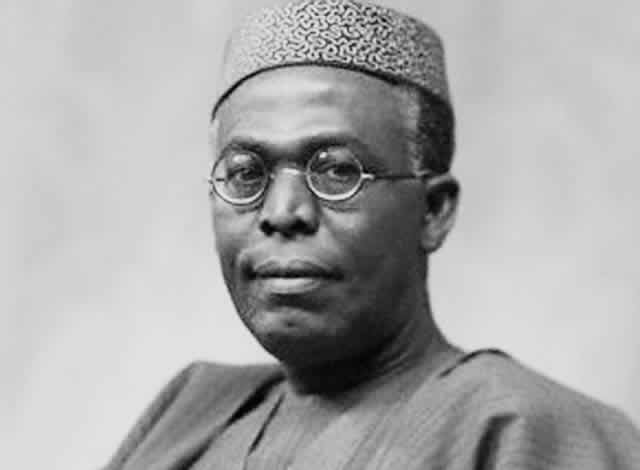
The Minister of State for Health and Social Welfare, Dr Kunle Salako, on Friday hailed the late sage and first Premier of the Western Region, Chief Obafemi Awolowo, describing him as a courageous and uncommon leader whose commitment to good governance would for many years remain a benchmark for excellent service.
Salako said that Awolowo would be remembered for his exceptional integrity, intellectualism, and implementation of welfare-oriented and human capital development policies which have helped to place the Western Region in the front row of the country’s socio-economic development and continue to shape the trajectory of the region.
The minister said he is, however, glad to know that President Bola Tinubu has equally been following closely the footsteps of the late sage, judging from the President’s various courageous economic reforms that are helping to restore the country’s economy.
Salako disclosed this during the 2026 Obafemi Awolowo Lecture organised by the Obafemi Awolowo Foundation and held at the Ikenne private residence of the late sage, with the theme “Politics As Future-Making: Awolowo And Leadership As Theory of Action.”
Dignitaries at the annual lecture included Chief Emeka Anyaoku, former Secretary-General of the Commonwealth and Chairman of the Selection Committee of the Obafemi Awolowo Prize for Leadership; Governor Dapo Abiodun, represented by his Deputy, Engr Noimot Salako-Oyedele; former governors of Ogun and Osun States, Otunba Gbenga Daniel and Prince Olagunsoye Oyinlola.
Others were the Governor of Oyo State, Seyi Makinde; Senator Femi Okuroumu; Chief Ayo Opadokun; Chief Yemi Farombi; Hon. Oladipupo Adebutu; Aare Gani Adams, the Aare Ona Kakanfo of Yorubaland and Oodua Peoples Congress leader; and traditional rulers, among others.
Salako explained that when Awolowo introduced the revolutionary universal basic education programme to the Western Region in 1955, it was misunderstood and heavily resisted by British colonialists, opposition politicians, and parents who wanted their children to work on farms.
He said Awolowo acted firmly and courageously and was quoted as declaring, “Any parent who stops a child from going to school will be arrested.”
He added that Awolowo had predicted correctly: “You may hate me today, but tomorrow you will thank me.”
He stated that today, the South-West region continues to leverage the solid foundation of human capital development laid by the late sage through policies and programmes for which every Yoruba man remains ever grateful.
Salako submitted that Tinubu, in his determined efforts to fix the country, has equally taken courageous steps like Awolowo, and that the reforms are already yielding results.
He said, “The reforms that President Bola Ahmed Tinubu GCFR introduced on the assumption of office are those of a man with clear vision, courage, and tenacity to follow through.
“Those reforms literally pulled Nigeria from the precipice of bankruptcy and fiscal collapse. Successive governments before May 2023 avoided addressing challenges head-on and chose to provide palliative treatment to an ailment requiring radical surgery.
“Today, the socio-economic indices are clearly showing that Nigeria is recovering from the inevitable radical economic surgery applied by Mr President.
“With a 4.23 per cent GDP growth rate in Q2 2025 — the fastest in four years — inflation reduced to 20.12 per cent as of August 2025, a strengthened and stable naira, a significant decrease in the debt service-to-revenue ratio from 97 per cent to below 50 per cent, consistent trade surplus, and increasing foreign reserves of $50.45 billion in February — the highest in 13 years — alongside growing foreign portfolio inflows, Nigeria, in the words of Mr President, has ‘turned the corner’.”
While commending the organisers of the annual lecture for sustaining the legacy of intellectualism and robust discourse the late sage was known for, Salako called for more support for the present administration to further make the country the pride of all.
In his remarks, former Secretary-General of the Commonwealth, Chief Emeka Anyaoku, described Awolowo as one of the three founding fathers of modern Nigeria and a leader whose legacy continued to shape national discourse.
Anyaoku noted that Awolowo’s record as Premier of the Western Region, opposition leader in the First Republic, and Vice-Chairman of the Federal Executive Council during the military era had earned him the reputation as “the best President Nigeria never had.”
While reflecting on Nigeria’s current challenges, Anyaoku cautioned against excessive political focus on the 2027 general elections at the expense of governance.
He said the international community would closely monitor the conduct and credibility of the elections, particularly in relation to the use of electronic transmission of results by the Independent National Electoral Commission.
On insecurity, Anyaoku urged sustained efforts to address kidnappings, killings, and displacement in several parts of the country, including Zamfara, Niger, Plateau, Benue, and Sokoto states.
He supported collaboration with friendly nations in tackling internal security challenges but stressed that such partnerships must respect Nigeria’s sovereignty.
The lecture, delivered by Prof. Wale Adebanwi, argued that Nigeria’s enduring leadership crisis stemmed from structural issues in state composition, political economy, social culture, and elite formation.
He said Awolowo’s approach to politics was rooted in long-term planning and what he described as “future-making” — the deliberate process of shaping society through visionary policies and scientific governance.
According to him, Awolowo’s intellectual works, including *Path to Nigerian Freedom* and *Path to Nigerian Greatness*, provided a programmatic blueprint for building a prosperous and egalitarian federation grounded in federalism, social justice, and human capital development.
Adebanwi urged contemporary leaders to adopt the same approach of rigorous analysis, planning, and evidence-based policymaking in addressing Nigeria’s development challenges.
In her welcome address, the Executive Director of the Obafemi Awolowo Foundation, Olatokunbo Awolowo-Dosunmu, said the annual lecture was designed to promote reflection on leadership, nation-building, and the values that defined Awolowo’s public life.
She also announced the creation of the Obafemi Awolowo Future Leaders Fellowship, a new initiative aimed at nurturing a generation of ethical and visionary young leaders across Africa and the diaspora.
According to her, the fellowship will provide mentorship, leadership training, and opportunities for young people aged 20 to 35 to engage with the principles of public service, social justice, and human development championed by Awolowo.
She added that the foundation was also considering the introduction of sector-based awards to recognise individuals who demonstrate excellence and integrity in their respective fields.
In his goodwill message, Senator representing Ogun East Senatorial District, Otunba Gbenga Daniel, described Awolowo as someone who refused to treat politics as improvisation or leadership as a performance for applause.
He said, “He saw politics as disciplined action rooted in ideas, animated by moral conviction, and directed toward a future that didn’t yet exist but could be built through vision and commitment.”
Daniel said the best tribute that could be offered to Awolowo was for leadership at all levels to prioritise selflessness and readiness to serve the people.