
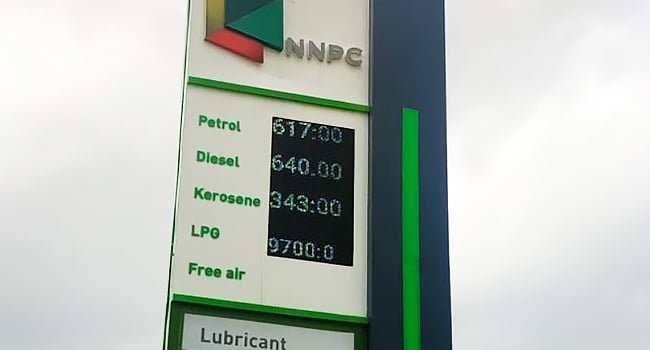
Petrol prices rose to N937 per litre on Tuesday amid escalating tensions in the Middle East, prompting oil marketers and refinery operators to urge the Federal Government to provide more crude oil to the Dangote Petroleum Refinery in naira to help stabilise domestic fuel prices.
The reported on Monday that the Dangote refinery increased its gantry price from N774 to N874. The adjustment followed a jump in oil prices to $84 per barrel, up from below $70 days before the airstrikes involving the United States, Iran, Israel, and other countries.
“The new gantry price is now N874 per litre from N774. The review became necessary due to changes in global crude fundamentals and replacement costs,” an official of the Dangote refinery said.
Following the increment, filling stations on Tuesday raised their pump prices to N937 or N935, depending on the location. A survey by our correspondents confirmed that an MRS filling station in Obalende, Lagos, sold petrol at N937 on Tuesday.
The MRS and Petrocam stations in Mowe, Ogun State, dispensed petrol at N935, while Heyden offered N930. Similarly, SAO, SGR, and AP sold the product at N925. Matrix also dispensed the fuel at N937.
Before the Middle East crisis, some filling stations had already been selling premium motor spirit at prices ranging between N812 and N839, depending on the location. However, the crisis over the weekend disrupted the global fuel market, affecting Nigeria and other countries.
Reacting in a statement on Tuesday, the Petroleum Products Retail Outlet Owners Association of Nigeria emphasised the urgent need to consolidate and strengthen Nigeria’s domestic refineries, particularly the Dangote refinery, through the provision of adequate and consistent crude oil supply in naira.
According to PETROAN’s spokesperson, Joseph Obele, this “proactive approach” is essential to minimising the impact of external geopolitical shocks on the nation’s petroleum market.
The National President of PETROAN, Billy Gillis-Harry, expressed deep concern over the ongoing military escalation involving the United States, Iran, Israel, and allied nations, and its far-reaching implications for the global energy industry, particularly Nigeria’s petroleum sector.
According to him, recent geopolitical tensions have significantly disrupted global energy markets and supply chains.
PETROAN noted that hostilities in the Middle East, especially around the strategic Strait of Hormuz, through which approximately 20 per cent of the world’s crude oil supply passes daily, have triggered sharp volatility in international oil prices and heightened uncertainty regarding supply continuity.
It added that as the conflict intensified, global crude oil benchmarks had surged, with analysts projecting that prices could exceed $100 per barrel if disruptions persist, noting that the upward trend reflected growing concerns over potential supply shortages should shipping activities through the Strait of Hormuz remain restricted.
PETROAN stated that any sustained increase in crude oil prices would inevitably be reflected at petroleum retail outlets across Nigeria. “If the crisis continues, the impact will extend beyond pump prices to affect foreign exchange stability, domestic fuel pricing structures, and overall inflation levels within the country,” Gillis-Harry warned.
The association urged the Federal Government to encourage and prioritise local refineries by ensuring a steady crude oil supply in naira, particularly to the Dangote refinery, and by creating enabling policies that support optimal operations.
PETROAN also called on the government to sustain and strengthen the Naira-for-Crude policy to reduce pressure on foreign exchange and stabilise domestic fuel pricing.
“In view of these developments, PETROAN calls for urgent and strategic actions to safeguard Nigeria’s energy security: encourage and prioritise local refineries by ensuring a steady crude oil supply in naira, particularly to the Dangote refinery, and create enabling policies that support optimal operations. Sustain and strengthen the Naira-for-Crude policy to reduce pressure on foreign exchange and stabilise domestic fuel pricing.
“Urgently revamp the four government-owned refineries to restore them to full operational capacity and reduce dependence on imported petroleum products. Monitor global market developments and respond proactively to emerging risks. Advocate policies that strengthen domestic refining capacity and reduce reliance on imports. Support measures aimed at shielding consumers from excessive fuel price shocks,” the statement stated.
In the same vein, the Crude Oil Refineries Association of Nigeria urged the Federal Government to expand and deepen the Naira-for-Crude policy, including providing more crude in naira to the Dangote refinery and modular refineries across the country to stabilise fuel prices.
CORAN spokesperson, Eche Idoko, made the appeal against the backdrop of escalating global crude oil prices triggered by ongoing tensions in the Middle East, which have directly impacted the domestic price of diesel.
According to Idoko, diesel remains one of the most critical fuels driving Nigeria’s economy, powering factories, farms, construction sites, telecommunications infrastructure, and small and medium-scale enterprises.
“While the current Naira-for-Crude policy has provided some relief within the downstream sector, its limited coverage has constrained its full economic impact. Expanding the initiative and ensuring adequate crude supply in naira to key refineries, including the Dangote refinery and modular operators such as Aradel Holdings Plc, OPAC Refinery, Walter Smith Refinery, and Edo Refinery and Petrochemicals Company, would significantly boost local refining output, particularly AGO production.
“Under an expanded Naira-for-Crude framework, refineries would access crude feedstock in local currency, reducing exposure to forex volatility. Refining capacity utilisation would increase, enabling higher production volumes of AGO. Operational costs would decline, allowing refiners to supply diesel at more stable and reasonable prices.
“CORAN, therefore, respectfully urges the Federal Government and the Presidential Committee to act swiftly in broadening the scope of the policy and ensuring adequate crude supply in naira. Nigeria’s energy security and economic resilience depend on it,” Idoko stated.
Abuja petrol prices rise
Major marketers, including MRS Oil Nigeria Plc and NNPC Limited, adjusted their pump prices upward in Abuja, pushing petrol to as high as N975 per litre in the Federal Capital Territory.
NNPC Retail outlets increased pump prices from N875 per litre to between N960 and N975 per litre. Dangote’s retail partner, MRS stations, also adjusted to N975 per litre, while AYM Shafa and AA Rano raised their rates from N880 to N960 per litre.
The latest adjustments came as global oil prices climbed to levels not seen in months. Brent crude surged by about eight per cent to $85 per barrel on Tuesday, its first time at that level since June 2024, while the US West Texas Intermediate crude rose to $75.91 per barrel.
According to reports, the spike was driven by fears of supply disruptions in the Middle East following coordinated US-Israel strikes on Iran and retaliatory attacks targeting energy infrastructure and military assets across the Gulf region.
Oil and gas installations in key producing countries have reportedly been shut either due to direct damage or as precautionary measures. QatarEnergy halted liquefied natural gas production following attacks on its facilities, while Saudi Aramco temporarily shut its Ras Tanura refinery after a fire incident linked to drone debris.
Major shipping lines have also suspended movements through the Strait of Hormuz and the Suez Canal, further tightening global supply chains.
For Nigeria, Africa’s largest crude oil producer, the development presents a mixed outlook. While higher crude prices could boost foreign exchange earnings and government revenues, the immediate domestic impact has been rising fuel costs, worsening inflationary pressures, and increased transportation expenses for households and businesses.
Energy experts warn that if Brent crude sustains levels above $85 per barrel, pump prices of PMS could cross the N1,000 threshold in the coming days, especially in deregulated markets where prices are directly influenced by global oil benchmarks.
With no clear end in sight to the geopolitical tensions, marketers say further upward adjustments may be inevitable, leaving Nigerians bracing for another round of economic strain driven by external shocks beyond the country’s control.