
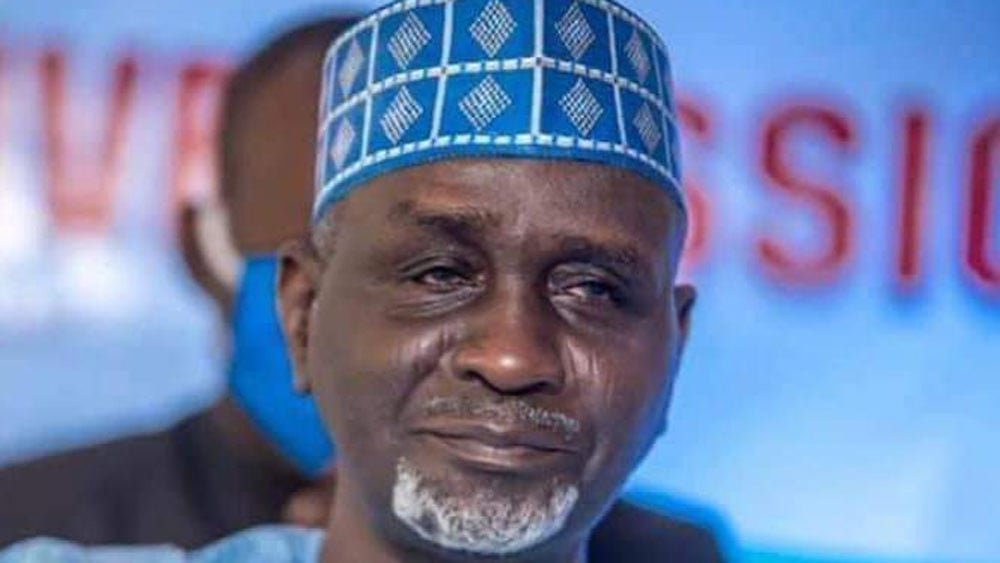
At the centre of the unfolding drama in Kano’s political scene is Ibrahim Shekarau, the influential former governor and current state leader of the Peoples Democratic Party, now heavily courted by the APC in what could prove a decisive move in Kano’s evolving power struggle, writes HUSSAINI IBRAHIM
The political temperature in Kano has risen sharply in recent weeks, with the leader of the Peoples Democratic Party in the state, Malam Ibrahim Shekarau, emerging as a central figure in an unfolding realignment that could redefine the state’s political trajectory ahead of 2027.
The tremors began after Governor Abba Kabir Yusuf defected from the New Nigeria Peoples Party to the All Progressives Congress, a move that observers say has not only altered the balance of power but also weakened and split the once formidable Kwankwasiyya political structure built around Senator Rabiu Musa Kwankwaso.
Consequently, attention has shifted to Shekarau, a former governor and one of the most enduring figures in Kano politics. Since the governor’s defection, influential voices within the APC have intensified efforts to entice him into their fold, believing that his entry would decisively neutralise Kwankwaso’s influence and consolidate the ruling party’s hold on the state.
Although Shekarau has maintained a cautious silence on his next political step, events in recent days suggest that he is at the centre of a broader chess game involving old rivals, shifting loyalties and strategic calculations.
The Kano State chapter of the All Progressives Congress has confirmed that it has intensified moves to woo the former governor of the state, Ibrahim Shekarau, into its fold.
The state Public Relations Officer of the party, Ahmed Aruwa, disclosed this , revealing that a series of high-powered delegations had been dispatched to the former governor as part of ongoing consultations.
According to him, discussions with Shekarau were progressing steadily, expressing optimism that the efforts would yield positive results.
“We have been working round the clock to ensure that Malam Ibrahim Shekarau joins the APC,” Aruwa said.
“Recently, multiple delegations were sent to him, and discussions are ongoing. We are hopeful that, by the grace of God, these engagements will produce the desired outcome.”
He noted that the recent defection of Governor Yusuf to the APC had further strengthened the party’s resolve to attract more influential political actors in the state.
“Now that the governor has officially joined our great party, we are even more optimistic. More committees will be constituted to reach out to other influential figures in Kano politics, particularly someone of Shekarau’s stature,” he added.
Aruwa described the former governor as a political leader whose influence transcends partisan lines, stressing that many key political figures in Kano today emerged under his mentorship.
“Malam Ibrahim Shekarau is a political institution. Many prominent politicians in Kano State today are products of his political tutelage,” he said.
“Distinguished Senator Barau I. Jibrin, Nasiru Yusuf Gawuna — our governorship candidate in the 2023 election — Malam Salisu Sagiru Takai, who was the PRP governorship candidate in 2019, Senator Kawu Sumaila, and former Minister of State for Housing and Urban Development, Abdullahi Muhammad Gwarzo, among others, all passed through his political school.”
On concerns about possible internal wrangling following the influx of new members, the APC spokesman dismissed speculations of factional crisis, insisting that the party remained united.
“Even before the governor joined us, there was no friction or faction within the APC in Kano. We have continued to operate as one united family,” he said.
He further disclosed that the party’s National Chairman, Prof. Nentawe Yilwatda, had approved a 40/60 formula to accommodate both existing members and new entrants in the state’s party structure.
“The National Chairman has confirmed the 40/60 arrangement to ensure inclusiveness and fairness. We have been working under various committees smoothly, with both old and new members cooperating effectively. I can assure you that things will be even better after the congresses,” Aruwa stated.
He added that the reorganisation process would commence with ward congresses across the state, after which subsequent congresses would follow in line with the party’s guidelines.
Aruwa also expressed confidence that the APC would consolidate its dominance across the 44 local government areas of Kano State, citing ongoing developmental projects executed by the APC-led Federal Government.
“We will maintain and even expand our influence across all the 44 local government areas through impactful developmental projects. The people of Kano are happy with the progress being recorded under the present APC-led administration,” he said.
The political undertones became more pronounced following the death of Shekarau’s elder brother, Dahiru Shekarau. The condolence visits that followed drew a cross-section of political actors across party lines. However, it was the visit by former Kano State governor and former National Chairman of the APC, Dr. Abdullahi Umar Ganduje, that generated the most interest.
While the visit was officially to commiserate with the family, analysts noted that it carried symbolic weight. Ganduje, who has had a long and complicated political relationship with both Shekarau and Kwankwaso, described Shekarau as a statesman whose role in Kano politics remains significant.
“We are here first as brothers and fellow Muslims to condole with Malam Ibrahim Shekarau over the loss of his elder brother,” Ganduje said.
“Politics should never override humanity. However, Kano needs experienced hands and unity among leaders who truly understand the state.”
When asked whether discussions about possible political collaboration were held, he responded, “In politics, consultation is continuous. What is important is what serves the interest of Kano people.”
However, he expressed strong support for former Governor Mala Ibrahim Shekarau joining the All Progressives Congress, describing it as a “welcome idea” for the unity and progress of Kano State.
Ganduje who spoke through his Chief of Staff, Mohammed Garba, said Shekarau, a former governor and influential political figure, would be “needed in the party,” noting that he has consistently appealed to political leaders across the state to rally behind a common agenda for Kano’s development.
When asked whether Dr. Ganduje’s recent condolence visit to Shekarau following the death of his elder brother had political undertones, Garba was emphatic:
“There was no politics at all. Dr. Ganduje does not politicise personal or religious events, whether deaths, weddings, or other family occasions. This visit was about respect for Shekarau as a former governor and a respected elder statesman.”
He cited similar gestures of personal goodwill by Dr. Ganduje, including consoling Ali Madakin Gini, an opposition member, after the death of his mother, and attending the burial of Kwankwaso’s father. “These are acts of respect, not political strategy,” he stressed.
On whether the APC or the Kano State government is actively persuading Shekarau to join the party following Governor Abba Kabir Yusuf’s defection, Garba clarified:
“I am not aware of any specific efforts by the government. I am not part of that administration. But personally, I welcome the idea. We need leaders like Shekarau to come together under one umbrella for Kano’s progress.”
Garba further explained that Ganduje’s vision is to foster unity among political leaders to strengthen governance in Kano.
“Seeing all leaders aligned with the present administration is a welcome development.
It’s about service to the state and advancing collective interests, not political maneuvering,” he said.
“The door is open to all leaders who want to contribute positively to Kano. There is no pressure, but the invitation is sincere,” he concluded.
Meanwhile, days before the condolence visit, a video circulated widely on social media in which Kwankwaso appeared to tease Shekarau. In the clip, Kwankwaso suggested that if someone had truly “won Kano,” he would not rest, adding that whenever anything happened, “you will hear him saying ‘Subhanallah’.”
The comment was widely interpreted as a veiled reference to Shekarau, who is known for frequently invoking the phrase, meaning “Glory be to Allah,” in his speeches and public reactions.
However, Shekarau responded with restraint. Speaking while receiving Ganduje, he asked one of Ganduje’s men to convey his message.
He said, “I thank Allah that people recognise that whenever anything happens, I call on His name. Remembering Allah is not a weakness. It is a strength.”
Although he avoided mentioning Kwankwaso directly, political observers described Shekarau’s response as measured but pointed, reflecting the enduring rivalry between the two men that has shaped Kano politics for over two decades.
Indeed, the defection of Governor Yusuf has deepened that rivalry in new ways. Yusuf, who rode to power on the back of the Kwankwasiyya movement under the platform of the NNPP, cited strategic considerations for his decision to join the APC.
“My decision was taken after wide consultation and careful reflection,” Yusuf said when contacted. “Governance requires alignment and cooperation. What matters to me is delivering development to Kano State.”
Nevertheless, his departure from the NNPP has left the Kwankwasiyya structure facing internal strain. Several local coordinators and ward-level mobilisers are said to be reassessing their positions. While some have pledged loyalty to Kwankwaso, others are reportedly gravitating towards the APC, calculating that political survival may depend on proximity to the ruling party.
A senior member of the APC in Kano, Mukhtar Unguwar Gini , said the party views Shekarau as a critical piece in its consolidation strategy.
“Shekarau has a well-established grassroots structure across the 44 local government areas. He commands loyalty among clerics, community leaders and older voters,” the source said. “If he joins the APC, it will significantly reduce the space for opposition.”
However, Shekarau has continued to emphasise consultation and reflection. “Politics is not about personal ambition,” he said. “It is about service, stability and the long-term interest of our people. Decisions must be taken with prayer and broad consultation.”
In the midst of these developments, Kwankwaso’s recent trip to India generated speculation. Rumours circulated that the former governor had travelled for medical reasons. However, a spokesperson for the Kwankwasiyya movement dismissed the claims.
“Senator Kwankwaso travelled for a personal engagement,” the spokesperson said. “There is no medical issue. The rumours are politically motivated attempts to create doubt.”
Even so, analysts argue that the timing of the trip has influenced public perception. Dr. Musa Sani, a political analyst based in Kano, said visibility matters in moments of political turbulence.
“When a movement is under pressure and its leader is out of the country, it can create uncertainty among supporters,” he said. “Even if the trip is purely personal, the optics become part of the political narrative.”
Similarly, Mustapha Kwaru, another political analyst, observed that the defection of a sitting governor from a movement built largely around an individual personality exposes structural weaknesses.
“The Kwankwasiyya movement has been strongly associated with Kwankwaso’s personal charisma,” he said. “When a key beneficiary of that structure defects, it sends a signal that loyalty is negotiable. If Shekarau aligns with the APC, it could deepen the fractures.”
At the grassroots level, reactions have been mixed. In Fagge Local Government Area, a youth activist, Sadiq Abdullahi, said the developments have created confusion among younger supporters.
“Many youths supported Kwankwasiyya because of its message and identity,” he said. “Now that the governor has moved, some people feel uncertain about where things are heading.”
In contrast, a resident of Hotoro, insisted that the movement remains strong. “Kwankwaso has a history with the people. One defection does not end a political family,” she said.
However, Bashir Lawan, an APC supporter in Tarauni, argued that the political tide has shifted. “With the governor already in the APC and if Shekarau eventually joins, it will change everything. The opposition will struggle to regroup,” he said.
For many observers, the unfolding situation reflects a broader pattern in Kano politics, where alliances are fluid and long-standing rivalries often give way to strategic recalibration. Shekarau and Kwankwaso, once allies and later adversaries, have shaped the state’s political narrative through cycles of competition and occasional alignment.
Now, Shekarau finds himself in a pivotal position. As leader of the PDP in Kano, he presides over a party that has struggled to regain its former strength in the state. Yet, his personal political capital remains significant.
When asked through his aide who requested anonymity whether he would consider joining the APC, Shekarau declined to give a definitive answer. “I have always said that my commitment is to the people of Kano and to principles I believe in,” he said. “Any decision will be communicated at the appropriate time.”
Meanwhile, Kwankwaso, in a brief reaction through an aide, maintained that his movement remains intact. “Political shifts are not new in Kano,” he said. “The people understand consistency and commitment.”
Even so, the current realignment suggests that the state’s political chessboard has been reset. The APC appears determined to consolidate power by attracting influential figures across party lines. The PDP is recalibrating under Shekarau’s watch. The Kwankwasiyya movement is navigating internal adjustments following the governor’s exit.
Furthermore, the condolence visits by Ganduje and the exchange of subtle messages between Shekarau and Kwankwaso underscore how personal relationships and symbolic gestures continue to shape political narratives in Kano.
As the state moves closer to the next electoral cycle, the question remains whether Shekarau will remain within the PDP framework or cross over to the APC, thereby reshaping the opposition landscape. Equally important is how Kwankwaso will respond to the evolving dynamics and whether he can reassert control over a movement that now faces its most significant test in recent years.
For now, uncertainty prevails. What is clear, however, is that Shekarau stands at the centre of a high-stakes political recalibration. In a state where loyalty, rivalry and religious symbolism often intersect, every word, visit and movement carries meaning.
Whether the unfolding drama will culminate in a formal defection or a redefined opposition strategy remains to be seen. Nonetheless, Kano’s political arena has entered a new phase — one defined by strategic positioning, cautious messaging and the enduring contest for influence among its most prominent actors.