
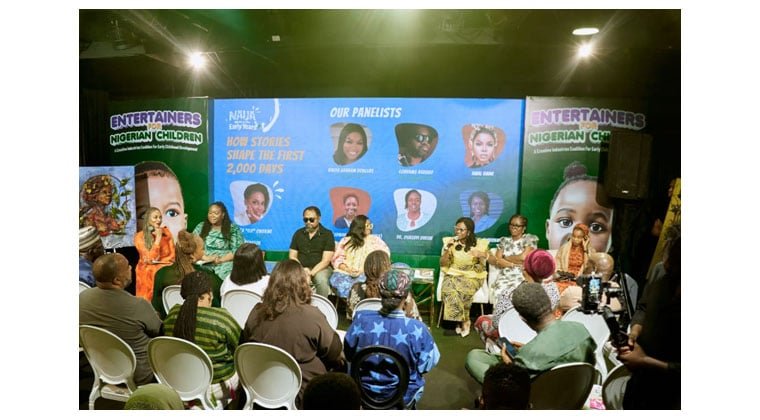
Nigeria’s creative and cultural powerhouses gathered in Lagos on the 28th of February for what organizers described as a turning point in how the country approaches early childhood development, marking a shift from treating the early years as social welfare to recognizing them as economic infrastructure.
The event titled : Naija Made In Early Years, hosted by the Centre for Black and African Arts and Civilization (CBAAC), and sponsored by the World Bank and Ogidi Studios, marked a historic mobilization of the nation’s creative industry to address a quiet national emergency: the development of Nigeria’s youngest citizens.
The Director-General of CBAAC, Aisha Adamu Augie, opened the session with a reminder that while modern science emphasizes “brain architecture,” African tradition has always held the blueprint. “The first classroom was never a building,” Augie stated, “but our mother’s lap, our father’s drum, and our grandmother’s folktale.”
However, that blueprint is currently under siege. With 40 percent of Nigerian children facing stunting and significant literacy gaps appearing as early as age four, the economic stakes are monumental. Keynote speaker Fadekemi “Fae” Olumide (Actress, Educator, and Cultural Advocate), a policy expert in early years education, challenged the industry to look beyond the “bankable” content of adult-themed music and fashion. She noted that the most critical infrastructure being built in Nigeria today is not roads or rail, but the cognitive development of children under five.
The room was a “who’s who” of Nigerian creative power. Music maestro Cobhams Asuquo, a vocal advocate at the event, brought a scientific perspective to the dialogue. Reflecting on his own childhood, Asuquo described himself as a product of “residual knowledge” gained from free-to-air radio. He shared how listening to the BBC as a child taught him concepts like “laminar and turbulent flow”, scientific principles he now applies to the 440Hz tuning of his music.
“Free-to-air is incredibly important,” Asuquo emphasized, noting that while social media dominates the urban elite, the “guy selling tea on the street” relies on radio and television to access life-saving information, from vaccination campaigns like “No More Zero Dose” to early learning cues.
The assembly also featured the legendary “Grandma Wura” (Bolanle Austen-Peters’ ‘Wura’ persona), who underscored the emotional power of storytelling. She recounted her days as a busy professional in the aviation and marine sectors who used stories from Tales by Moonlight and personal childhood mistakes to connect with her children. Her testimony highlighted a vital pillar of the initiative: the role of the “present father,” citing her own upbringing as a collaborative effort between her hardworking mother and a father who engaged her with puzzles and literature.
World Bank representatives provided the technical backbone to these stories, presenting data that showed every US$1 invested in early childhood yields up to a US$13 return. The consensus among the gathered filmmakers, including industry veterans like Steve Gukas and rappers like M.I Abaga, was absolute: the creative sector is no longer on the sidelines. By pairing child development specialists with scriptwriters, the coalition aims to ensure that Nigeria’s “soft power” becomes a primary partner in building the nation’s human capital.