
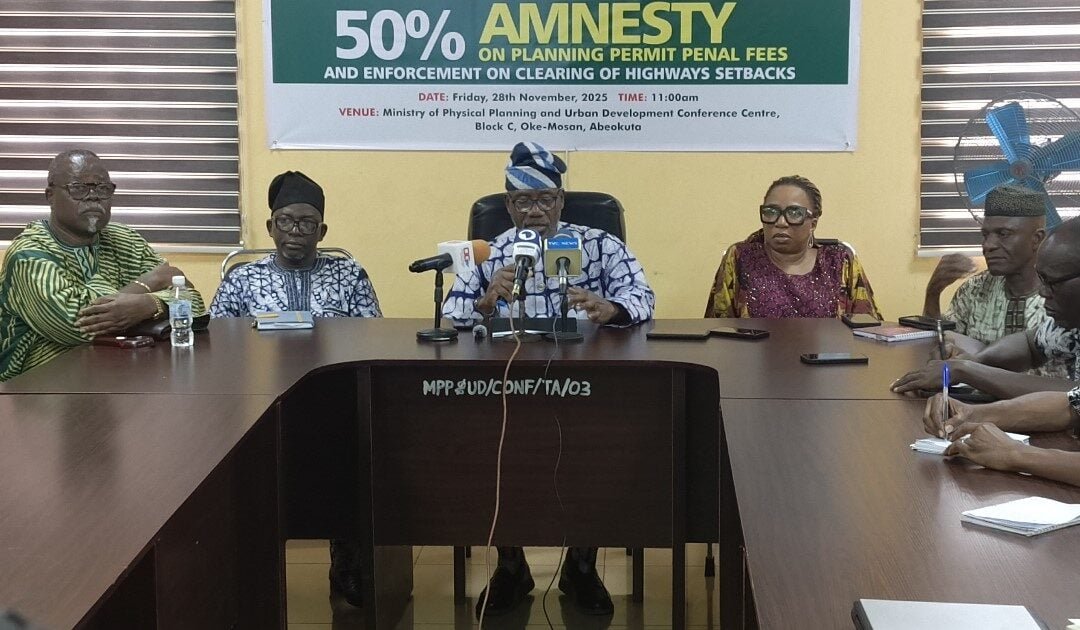
The Governor of Ogun State, Dapo Abiodun, has approved a 50% amnesty on penal fees for property owners in the state who lack the requisite building permits and approvals.
The three-month amnesty will run from November 2025 to January 2026.
Abiodun has also ordered the demolition of shanties along major state highways to combat environmental degradation, enhance the state’s aesthetic appeal, and strengthen its security architecture.
The Commissioner for Physical Planning and Urban Development, Tunji Odunlami, disclosed this at a briefing held at the ministry’s conference room on Friday.
Odunlami said it is no longer a secret that the state has, in recent years, witnessed—and continues to witness—rapid development across its geographical space.
He, however, regretted that this rapid development had come at a cost with many property owners who have developed or are developing their properties, or are undertaking construction activities, have done so without securing the required permits as stipulated by law.
Odunlami noted that while the law provides penalties for such infractions, the government recognises the economic realities faced by citizens, especially as the year draws to a close, and has decided to reduce these penalties by 50%.
He explained, “On 1st November 2025, His Excellency Prince Dapo Abiodun approved the commencement of an amnesty programme.
“This window provides an opportunity for those who have built without obtaining planning permits, as required by the Ogun State Urban and Regional Planning and Development Law, to regularise their developments and enjoy a 50% reduction in the applicable penal fees.”
Odunlami stated that the amnesty covers residential, commercial, industrial, institutional, and mixed-use developments, as well as all other categories of physical developments under the law and regulations.
He urged the public—including individuals, organisations, corporate bodies, real estate developers, industrial operators, and commercial landlords—to take full advantage of this opportunity by regularising their developments and ensuring full compliance with the state’s planning laws and regulations.
The commissioner advised that property owners should visit the ministry’s headquarters at the governor’s Office, Oke Mosan, Abeokuta, or any of its 32 zonal planning offices across the state for seamless, transparent, and efficient processing of their documents throughout the amnesty period.
Odunlami also expressed concern over the continuous encroachment of highways and road setbacks by shanties, makeshift structures, signage, containers, shops, markets, car and heavy equipment dealerships, truck parks, and other unauthorised developments.
Some of the affected major highways include Lagos–Ibadan, Abeokuta–Siun–Sagamu, Sagamu Interchange to Ajebandele (end of Sagamu–Ijebu Ode–Benin Expressway), and Abeokuta–Sango–Lagos Expressway, among others.
He said these activities pose serious safety hazards, obstruct visibility, disrupt urban orderliness, block drainage channels, degrade the environment, and contribute to flooding and waste accumulation.
Odunlami emphasised that the government will no longer tolerate unauthorised use of setback areas, except for activities related to infrastructure, transportation, traffic control, and the maintenance and management of those spaces.
He called on all property owners whose plots face expressways and major highways to immediately remove any unauthorised developments or uses within their setback spaces.
While urging voluntary compliance, the commissioner warned that failure to comply may result in sanctions, including the withdrawal of planning permits and payment of abatement charges.
The state of physical planning and urban development in Nigeria has been marked by rapid, largely unplanned urbanisation and challenges in policy implementation, despite recent government efforts to address these issues.
Although legal frameworks such as the Nigerian Urban and Regional Planning Act of 1992 exist, implementation and enforcement remain weak due to political interference, corruption, and lack of commitment from officials.
The Federal Government has, however, recently approved a revised National Urban Development Policy (NUDP) to provide a new framework for sustainable urban growth.