
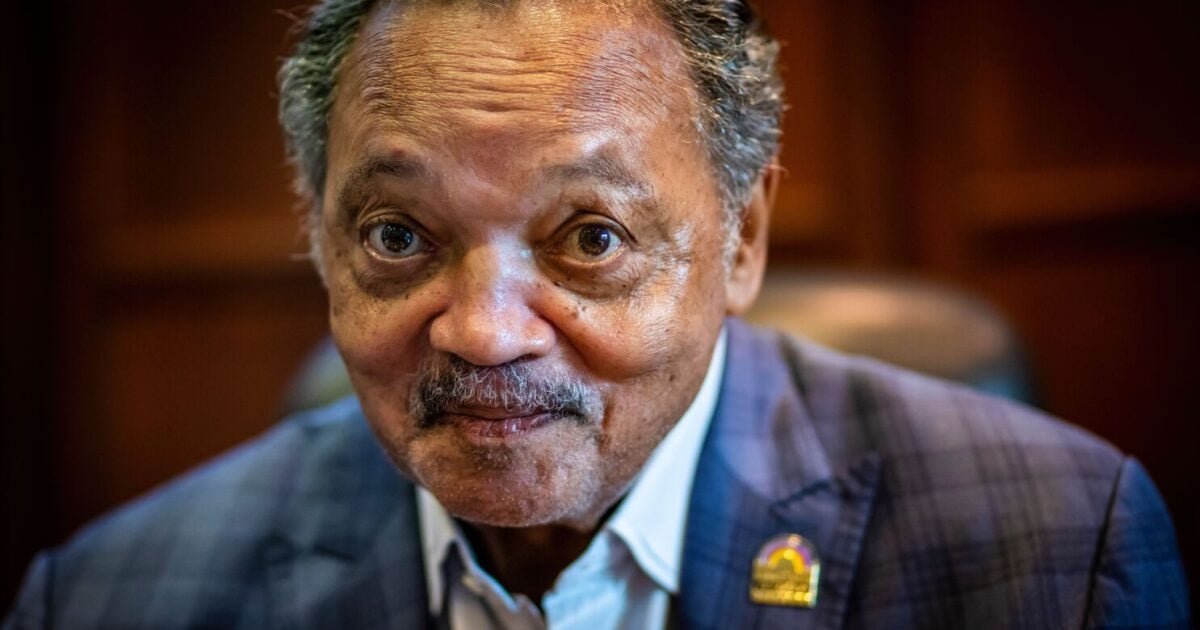
United States civil rights leader and Baptist minister, Jesse Jackson, has died at the age of 84 on Tuesday, his family announced in a statement.
The family hailed “his unwavering belief in justice, equality, and love” and described him as a servant leader to the oppressed, the voiceless, and the overlooked worldwide.
Early life and education
Born on October 8, 1941, in Greenville, Chicago, Jackson grew up during the Jim Crow era, a period marked by racially discriminatory laws and practices in the American South.
He was born to a 16-year-old high school student, and his biological father was a 33-year-old married man who lived nearby. His mother later married another man who adopted him.
Jackson earned a football scholarship to the University of Illinois but later transferred to North Carolina Agricultural and Technical State University, citing racial discrimination. While in college, he became active in the civil rights movement and was arrested after attempting to enter a whites-only public library in South Carolina.
He later attended Chicago Theological Seminary and was ordained a Baptist minister in 1968.
Role in the civil rights movement
Jackson rose to national prominence as a close associate of civil rights icon Martin Luther King Jr.. He worked alongside King in the Southern Christian Leadership Conference, where he was given leadership responsibilities focused on expanding economic opportunities for Black communities.
On April 4, 1968, when King was assassinated at the Lorraine Motel in Memphis, Jackson was staying at the same location. His public account of the assassination later drew criticism from some of King’s associates.
Founding of civil rights organisations
Following King’s death, Jackson founded Operation PUSH in Chicago in the early 1970s. In 1984, he established the National Rainbow Coalition, which later merged with Operation PUSH in 1996 to form the Rainbow/PUSH Coalition. He stepped down as president of the organisation in 2023 after more than five decades of activism.
International diplomacy and media career
Jackson played a role in international diplomacy, securing the release of U.S. naval aviator Robert Goodman Jr. in 1984, prompting then-President Ronald Reagan to commend his efforts.
He later met Iraqi leader Saddam Hussein in 1990 to negotiate the release of Americans detained after Iraq’s invasion of Kuwait. He also helped secure the release of prisoners from Cuba and three U.S. airmen held in Serbia in 1999.
From 1992 to 2000, Jackson hosted a weekly programme on . In 2000, President Bill Clinton awarded him the Presidential Medal of Freedom, the highest civilian honour in the United States.
Jackson remained active in racial justice advocacy, including condemning the 2020 police killing of George Floyd.
Politics
He ran for the Democratic presidential nomination in 1984 and 1988, attracting Black voters and many white liberals in mounting unexpectedly strong campaigns, but fell short of becoming the first Black major party White House nominee. Ultimately, he never held elective office.
Jackson pursued his political ambitions in the 1980s, relying on his mesmerising oratory. It was not until fellow Chicagoan Barack Obama’s election as president in 2008 that a Black candidate came as close to securing a major party presidential nomination as Jackson.
In 1984, Jackson won 3.3 million votes in Democratic nominating contests, about 18% of those cast, and finished third behind eventual nominee Walter Mondale and Gary Hart in the race for the right to face Republican incumbent Ronald Reagan. His candidacy lost momentum after it became public that Jackson had privately called Jewish people “Hymies” and New York “Hymietown.”
In 1988, Jackson was a more polished and mainstream candidate, coming in a close second in the Democratic race to face Republican George H.W. Bush. Jackson gave eventual Democratic nominee Michael Dukakis a run for his money, winning 11 state primaries and caucuses, including several in the South, and amassing 6.8 million votes in nominating contests, or 29%.
Jackson cast himself as a barrier-breaker for people of colour, the impoverished and the powerless. He electrified the 1988 Democratic convention with a speech telling his life story and calling on Americans to find common ground.
Health challenges in later years
Jackson was diagnosed with Parkinson’s disease in 2017. In November 2025, Jackson was hospitalised after being diagnosed with Progressive Supranuclear Palsy, a rare neurological disorder.
According to the U.S. National Institute of Neurological Disorders and Stroke, PSP affects body movements, walking and balance, and eye movements. The disease typically begins in a person’s 60s and shares some symptoms with Parkinson’s disease. Most people diagnosed with PSP develop severe disability within three to five years.
Jackson is survived by his wife, Jacqueline Brown, whom he married in 1962, their children, and extended family.