
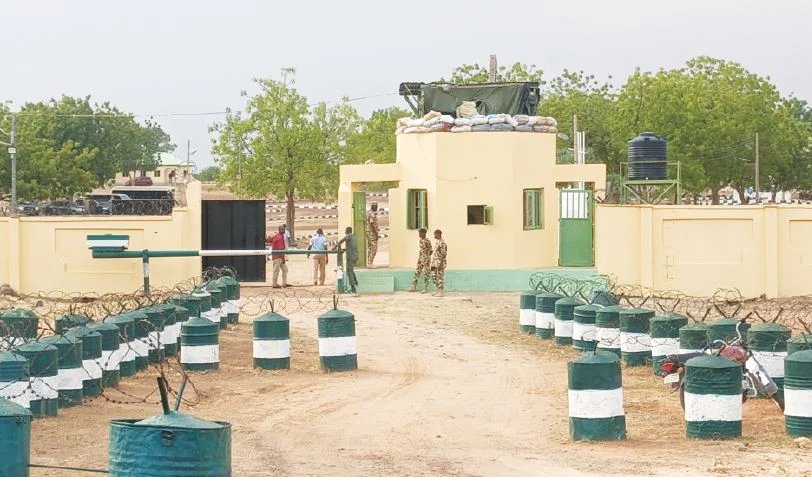
In this report, focusing on participants of Operation Safe Corridor, Nigeria’s deradicalisation, rehabilitation and reintegration programme for repentant terrorists, SOLOMON ODENIYI writes that several individuals among those enrolled claim they were wrongly arrested during security operations and are now undergoing the same rehabilitation and reintegration process alongside convicted or suspected insurgents
In 2013, Baba Garba was only 18 when soldiers stormed his community of Warabe in Borno State.
The young man said that morning marked the beginning of a life he never imagined for himself.
At the time, Boko Haram attacks had become a constant and grim reality in parts of the state. But Garba said he never expected that living in a community frequently targeted by insurgents would eventually place him in the path of a sweeping military crackdown.
He recalled being at home when military vehicles suddenly rolled into the community, throwing residents into panic as soldiers began rounding up young men.
According to him, he was picked up alongside several others.
“We were at home in Warabe when the attack happened. The Army came and took us to Giwa Barracks. We spent four days there before they moved us to Kainji, where I stayed for 11 years. I have now spent two years here in the camp. It has been 13 years since I left home,” he recounted amid tears.
Now 31, Garba says 13 years of his life have been lost since the day he was whisked away from his home over allegations he insists he knew nothing about.
When our correspondent visited the Malam Sidi rehabilitation camp in Gombe ahead of the graduation of over 700 repentant insurgents, Garba was among the participants preparing for reintegration into society under Operation Safe Corridor, Nigeria’s deradicalisation, rehabilitation and reintegration programme for former insurgents.
Established in 2016, the initiative is a non-kinetic counter-insurgency strategy designed to rehabilitate and reintegrate surrendered members of Boko Haram and other extremist groups.
It combines psychological counselling, religious reorientation, vocational training, and structured re-education aimed at transforming former combatants into productive members of society.
Inside the camp, Garba now spends his days learning vocational skills and attending rehabilitation sessions, a stark contrast to the years he says he spent moving through various detention facilities after his arrest.
Inside Operation Safe Corridor
Documents reviewed by Sunday show that individuals admitted into Operation Safe Corridor undergo a structured deradicalisation and rehabilitation process designed to prepare them for reintegration into society.
On arrival at the camp, participants, referred to as “clients”, undergo comprehensive medical and physical examinations conducted by health professionals to assess their overall condition and determine appropriate care during their stay.
Officials of the National Identity Management Commission also capture their biometrics to facilitate the issuance of national identity cards upon completion of the programme.
This is followed by screening, profiling, and documentation by the camp’s intelligence unit to support background checks, risk assessment, and training plans.
Throughout the programme, participants are exposed to a range of therapeutic and rehabilitation interventions.
Spiritual counsellors work to challenge extremist interpretations of both Christian and Islamic teachings, while psychologists provide mental health support, including treatment for anxiety, trauma, and anger-related conditions.
Medical services are provided within the camp, with more serious cases referred to the Federal Teaching Hospital, Gombe.
Additional interventions include psychosocial support, drug abuse treatment, recreational activities, and basic Western education, all tailored to support behavioural change and reintegration.
As part of vocational training, participants acquire skills such as barbing, shoemaking, tailoring, carpentry, baking, electrical repairs, vulcanising, and laundry services.
They are also introduced to agricultural practices, including crop farming, poultry, and fish farming, to promote self-reliance after discharge.
In preparation for reintegration, the programme also incorporates transitional justice measures, including supervised phone calls and visits with family members and community stakeholders aimed at rebuilding trust and encouraging acceptance.
A key requirement for graduation is the administration of an oath of allegiance to the Federal Republic of Nigeria. Conducted before a commissioner for oaths representing the Federal High Court in Gombe State, participants are required to renounce any affiliation with insurgent groups and pledge loyalty to the state.
While authorities present the programme as a structured pathway for rehabilitating former insurgents, questions persist about the backgrounds of some participants and whether all those processed through the system were, in fact, involved in insurgent activities.
Though Operation Safe Corridor is designed for former insurgents, several beneficiaries of the programme said they were neither repentant Boko Haram nor ISWAP ex-combatants.
Caught in web of suspicion
Garba’s story is not isolated.
For Usman Hassan, it was not a military raid at home that altered the course of his life, but a routine visit to a barbing salon in 2011.
What began as a necessary ordinary haircut, he said, ended with security operatives accusing him of knowing a suspect they were tracking.
“I went to barb my hair when some security operatives came and asked me about someone they were looking for. They said they heard I knew the person. I told them I didn’t know him, but they insisted and arrested me,” Hassan recalled.
That encounter, he said, marked the beginning of more than a decade in detention before his eventual release in 2025.
Like Garba, Hassan maintains that he was caught in a web of suspicion and association during the height of Nigeria’s counterinsurgency operations in the North-East.
Swept up in security operations
Mohammed Ali, now reintegrated into society, also described being swept up during a mass security operation.
“I was in my shop when security operatives cordoned off the area. They took 27 of us. Those arrested were drivers, passengers, and shop owners,” he said.
According to Ali, only two of those arrested survived years in detention.
“I spent 13 years in custody,” he added with a wry smile.
After undergoing rehabilitation, Ali said he learned shoemaking before eventually returning to telecommunications, the trade he practised before his arrest.
“Today, I am doing well. I even have people working under me,” he muttered.
Despite criticisms surrounding Operation Safe Corridor, Ali believes the programme should continue.
“There are many youths with potential here. If given the opportunity, they can contribute positively to society,” he said, while also calling for reforms within the justice system.
“Security agencies should be diligent. Justice delayed is justice denied,” Ali added.
Beyond Ali’s account, interviews with several participants revealed what many described as a recurring pattern of arrests driven by raids, suspicion, or association rather than proven involvement in insurgency.
Wrongly branded
Jimoh Sifian is another victim caught in what he described as an unfortunate web of circumstance.
A civil servant from Okene in Kogi State, his journey into detention had nothing to do with insurgency. Instead, it began with a relationship with a student at the Federal University of Technology, Minna.
“I worked with the Kogi State Civil Service Commission. I used to visit my wife in Niger State regularly,” Sifian said.
According to him, trouble started because of a woman he was dating, unaware she had ties to a powerful individual.
“I had a girlfriend who was a student of FUTMINNA. One day, we were at a relaxation spot called Democracy Centre when a man drove up and called her. She ignored him. He was angry and warned me to stay away from her or face severe consequences,” Sifian recalled.
Two days later, his life changed.
“Two days later, on November 3, 2020, security operatives stormed my house and took me to Abuja. I was interrogated about my connection to the girl. That was when I realised someone influential was behind my arrest,” Sifian recounted.
He said he later learnt his case was linked to what he described as “a big man’s interest”.
Despite maintaining his innocence, he spent years in detention before being transferred to the rehabilitation camp.
“I am a graduate. I have worked since 2005. But now, I don’t know what awaits me after here,” he said.
Still, Sifian said the experience has changed him.
“I have learned patience. I have learned skills like fishing and poultry. I just believe it is destiny. To those in power, they should be transparent in whatever they do,” he appealed.
For Basil Anetochukwu, the ordeal began with something as ordinary as trying to fix an electrical fault in his home in Awka.
“I called an electrician to repair an issue in my house. But before he came, security operatives invaded my house around 3 a.m. and arrested me,” he recounted.
Anetochukwu said he was moved across detention facilities in Anambra, Enugu and Abuja before eventually being transferred to the rehabilitation camp.
“It was in court that I realised I was being linked to a case involving the person they were actually tracking,” he explained.
Months into the programme, he said his perception of Operation Safe Corridor has changed.
Anetochukwu said many participants share similar experiences.
“About 98 per cent of us here did not commit any offence. Many are victims of circumstance,” he said, urging the government to sustain the programme despite controversy.
Similarly, Mohammed Bello said his arrest in 2013 was linked to his work as a mobile SIM card agent, a business he insists had no ties to terrorism.
“I was selling registered SIM cards. I wasn’t selling to terrorists. I had no connection with them, but they still came to arrest me in Bauchi. I was 21 then. Now I am 34,” he said.
When viewed alongside others’ accounts of raids and arrests, the narratives point to a pattern in which detention was often driven by proximity, suspicion, or association rather than clear evidence of direct involvement in insurgency.
Although the military has consistently denied carrying out indiscriminate arrests, the testimonies of Garba, Ali, Anetochukwu, and Usman Bello suggest otherwise.
Wrongful arrest
A 2014 report by Amnesty International found that during counterinsurgency operations in the North-East, at least 20,000 people, mostly young men and boys, were arbitrarily arrested, with allegations of torture, enforced disappearances, and deaths in detention.
Authorities say about 17,000 suspected terrorists and their family members have surrendered since 2015. Meanwhile, roughly 3,000 individuals have been reintegrated through Operation Safe Corridor.
However, there is no publicly available breakdown distinguishing confirmed fighters from civilians who may have been wrongly detained. That absence of clarity raises a troubling question.
Coerced into insurgency
Unlike many participants who insisted they were merely caught up in security operations, Mohammed Mohammed admitted he had direct contact with Boko Haram but said it was by force, not choice.
The native of Kukawa Local Government Area of Borno State recalled that in 2018, he set out to tend to his fishing nets in Baga, unaware that he was walking into captivity.
“In the early hours, I left home to check the nets I had set the previous night. I was fishing in Baga when they captured us. We were three that they took. They took us deep into the bush,” he recounted.
What followed, he said, were five harrowing years under Boko Haram control.
“They made us follow them to attack people. We were running errands and doing other tasks. Sometimes, we were used as foot soldiers,” Mohammed added.
According to him, escape was almost impossible.
“I was always looking for a way to escape. I was unhappy there. Out of the three of us that were taken, I am the only one still alive,” he revealed.
For years, Mohammed said survival depended on obedience, fear, and waiting for the slightest opportunity to flee.
That opportunity eventually came during a military raid on a Boko Haram camp.
“When I saw the opportunity, I ran. There was a raid on our camp, so I took advantage of it. That was how security operatives found me,” he said.
Mohammed is still undergoing rehabilitation at the Operation Safe Corridor camp, and is learning vocational skills and preparing for reintegration into society.
“What I have learned here has shaped me. With the starter pack we will receive, I believe I can take care of myself,” he said with optimism.
Contrary to the warnings he received while in captivity, Mohammed said his experience after surrendering has been different from what Boko Haram commanders told them.
“In the bush, they warned us never to surrender. They said the government would kill us. But that is not true. Here, we are treated well. I now have peace of mind, more than I ever had there,” he said.
Mohammed urged others still fighting alongside insurgents to lay down their arms.
Military misclassification
A security analyst, Chidi Omeje, said the risk of misclassification has long been embedded in Nigeria’s counterinsurgency approach.
“After attacks, there were instances of mass arrests. Some of those picked up had no business being labelled as terrorists,” he said.
Omeje said proper profiling remains the only safeguard against injustice.
“If you profile them properly, you will find that not everyone should be classified as a terrorist,” he added.
Omeje warned that failing to distinguish between perpetrators and victims could lead to innocent people being punished for crimes they did not commit.
He further advocated a justice approach that goes beyond punishment, urging authorities to consider restorative measures for those wrongly accused.
According to him, such cases should be thoroughly investigated, and where abuses are established, accountability should follow.
“There are many people across the country who may be in detention for crimes they know nothing about. Cases like this should serve as an opportunity to review the system, identify those wrongly held, and ensure that justice is done,” he said.
The Country Director of Amnesty International, Sanusi Isa, said that despite its stated objectives, many detainees were not informed of the legal basis for their detention.
“Most of the men and boys there have not been informed of any legal basis for their detention and still lack access to lawyers or courts to contest it. Their promised six-month stay has, in some cases, extended to 19 months, during which they are deprived of liberty and kept under constant armed guard.
“A vocational training programme under Safe Corridor may amount to forced labour, since most detainees, if not all, have never been convicted of any crime and are made to produce items such as shoes, soap, and furniture without pay,” he said.
Isa stressed that these issues point to fundamental flaws in the system.
“Our research indicates that many of those detained were simply unlucky to have been arrested in areas formerly under insurgent control. The entire system requires urgent reform, as there are clear failures on multiple levels,” he added.
Victims can seek damages — SAN
A Senior Advocate of Nigeria, Adedayo Ifedipe, described the prolonged detention as a clear violation of constitutional rights, stressing that Nigerian law does not permit the arrest or detention of relatives in place of a suspect.
“There is no provision in our laws that allows a man to be arrested in lieu of another. If you are looking for a thief and cannot find him, there is no justification for picking his siblings, wife, spouse, parents, or brother. That is not the law,” he said.
The SAN argued that detaining a man for 13 years without trial could not be justified under any circumstances, noting that placing him in a rehabilitation programme was insufficient compensation for the years lost in custody.
“To have kept a man for 13 years, in whatever circumstances, cannot be excused. And to say you are releasing him and putting him in Operation Safe Corridor is not enough compensation for the wrong done to him,” Ifedipe stated.
He called for broader reforms in arrest and detention practices, urging authorities to establish review mechanisms to quickly determine whether detainees have a case to answer.
“I should think the government needs a more holistic approach. If people are arrested, there is no reason why, within two to three weeks, a panel cannot be set up to review their cases. Those with no case should be released.
“Those with cases to answer should be charged in court. The idea of keeping people ad infinitum in custody is not only wrong, but it is also unconstitutional,” the SAN added.
Ifedipe further noted that the Administration of Criminal Justice Act already provides procedures for lawful remand, warning against arbitrary and prolonged detention without trial.
“Under the Criminal Justice Act, provisions exist for seeking judicial orders to detain persons. You cannot keep people endlessly without due process. The government itself needs to look inward and review the protocols for arresting, handling, and prosecuting these cases,” he said.
According to Ifedipe, victims of unlawful detention have the legal right to seek redress in court by filing actions for the enforcement of their fundamental rights and demanding compensation for damages suffered.
“If they want to get justice, they can go to court for the enforcement of their fundamental rights and ask for damages for the years lost,” he said.
‘Wrong narratives about Operation Safe Corridor’
Responding to concerns raised by some participants, the Coordinator of Operation Safe Corridor, Brigadier General Yusuf Ali, said the programme was established to address gaps in Nigeria’s handling of terrorism-related cases, particularly where legal processes remain unresolved for extended periods.
He noted that terrorism cases are complex and cannot be swiftly resolved at lower levels of the judicial system, often resulting in prolonged detention.
“Once someone is labelled a terrorist, it becomes difficult to process their case quickly. Many of them spend years in custody while their cases are being determined,” Ali explained.
He added that even when such individuals are eventually discharged or cleared by the courts, releasing them directly into society may pose security risks.
“During detention, they may have mixed with actual members of insurgent groups, and the trauma of wrongful detention, anger, and exposure can predispose them to violent extremism,” he noted.
Ali explained that the programme was designed to mitigate these risks through structured rehabilitation, counselling, and vocational training.
The coordinator acknowledged that public perception remains one of the programme’s biggest challenges, citing what he described as widespread misinformation.
He referenced recent claims by a foreign blogger alleging that individuals in the camp had committed mass killings, an assertion he strongly rejected.
“There is a lot of misrepresentation and disinformation about what we do here. People who have never been to Nigeria form opinions based on false narratives, and that undermines efforts to restore peace and stability,” Ali said.
On concerns about reintegration, particularly fears within communities affected by insurgency, Ali said deliberate steps are taken to prepare host communities before beneficiaries return.
“We engage traditional rulers, opinion leaders, and community stakeholders to create a conducive environment. They are informed that these individuals have been tried, cleared, and rehabilitated,” he explained.
Ali admitted, however, that rebuilding trust is gradual.
“Stigma does not disappear overnight. It takes time for communities to observe their behaviour and accept that they have changed,” he added.
Ali further argued that empowerment is central to preventing relapse.
He said, “That is why we equip them with skills. If they return without means of livelihood, the risk of negative behaviour increases. But when they can contribute positively, acceptance becomes easier.”
Responding to circulating claims that beneficiaries of the programme are recruited into the military, Ali dismissed the allegation.
“The military has its own established recruitment processes. Operation Safe Corridor does not feed into that system,” he said.
While acknowledging the pain of victims of insurgency, he maintained that a combination of military operations and rehabilitation remains essential to addressing the crisis.
“Terrorism is not something you end overnight. It is not a sprint; it is a marathon. It requires patience, collaboration, and the collective effort of all Nigerians,” Ali stressed.