
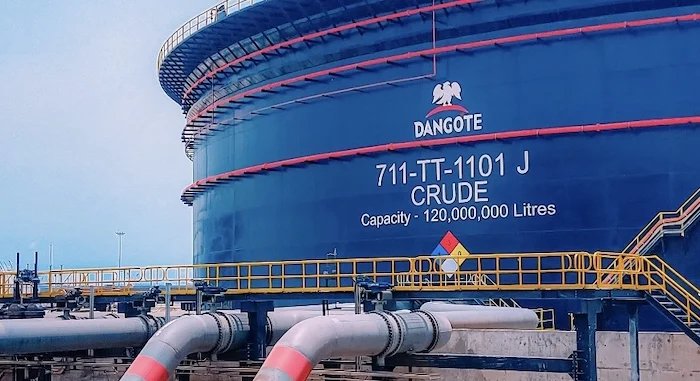
The ramp-up of the Dangote Petroleum Refinery has triggered a sharp decline in clean petroleum product imports into West Africa, cutting tanker flows and reshaping regional shipping routes, according to a report by S&P Global.
Data from S&P Global Commodities at Sea showed that West African imports of clean refined products dropped to 765,000 barrels per day in May from 997,000 barrels per day in April, representing a 23 per cent decline.
Shipping association BIMCO was quoted as saying that West African imports of clean refined products fell significantly within a month as the 650,000-barrel-per-day refinery in Nigeria expanded output and displaced imported volumes across the region.
Analysts at BIMCO reported that imports dropped by 44 per cent over the period under review, while overall tonne-miles declined sharply as trading patterns adjusted to the new supply reality.
“LR1 and LR2 product tankers recorded the largest declines, down 88 per cent and 78 per cent respectively, and together accounted for 55 per cent of the total tonne-mile loss,” S&P quoted BIMCO as saying.
The association also noted that MR product tanker tonne-miles fell only marginally despite a broad drop in imports from major loading regions, as shifting supply routes partially offset the decline.
“MR product tanker tonne-miles fell only 4 per cent year over year during April to May, despite a sharp drop in imports from all major loading regions. A 34-fold increase in volumes from the Americas largely offset the decline, limiting the overall loss,” BIMCO said.
Historically, the Rotterdam-to-Lagos fuel trade had been a major corridor for MR tankers, but analysts said it has weakened significantly as domestic refining capacity in Nigeria expands.
“Data indicated a 39 per cent year-on-year drop in Nigerian clean petroleum product imports by mid-2025, essentially removing a massive source of employment for MR tankers in the Atlantic,” CAS analysts said.
Platts, part of S&P Global Energy, also reported a decline in freight rates on the UK/Continent-to-West Africa route, reflecting reduced demand for long-haul fuel shipments.
The Dangote refinery, commissioned in 2024, reached its 650,000 barrels-per-day capacity in February 2026 and is now supplying the bulk of Nigeria’s domestic fuel needs. According to government figures, the facility supplied roughly 80 per cent of Nigeria’s gasoline demand in April.
Analysts said the refinery’s rise is not only reducing imports but also repositioning Nigeria as a regional exporter of refined products, with shipments now flowing to neighbouring West African countries and beyond.
The shift has also altered the role of key storage and redistribution hubs such as Lomé, Togo, which analysts said may struggle to regain previous import volumes under the new supply structure.
“As Lome may never regain Nigeria’s volumes, its position as a major offshore import and storage hub could be lost along with the related tanker demand,” BIMCO’s Niels Rasmussen reportedly said.
Industry observers said the development marks a major structural shift in Atlantic Basin fuel trade, with increased regional “shuttle” voyages replacing long-haul imports that previously dominated West African supply chains.
The report added that petroleum products are now being shipped from Lagos to West African neighbours such as Ghana, Togo and Ivory Coast, as well as to destinations including South Korea, the United States and Europe.
This shift is replacing long-haul imports with shorter regional “shuttle” voyages, which increase the frequency of tanker calls but reduce overall tonne-miles compared to global imports, CAS analysts said.
Dangote emerged as a growing export hub in the wake of the Middle East conflict, shipping a record 372,000 barrels per day of clean petroleum products in April, according to CAS data.