
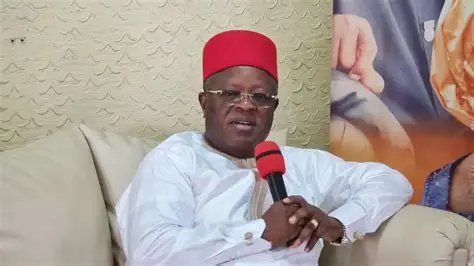
The Minister of Works, David Umahi, has defended the Federal Government’s investment in road infrastructure, describing President Bola Tinubu’s four legacy highway projects as strategic economic corridors designed to transform agriculture, trade and industrial development across the country.
Umahi also disclosed that the government is constructing what he described as the “longest flyover in Africa” near the Dangote Refinery axis of the Lagos-Calabar Coastal Highway to address anticipated traffic congestion arising from industrial activities around the Lekki Deep Sea Port and the refinery.
The minister spoke on Saturday during the Renewed Hope Media Tour at the site of the ongoing 1.3-kilometre Ndi-Egbe Bridge in Afikpo Local Government Area of Ebonyi State, which links the state to Ugep in Cross River State.
The media tour, organised by the Presidential Communications Team, was designed to showcase projects being implemented under President Tinubu’s Renewed Hope Agenda and complementary initiatives by state governments.
Speaking on the Lagos-Calabar Coastal Highway, Umahi said the Federal Government had taken proactive measures to eliminate future traffic bottlenecks along critical economic corridors.
He said the structure was being designed specifically to manage the high volume of trucks servicing the refinery and adjoining economic hubs, including the Lekki Deep Sea Port, warning that without such infrastructure, the axis could become a major congestion point.
“We are building a fantastic flyover that resolves the conflict at that point. And we are building the longest flyover at the front of Dangote refinery, because the overboarding trucks of theirs, we have to take into consideration, and also a lot of traffic over there.
“So that’s why we are building a very serious and longest flyover you can ever have, you know, in Africa. That is ongoing. And so it’s 55km, and it’s N1.33bn. That job is technically done over 70 per cent. The 70 per cent loan component is being procured, and that job is ongoing. That job will be completed by December.”
He added that the first section of the coastal highway had been completed and was ready for commissioning. “Don’t forget that the first section is fully completed and ready for commissioning,” he said.
Providing updates on the Ndi-Egbe Bridge project, Umahi said the strategic crossing, which forms part of the broader transportation network connecting the South-East and South-South regions, had reached about 45 per cent completion.
The bridge, measuring approximately 1.3km, is expected to significantly improve connectivity between Ebonyi and Cross River states upon completion in December 2026.
“So you have approximately 1.3km of bridge over Ndi-Egbe. This bridge is very strategic because from this point to the end of the Lagos-Calabar Coastal Highway in Calabar is about eight kilometres,” he said. “When completed, we will use this bridge for economic cost benefits and then proceed with the remaining section.”
According to him, the bridge forms a critical component of the President’s four legacy infrastructure projects, which are intended to interconnect Nigeria’s six geopolitical zones. “And that’s why I said that the four legacy projects of the President are now in a loop, connecting the six regions of Nigeria,” Umahi explained.
The minister, however, acknowledged temporary setbacks affecting progress at the bridge site, attributing them to funding delays and technical challenges posed by water currents.
“We may ask why work is not going as fast as expected. Two reasons. One is that I have been very patient, but I want to assure them that the President has directed payment of contractors, and the process is about to start,” he said. “They have nothing to worry about. I commend CGC very well because we pushed them to this length.”
He further explained that the contractor had been compelled to deploy specialised equipment due to the difficult river conditions. “They had to bring new equipment because the water current became very unbearable. But they have a very good understanding with us to continue the project, and they will be paid,” he added.
“In the meantime, they are moulding the beams. The major work has been technically done, and I would say that this project is about 45 per cent completed.”
Umahi also provided details on the Federal Government’s flagship road programmes, insisting that the projects should be viewed as economic investments rather than ordinary road construction initiatives.
“We have the first legacy project of Mr President, which is from Lagos to Calabar. This Lagos-Calabar project is about 750 kilometres,” he said. “The second legacy project is the Sokoto-Badagry Superhighway, which is 1,068km.”
He identified the Calabar-Abuja Trans-Sahara Superhighway as another key component of the administration’s infrastructure agenda, explaining that it would connect Cross River, Ebonyi, Benue, Kogi, Nasarawa and the Federal Capital Territory. The minister warned against calls by some political actors to discontinue the projects if elected into office.
“When some presidential aspirants say that when they come, they are going to stop these projects, I want Nigerians to watch them very well and pray against them because these projects are investments,” he said. “They are not just road construction projects.”
According to Umahi, the economic benefits embedded in the projects extend beyond transportation. “If we talk about the benefits of these projects, on the Lagos-Calabar Highway, you have about 75 dams. We are designing these dams in collaboration with the Ministry of Water Resources for irrigation and power generation,” he said. “We are also mapping out a lot of land in millions of hectares to settle people for agriculture.”
He added that the highway corridors would stimulate housing development, manufacturing activities and tourism. “Lagos-Calabar has windmill benefits. We have a lot of corridors we are going to turn into housing estates, factories and hotels,” Umahi said. “The benefits cannot be exhausted, but you also have to think about direct and indirect jobs.”
According to him, “The Sokoto-Badagry Superhighway corridor has over 73 dams for irrigation farming to boost agriculture.” He maintained that the projects would strengthen regional integration and cross-border trade.
“At Badagry, you connect to the Lagos-Abidjan corridor and Benin Republic. At Ilela, you can see the Niger Republic. They trade together. So these projects are catalysts for economic revolution,” he said.
The Renewed Hope Media Tour was led by the Special Adviser to the President on Information and Strategy, Bayo Onanuga. Other members of the Presidential Communications Team on the tour included Sunday Dare, Tope Ajayi, Tunde Rahman, Otega Ogra, Fredrick Nwabufo, Linda Akhigbe and Segun Dada.
The delegation, alongside Umahi, acting Federal Controller of Works in Ebonyi State, Maxwell Okoh, and Mohammed Mustafa, Project Manager of Infiouest International Limited, inspected several infrastructure projects, including the ongoing construction of a 90-metre link bridge and concrete pavement sections of the Calabar-Abuja Trans-Sahara Superhighway.
At the Government House in Abakaliki, Onanuga said the media tour was intended to provide Nigerians with firsthand information on projects being executed under the Tinubu administration while highlighting cooperation between the Federal Government and state governments in delivering development projects.
The Lagos-Calabar Coastal Highway, Sokoto-Badagry Superhighway, Calabar-Abuja Trans-Sahara Highway and associated connecting routes constitute the Tinubu administration’s signature road infrastructure programme. The projects are being executed in phases across multiple states, with the Federal Government arguing that they will improve logistics, enhance regional trade, open up agricultural belts and stimulate private investment across Nigeria.