
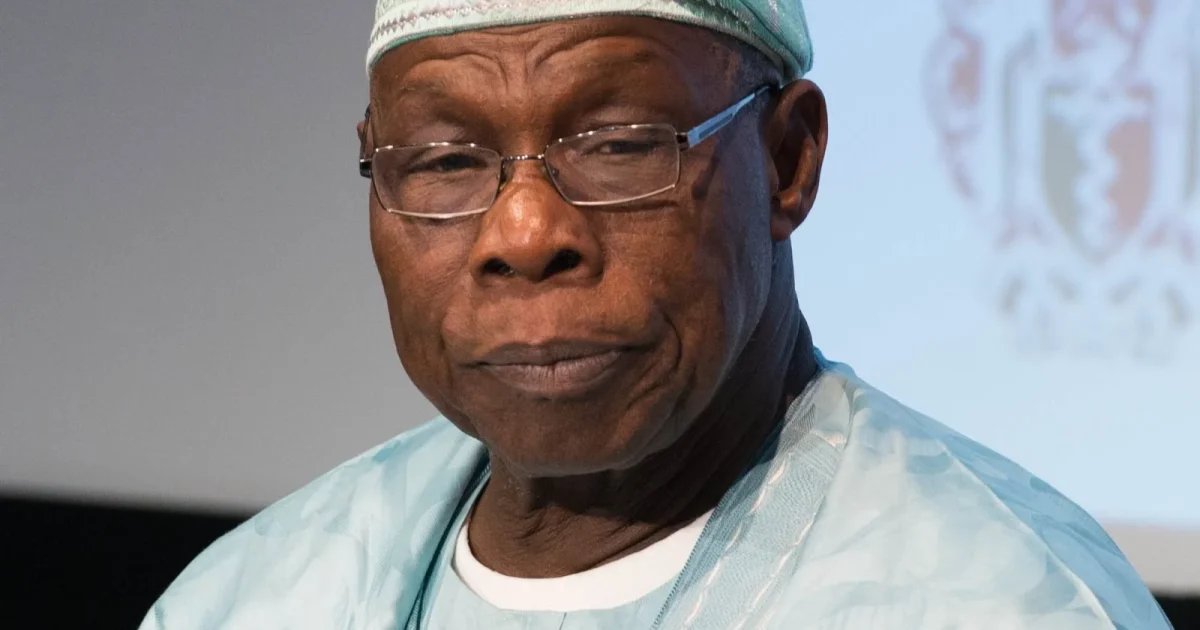
Former President Olusegun Obasanjo has called for an urgent national framework and dedicated infrastructure to shield, preserve, and elevate Nigeria’s indigenous Adire textile craft, declaring that its survival should be treated as a strategic national priority.
Obasanjo made the call on Friday during a guided tour of the annual Ecobank Adire exhibition held at the bank’s corporate headquarters in Lagos.
The event, themed ‘Threads Across Borders,’ was curated by Dr Odun Orimolade, who led the former President alongside the Managing Director and Regional Executive of Ecobank Nigeria, Jubril Lawal, through the exhibition pavilions.
Addressing a gathering of cultural stakeholders, corporate leaders, and local artisans, Obasanjo emphasised that the preservation of the craft must transcend localised efforts.
“Who will then take charge of thinking about it? It is a national issue, not a regional issue, not even a township issue,” Obasanjo stated.
Reflecting on the historical fragmentation that has hindered past efforts to institutionalise the trade, the former President recounted previous structural challenges within artisan groups.
“And at one time, I said, if you have an address, a social number, I will give it to you. And I put myself up as the grand patron. What happened is that before even the association, they started fighting amongst themselves,” Obasanjo recalled.
Despite those historical setbacks, Obasanjo insisted that Nigeria must establish a permanent visual and operational anchor to showcase the cultural asset to the world.
“But we need something like that. And we need a place,” he stressed, adding, “And at that time, I thought, look, we will have a direct vision of Nigeria. We will have a kind of unit. But we will have a building. And all these types of things will be displayed there.”
The former president’s emphasis on structural preservation comes at a critical time when Nigeria’s multi-billion-naira indigenous textile industry faces stiff competition from cheap, foreign-printed counterfeits.
Historically rooted in Egbaland, the authentic, labour-intensive art of Adire production has long relied on intergenerational knowledge transfers.
However, shifting economic realities and an influx of mass-produced imitations have threatened the livelihoods of local cluster artisans, amplifying calls for institutional protections.
Operating under a pan-African mandate, the Ecobank has increasingly positioned its annual textile exhibition as a launchpad for micro, small, and medium enterprises aiming to tap into the regional trade opportunities presented by the African Continental Free Trade Area.
Turning directly to the stakeholders and organisers present at the exhibition, the former President challenged the room to find actionable pathways to resurrect and implement this long-term vision.
“Can we still do that?” Obasanjo questioned. “And if we can do that, how can we do it? Go and think about it and then report to me,” he added.
Expressing concern over the potential loss of intergenerational knowledge as younger generations transition into formal Western education, Obasanjo warned that the traditional family-run production lines were thinning out.
“Now, you will come from a family that does it. Now, I don’t know whether you still have among your family that are still doing it. Because you are all now going to school,” Obasanjo observed.
He further underlined the immense economic and international value locked within the fabric industry, noting that a properly structured ecosystem could anchor a thriving cultural tourism sector.
“Even bringing people, tourism, it can be a source of tourism. People go and see how it is done. They look at it. They pay something for it. So who will take on this? And then how do we work on it?” the former president noted.
The call to action prompted an immediate response from exhibition coordinators, who pointed out that the event’s current reach already included international participants from across West Africa and Latin America, positioning the Lagos exhibition as a viable launching pad.
“Today, sir, we have a direct group from Ghana, Mexico, and Sierra Leone, all in the next hall that we are in. They are all exhibiting. So we will use this as the hub to see how we can transform and elevate the fabric,” organisers explained during the tour.
Seizing on the momentum, Obasanjo pressed for immediate corporate leadership to steer the national initiative, throwing the challenge directly to the host financial institution.
“Who is going to accept the challenge? Who will take it together? Who is the leader of the group? Who will do it, sir?” Obasanjo demanded.
In response, Lawal confirmed the bank’s commitment to anchoring the project, declaring, “Ecobank will do it.”
Welcoming the corporate commitment, the former president instantly assumed an oversight role, locking in the bank’s responsibility to provide the physical infrastructure needed to kickstart the national framework.
“So I nominate myself as the grand patron. I nominate myself. And now that Ecobank is taking it upon itself, I know we will get there,” Obasanjo declared.
The former President insisted that the immediate next step must be the allocation of a dedicated physical property, which he named ‘The Adire House’, to serve as the administrative and creative headquarters for the craft’s preservation.
“It doesn’t matter. Now that you have taken that, first of all, you will give us a place where we will live. And it is a place that we will call the Adire House to give us that. We have the Adire House. And I nominate myself as grand patron. Whether you like it or not,” Obasanjo concluded.