
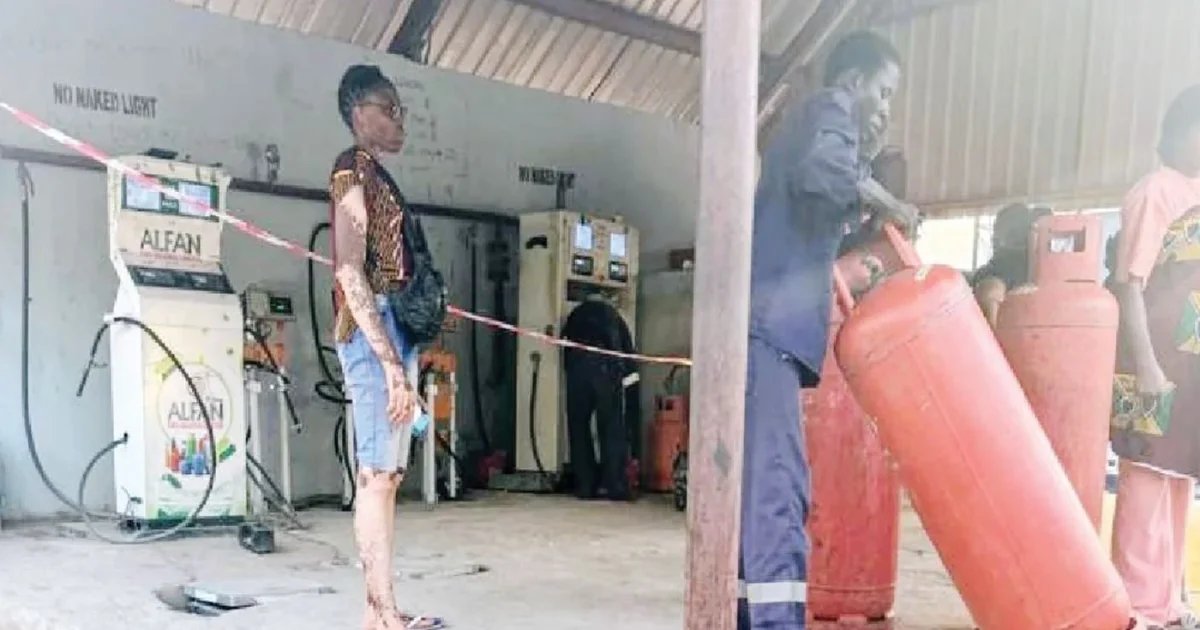
Across Delta State, soaring cooking gas prices are quietly reversing years of progress toward cleaner household energy. Residents say the cost of refilling cylinders has risen so sharply in recent months that many families are returning to firewood and charcoal, while others are cutting back on meals and cooking less often. Interviews with households, traders and gas retailers reveal a growing crisis that is forcing thousands to rethink how they prepare food and manage already stretched incomes, EFECHA GOLD reports
For years, the kitchen was the heartbeat of many homes in Delta State.
It was where families gathered after a long day, where mothers prepared meals for their children, where laughter mixed with the aroma of food, and where daily life unfolded around the cooking pot.
Today, that familiar scene is changing.
Across the state, rising cooking gas prices are forcing families to make painful adjustments. Meals are being reduced, cooking habits are changing, and many households are returning to firewood and charcoal as the cost of liquefied petroleum gas continues to climb.
What was once considered a cleaner and more convenient cooking option has gradually become a luxury many families can barely afford.
From Warri to Agbor, Ughelli to Sapele, and from Kwale to Asaba, residents told The how the soaring cost of cooking gas is worsening the hardship already caused by rising food prices, transportation costs and economic uncertainty.
For many families, the crisis is no longer about energy. It is about survival.
A business is becoming harder to sustain
At a roadside gas outlet in Delta State, a retailer identified simply as Flazy stood beside rows of gas cylinders waiting for customers.
Business, he said, is no longer what it used to be.
“As of June 15, we were selling between N1,900 and N2,000 per kilogramme,” he said.
According to him, prices have become so unstable that operators struggle to plan.
“Last month it was around N1,400. The increase has been very fast. Sometimes you go to the gas plant and they tell you there is no gas available. You spend money on transportation looking for supplies and still come back uncertain,” he said.
The retailer said the rising prices have affected customers more than anyone else.
“People no longer buy the way they used to. Someone who normally buys 5kg now asks for 2kg. Everybody is managing,” he added.
A second gas vendor painted a similar picture.
He said consumption had dropped significantly in recent months as households struggled to cope with the increasing cost.
“People buy only what they can afford at the moment. They no longer fill their cylinders. Many just buy small quantities to get through a few days,” he said.
According to him, unstable supply remains one of the major factors driving the situation.
“The supply is not stable, and that affects everything. The price keeps changing and customers are buying less.”
A problem spreading across the Delta
Findings by our correspondent showed that the increase in cooking gas prices is being felt across major towns and cities in Delta State.
In Ughelli, gas sells for about N1,500 per kilogram at some stations and between N1,750 and N1,800 at retail outlets.
In Warri, residents who bought gas for around N1,450 per kilogramme in May now pay between N1,600 and N1,700.
In Agbor, the price rose from about N1,550 to N1,750 within weeks and N2,200 for retailers.
The situation is even more difficult in Kwale, where gas that sold for around N1,450 per kilogramme now goes for nearly N1,800.
In Sapele, residents reported paying as much as N1,850 per kilogramme.
Behind these figures are thousands of households battling to adjust their budgets.
For many residents, every increase means one more sacrifice.
A little less food. A smaller quantity of gas. Another item was removed from the family budget.
‘N5,000 not enough’
For Paul, a father of four, the rising cost of cooking gas has transformed ordinary family life into a daily struggle.
The frustration in his voice was impossible to miss.
“To be honest, this issue of cooking gas is very terrible,” he said.
He explained that his family now buys gas in very small quantities because larger purchases are no longer affordable.
“I buy maybe N3,000 worth of gas just to cook and feed my children. Before, N5,000 could last for some time. Now it cannot even buy up to 3kg.”
Paul said the effects are felt every day.
“We calculate everything now. Every meal is planned carefully because you don’t want to waste gas.”
The adjustments have extended beyond cooking.
“My children now bathe with cold water because we are trying to save gas,” he said quietly.
For him, the most painful part is watching his family adapt to circumstances beyond their control.
“You just keep managing because there is no other option.”
Young people feeling pressure
The hardship is not limited to parents.
A young graduate preparing for the mandatory National Youth Service Corps said the constant rise in gas prices has made budgeting almost impossible.
“In March, I bought gas for about N14,000. Then it increased in April and increased again in May,” she said.
What worries her most is the speed of the increase.
“You think you have planned your expenses, then everything changes suddenly.”
She recalled buying gas during a trip to Benin City.
“I paid about N18,500. The increase was shocking.”
The graduate said the situation leaves many young people trapped.
“Food outside is expensive. Cooking at home is also expensive. You cannot escape it.”
When cooking becomes calculation
Across many Delta homes, cooking habits are quietly changing.
Families are increasingly choosing meals based not on preference or nutrition but on how much gas is required to prepare them.
Foods that require long cooking times are being avoided.
Large family meals are becoming less frequent.
In some households, cooking is done only once daily to conserve gas.
What was once a routine activity has become a careful exercise in financial management.
Residents say every meal now comes with a calculation.
How much gas remains?
How many days can it last?
Can the family afford another refill?
Businesses fighting to survive
The crisis is also affecting small businesses that rely heavily on cooking gas.
A food vendor in Delta State said rising gas prices are threatening her livelihood.
“The business has become very difficult,” she said.
According to her, the cost of gas now consumes a significant portion of her weekly expenses.
“We spend about N29,000 every week on gas alone.”
Despite the increasing costs, she has avoided raising food prices because many customers are already struggling.
“We have not increased our prices, but it is becoming difficult.”
She fears that increasing prices may drive customers away, while maintaining current prices reduces her profit.
“If I stop this business, what will I do? This is what I depend on to survive.”
Like many small business owners, she finds herself caught between rising operational costs and customers with declining purchasing power.
“We are all just trying to survive,” she said.
Burden felt by everyone
At Okpanam Market, a phone seller described the gas crisis as one of the most difficult challenges facing ordinary Nigerians.
“It is affecting everybody,” he said.
“Rich people feel it. Poor people feel it. Traders feel it. Families feel it.”
Like many residents, he now buys gas in small quantities.
“I cannot buy as much as before. I just buy what I can afford.”
He said one visible sign of the hardship is the disappearance of queues at gas stations.
“Before, you would see many people waiting to buy gas. Now the stations are less crowded because people do not have money.”
Then he paused before describing what hurts him most.
“The worst feeling is when your children are hungry and you cannot cook.”
More than economic problem
For many residents, the cooking gas crisis is no longer merely an economic issue.
It has become a human story.
A story of families making sacrifices.
A story of parents trying to stretch shrinking incomes.
A story of traders struggling to keep businesses alive.
A story of young people trying to plan their future amid uncertainty.
Across Delta State, kitchens that once symbolised comfort and togetherness are becoming places of difficult decisions.
Every kilogramme of gas purchased now represents a choice.
Every refill comes with worry.
Every meal comes with calculation.
And for countless families, survival is increasingly measured not by what is available on the table, but by how much gas remains in the cylinder.
As households continue to battle rising costs, many residents say they can only hope for relief.
Until then, the silent struggle continues—one meal, one refill and one day at a time.