
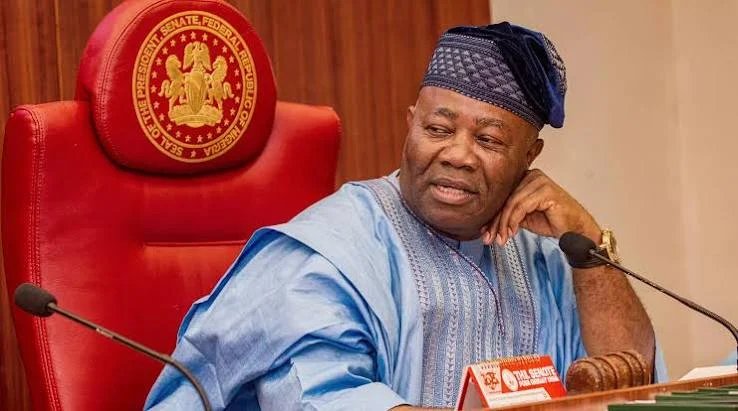
The President of the Senate, Godswill Akpabio, has called for stronger economic cooperation between Nigeria and Germany, urging both countries to translate their longstanding relationship into investments, industrial growth and job creation.
Akpabio made the call in Abuja on Thursday when he received a delegation of the Committee on Economic Cooperation and Development of the German Bundestag, led by Professor Wolfgang Stefinger.
In an address titled “Let Friendship Become Factories”, the Senate President said Nigeria and Germany had spent more than six decades building friendship and mutual trust, adding that the priority should now be to convert the relationship into tangible economic benefits.
He said, “Today, our responsibility is to translate that foundation into greater opportunities, stronger institutions and shared prosperity for our peoples.
“As we meet and share experience, let us have a stronger partnership in the areas of electricity that powers businesses, the skills that secure our livelihoods, and the jobs that sustain families.
“As parliamentarians, we have a special responsibility. The government negotiates partnerships; parliaments help give them continuity, accountability and lasting value. Through legislation, oversight and budgetary decisions, we help turn commitments into results.”
Akpabio proposed the establishment of a structured Nigeria-Germany Parliamentary Dialogue, supported by committee exchanges and designated contacts to ensure sustained engagement beyond the visit.
He said Nigeria was seeking to expand production, strengthen its industries and create productive employment through increased German investment.
“Our economic ambition is clear. We seek to expand production, strengthen industry and create productive employment for our people,” he said.
The Senate President identified manufacturing, agro-processing, pharmaceuticals, technology and infrastructure as priority areas for investment, stressing the need for partnerships that would build local capacity, facilitate technology transfer and connect Nigerian businesses to international markets.
He said Nigeria wanted to move beyond increasing trade with Germany to jointly producing goods and creating economic opportunities.
Akpabio added that both countries needed to address barriers to investment, including high financing costs, export-credit premiums and unnecessary regulatory obstacles.
“German small and medium-sized enterprises should find credible opportunities to invest alongside Nigerian businesses,” he said.
On electricity, the Senate President said reliable power supply was essential to industrialisation, noting that businesses needed stable electricity to increase production and reduce operating costs.
He said Nigeria valued the Presidential Power Initiative, implemented in partnership with Siemens, and wanted faster progress in achieving its objectives.
Akpabio also called for increased investment in renewable energy, natural gas and sustainable infrastructure, saying improved electricity supply would boost productivity and encourage further investment.
He identified technical education, vocational training and skills development as other areas where Nigeria could benefit from Germany’s experience in apprenticeships and industry-linked training.
He urged both countries to establish stronger links between Nigerian institutions and German technical colleges, industries and employers, particularly in engineering, digital technology, artificial intelligence and entrepreneurship.
“The most enduring investment in our partnership will be the skills we place in the hands of the next generation. These opportunities require peace and security.
“We appreciate Germany’s security cooperation and seek stronger collaboration in training, intelligence, surveillance, counterterrorism, border security and maritime protection, with respect for human rights.
“A secure Nigeria strengthens stability across West Africa and the Sahel, protects commerce and advances our shared interests. Our development cooperation must likewise produce sustainable enterprises, productive jobs and measurable improvements in people’s lives.”
On migration, Akpabio called for expanded safe and lawful migration pathways, recognition of professional qualifications and stronger efforts to combat human trafficking.
He also stressed the need to ensure that the return and reintegration of migrants respected due process and human dignity, while describing Nigerians in the diaspora and cultural ties between the two countries as important links.
To ensure the visit produced measurable results, Akpabio proposed five priorities: sustained parliamentary dialogue, faster electricity and renewable-energy cooperation, a skills and innovation partnership, improved access to investment and development finance, and designated parliamentary contacts to monitor the implementation of agreed actions.
The proposed measures, he said, would help strengthen bilateral relations and translate existing cooperation into practical benefits for Nigerians and Germans.