
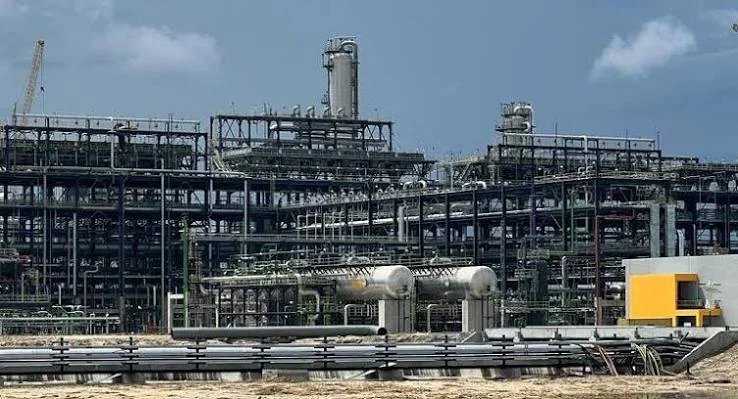
The Dangote Petroleum Refinery exported an average of 54.63 million litres of petrol, diesel and aviation fuel daily in September 2026, exceeding the 39.98 million litres supplied to the Nigerian market.
Findings showed that the refinery’s export volumes overtook domestic receipts for the first time in the two months under review.
The development came as the refinery operated at 105.98 per cent of its installed capacity, its highest utilisation rate in the January–September period, highlighting the growing role of the $20bn facility in the international petroleum products market even as Nigeria continues to grapple with concerns over domestic fuel availability.
Data from the September 2026 fact sheet of the Nigerian Midstream and Downstream Petroleum Regulatory Authority analysed by our correspondent on Saturday showed that combined exports of the three products increased by 37.33 per cent to 54.63 million litres per day from 39.78 million litres per day in August.
In contrast, domestic receipts declined by 22.08 per cent to 39.98 million litres per day from 51.31 million litres per day in the preceding month.
The figures mean that the refinery exported 14.65 million litres more than it supplied to the domestic market daily in September.
This reversed the situation in August, when domestic receipts exceeded exports by 11.53 million litres per day.
The shift occurred despite an increase in production, with the refinery raising its combined output of Premium Motor Spirit, Automotive Gas Oil and aviation turbine kerosene by 15.68 per cent to 97.67 million litres per day from 84.43 million litres.
The latest figures also showed that the refinery had operated at or above 100 per cent of its installed capacity in four months in 2026, namely May, June, August and September.
Its utilisation rate stood at 101.25 per cent in May and 101.36 per cent in June before dropping sharply to 71.09 per cent in July following maintenance on its crude distillation and residue fluid catalytic cracking units.
Operations recovered to 105.21 per cent in August and climbed further to 105.98 per cent in September.
The refinery had operated at 99.12 per cent in April, after recording 61.27 per cent in January, 78.13 per cent in February and about 93.62 per cent in March.
The September utilisation rate implies that the facility processed approximately 689,000 barrels of crude oil daily, above its installed capacity of 650,000 barrels per day.
However, the refinery management says its capacity has been upgraded to 700,000 barrels per day.
The NMDPRA data indicated that the refinery received about 618,000 barrels of crude daily during the month, meaning that the difference of approximately 71,000 barrels was sourced from existing refinery inventories.
A breakdown of the September figures showed that petrol production increased by 12.59 per cent to 47.22 million litres daily from 41.94 million litres in August.
However, petrol exports rose by 58.99 per cent to 15.47 million litres per day from 9.73 million litres, while domestic receipts fell by 20.55 per cent to 28.50 million litres from 35.87 million litres.
The refinery also increased diesel production by 35.04 per cent to 24.32 million litres daily from 18.01 million litres.
Diesel exports surged by 81.83 per cent to 15.91 million litres per day from 8.75 million litres, while domestic receipts dropped by 34.20 per cent to 8.14 million litres from 12.37 million litres.
Consequently, diesel exports were almost twice the quantity supplied to the domestic market.
Aviation fuel exports also remained significant, rising by 9.15 per cent to 23.25 million litres daily from 21.30 million litres in August.
Domestic receipts increased slightly to 3.34 million litres from 3.07 million litres.
Exports accounted for 87.44 per cent of the refinery’s aviation fuel evacuation in September, making the product the biggest contributor to the overall export dominance.
Although domestic receipts of petrol and diesel combined remained higher than their exports, the difference narrowed considerably.
The refinery supplied 36.64 million litres of the two products daily to the domestic market, against exports of 31.38 million litres.
The gap fell to 5.26 million litres daily in September from 29.76 million litres in August.
The export surge has raised fresh questions about the relationship between rising domestic refining capacity, petroleum products exports and the availability of fuel in the local market.
Notably, the refinery’s daily petrol production of 47.22 million litres exceeded Nigeria’s average daily petrol consumption of 44.4 million litres in September.
However, only 28.50 million litres of its output entered the domestic market, while 15.47 million litres were exported and 3.25 million litres added to refinery stocks.
The regulator’s figures showed that domestic refining met about 65 per cent of national petrol consumption during the month.
Nigeria’s average daily petrol receipts from domestic refineries and imports fell by 23.37 per cent to 38.7 million litres in September from 50.5 million litres in August.
Petrol imports also declined by 30.14 per cent to 10.2 million litres daily, which the NMDPRA attributed to the exhaustion of approved import permit volumes.
Diesel receipts recorded a sharper decline, falling by 40 per cent to 8.7 million litres daily, the lowest level in the 13 months covered by the fact sheet.
This was below average daily consumption of 14.5 million litres, with the regulator attributing the decline to low imports and domestic evacuation amid high prices.
The country’s petrol stock sufficiency stood at 23.9 days in September, below the NMDPRA’s 30-day benchmark.
Diesel stock sufficiency also declined to 49.7 days from 51.6 days in August.
The figures highlight the complexities of Nigeria’s downstream petroleum market following the removal of petrol subsidies and the emergence of the Dangote refinery as a major supplier.
The 700,000-barrel-per-day refinery, which began producing petrol in September 2024, was expected to reduce Nigeria’s dependence on imported petroleum products, conserve foreign exchange and improve domestic supply.
However, the September data show that increased production does not necessarily translate into equivalent domestic deliveries, as exports, inventory management and market pricing also determine how much of the refinery’s output reaches Nigerian consumers.
The challenge for the government and petroleum regulators is to ensure that the expansion of domestic refining capacity translates into reliable local supply, adequate stock levels and competitive prices while allowing refiners to participate in international markets.