
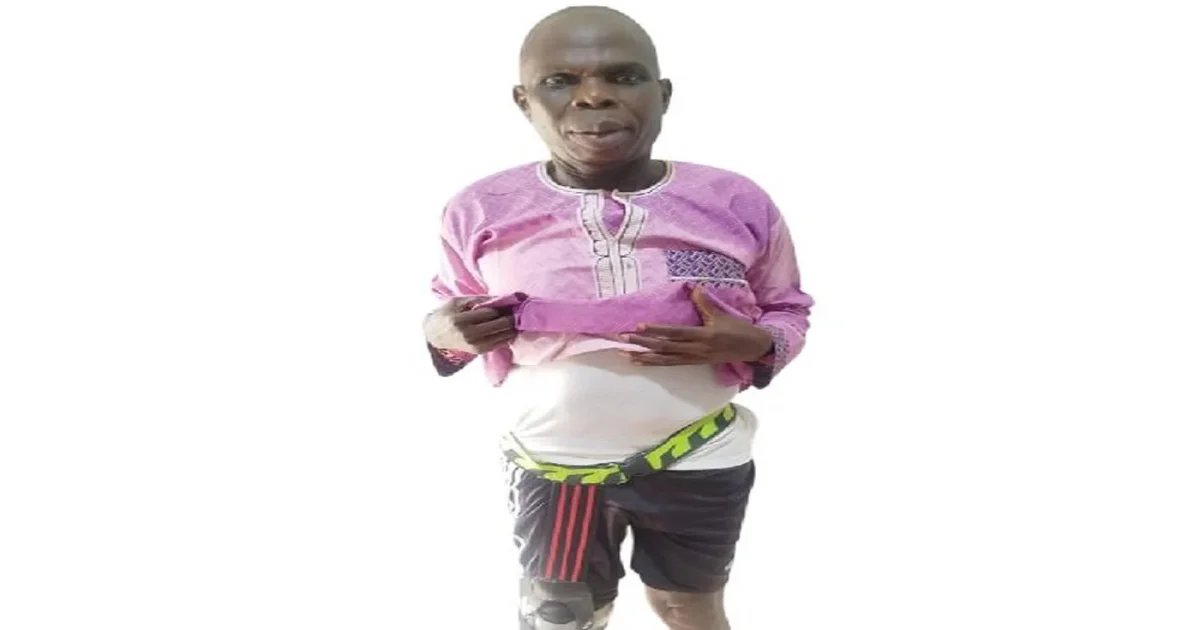
Owolabi Odesanmi, who retired after 35 years of service with the Nigeria Police Force, speaks with PETER DADA about his life as an amputee and his regrets
Tell us a little about yourself.
My name is Owolabi Odesanmi, a retired Superintendent of Police. I retired from the Ondo State Police Command as the Divisional Crime Officer of the Okuta-Elerinla Police Division in Akure. I am from Erinjiyan Ekiti in Ekiti West Local Government Area of Ekiti State, and I am 58 years old.
When did you join the Nigeria Police Force?
I started my police career in July 1990 as a Police Constable. In 1993, I was transferred to the Police Headquarters in Akure, specifically to the Logistics and Supply Department. That was on April 26, 1993.
I was promoted to the rank of Corporal in the Logistics and Supply Unit under the Area Command on August 1, 1994. On March 1, 1997, I was promoted to the rank of Sergeant.
I spent over 10 years as a Sergeant. However, on February 1, 2007, after a 10-year interval, I was promoted to the rank of Police Inspector. I was subsequently confirmed as an Inspector on June 1, 2010. Thereafter, I appeared before the Departmental Selection Board on December 31, 2013, before I was promoted to the rank of Assistant Superintendent of Police.
From the position of ASP, I was promoted to Deputy Superintendent of Police on January 1, 2019, and on May 12, 2022, I was promoted to Superintendent of Police. I retired on that rank on January 1, 2025.
You are an amputee. Did you lose your leg while serving in the police force, or did it happen after your retirement?
I lost one of my legs while serving at the Nigerian Ports Authority Command in Apapa, Lagos.
How did it happen?
It happened on October 5, 2001, almost 25 years ago. I was pursuing a thief in an attempt to arrest him while serving at the NPA Area Command. After the suspect jumped over a trailer and I caught up with him, the trailer suddenly moved and hit me, badly injuring my right leg. It was eventually amputated, and since then, I have been using a prosthetic limb.
Who was responsible for your medical bills and treatment after the accident?
At the time, the Area Commander, the late DIG David Omodola, wrote to the Nigerian Ports Authority on my behalf. The NPA paid me N390,000 as compensation, while the police paid only N34,000 as insurance. Since then, I have received no further support.
They initially provided a prosthetic limb for me, but when it got damaged, I had to buy another one for over N1m. The Port Authority took responsibility at the time, but since then, no additional support has been provided.
The prosthetic limb I am currently using is also in bad condition. How can I save N1m from a monthly pension of N90,000 to buy another one? I am really suffering.
How were you able to afford another prosthetic limb after the first one was damaged, considering it cost N1 million?
I bought it with part of the gratuity I was paid last year.
How much was your gratuity?
I was paid N3,326,046.
How have you been coping with life as an amputee after retirement?
Since I retired on January 1, 2025, the Nigeria Police Force paid me a lump sum of N3,326,046 and has been paying me a monthly pension of N90,802. What I receive as pension is not enough to take care of myself and my family.
I can no longer adequately cater for my children. One of them is still in primary school, another is in secondary school, while two are in the university.
It is very difficult for me to take care of my four children. My pension cannot adequately support my family. As I said earlier, two are in university, one is in secondary school and one is in primary school.
Added to this is the fact that a new prosthetic limb costs about N1m. With a monthly pension of around N90,000, it is practically impossible to save enough money to replace it.
So, what have you been doing for a living since retirement?
I have not been doing anything because the pain from the accident is severe. People around me assist me. I depend on them for support so that I can survive. The N90,000 pension I receive every month does not last two weeks after I distribute it among my children.
We are living like beggars. Honestly, I survive through the assistance of friends, neighbours and well-wishers. I depend on people for support. It is painful because after serving my country for many years, I now live almost like a beggar.
Do you have a house of your own?
I was able to build a house through my efforts and with support from my wife.
What does your wife do?
My wife is a public servant.
What do you think is the problem with the Nigeria Police Force regarding the welfare of retirees?
There is a problem within the police force. There is no unity among us. Even among retirees, some people see our group as rebels against the older sets. Some retired 24 years ago, others 16 years ago, and they believe newer retirees do not have the locus standi to complain.
Why do you think they say that?
They feel they retired before us and are therefore superior. Our national coordinator and I have heard them say they are lobbying through the Director-General of PENCOM and retired DIGs to secure relief from what they describe as the slavery of PENCOM, which they consider obnoxious.
They started that campaign 16 years ago. When we joined them, we experienced the same hardship under PENCOM. If I had retired and was receiving over N300,000 as pension, would that not be reasonable? But you are paying me N90,000. How do you expect me to survive?
What is your grouse against PENCOM?
Many of us consider the system unfair and inadequate. Before retirement, I earned far more than I now receive as pension. It is difficult to survive on N90,000 a month after serving the nation for decades.
What do you think is the way forward?
The way forward is to remove police personnel from PENCOM, as was done for the military, the DSS and the NIA. We want the Police Pension Board Establishment Bill, commonly known as the Police Exit Bill, to be signed into law. The bill has been passed by the National Assembly and only awaits presidential assent.
We are appealing to the President to sign it into law. If we serve the nation in the same way as the military, DSS and NIA, facing similar risks, then we deserve a better retirement package.
In May this year, I learnt that 17 police officers were killed in Borno State. About two weeks ago, two others were killed while escorting the Chief of Staff to the Governor of Anambra State.
Virtually every day, a police officer is either killed or injured in service to the nation. To many foreigners, the police represent Nigeria. Yet after retirement, we are treated in a way that leaves us feeling dejected.
But the Police Exit Bill is already on the President’s table awaiting assent.
Yes, and that is why I am appealing to him. Those who served in Lagos State Command when he was governor spoke highly of him and how supportive he was to officers.
What he did for them as a compassionate governor, he should do for us now. He should not allow their relief to become our suffering. We are suffering. As a result of this hardship, I don’t see myself moving around on crutches and begging. He should help us by signing the bill into law.
My friends in the military told me that none of them received less than N18m or N19m as gratuity when they retired. My rank as a Superintendent of Police is equivalent to that of a Major in the Army, and none of them received less than N23m.
If I had received N23m, I would have been able to take proper care of my family, and my pension would also have been adequate, just as theirs is. They are not protesting because their gratuities and pensions are paid appropriately.
Looking back, how does the Nigeria Police Force of today differ from the force you joined?
When I joined the force, police officers were provided with uniforms, bedding and other essential items. Today, officers often buy uniforms and equipment with their own money. Supplies are inadequate, and many officers struggle to obtain basic kits.
What is your opinion on the welfare of police officers who are still in service?
Their welfare remains poor. Many officers spend their personal money on uniforms, fuel and operational needs. This affects morale and efficiency.
Do you support the creation of state police to address insecurity across the country?
Yes, I believe state police can work if state governments properly fund and supervise them. With adequate resources and accountability, they can improve security and officers’ welfare.
Looking back, do you regret joining the police force?
Honestly, yes. Considering my experience and the treatment of retired officers, I would not encourage my children to join the police.
I served faithfully, suffered a life-changing injury and yet I am struggling to survive after retirement.
However, I will advise my younger colleagues who are still in service to remain diligent and professional in protecting the nation. I also appeal to the government to improve the welfare of both serving and retired officers so that they can live with dignity after years of sacrifice.