
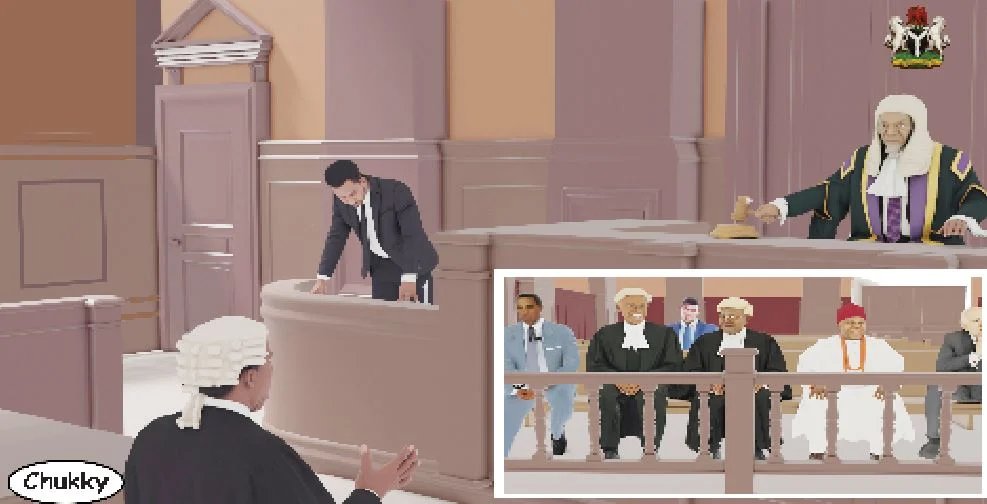
Once regarded as the last hope of the common man, the judiciary is facing growing public distrust amid allegations of corruption, delayed justice, conflicting judgments, and political interference, raising serious concerns about the integrity and independence of the nation’s courts. CHIJIOKE IREMEKA examines the alleged political conviction of Barrister Emeka Ngene and others
Barrister Emeka Ngene’s incarceration echoes a warning about the dangers of politics infiltrating the judiciary, as once expressed by former President of the Court of Appeal, Justice Ayo Salami.
He had warned that while the judiciary is meant to remain the hope of the common man, once politicians penetrate the courts, the institution risks becoming the “hope of politicians” instead.
His position reflects a broader and enduring concern that judicial independence becomes compromised when partisan interests or corruption influence legal outcomes, as was alleged in the case involving Ngene and other alleged victims of judicial misfires.
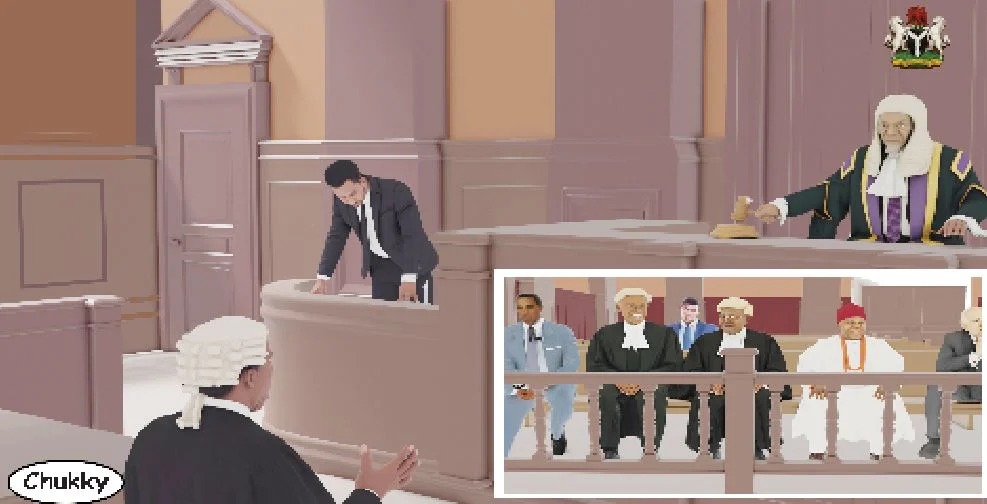
In 2024, Ngene was convicted and sentenced to seven years’ imprisonment by a magistrate’s court sitting in Enugu over allegations of theft and conspiracy involving community funds, at a time when he was on the verge of winning the Enugu South Urban 1 State Constituency seat in the House of Assembly and participating in all reruns ordered by the tribunal.
Elected on the platform of the Labour Party, he was eventually declared the winner by the Independent National Electoral Commission while still in prison, under circumstances that raised troubling questions about justice and cast a shadow over the long-held belief that the judiciary remains the last hope of the common man.
In the words of former Justice of the Supreme Court of Nigeria, Chukwudifu Oputa, “Justice must not only be done but must also be seen to be done.”
Though the dictum was originally laid down by the then Lord Chief Justice of England, Lord Hewart, in Rex v. Sussex, the principle became a cornerstone of Oputa’s judicial philosophy.
The late jurist, widely celebrated as the “Socrates of the Supreme Court,” built a lasting legacy around fairness, transparency, and the humanity of the law.
Explaining what justice means to the accused, the complainant, and society at large, Oputa famously stated, “Justice is not a one-way traffic. It is not justice for the appellant only. Justice is not even a two-way traffic. It is really a three-way traffic.”
He explained that justice for the accused requires that the individual receive a fair hearing and be neither railroaded nor unduly punished, as alleged in Ngene’s case, where claims persist that he was denied a fair hearing because several judges recused themselves.
Oputa also stressed the need for justice for the victim or complainant, whose rights, property, or life may have been violated, as well as justice for society at large, whose values and laws are undermined when wrongdoing occurs.
It is on this tripod of justice that Saturday ’s investigation rests, as it revisits the circumstances surrounding the trial and conviction of Ngene, which were delivered within a short period.
Investigation by Saturday
Judicial experts, who spoke to Saturday said Ngene’s case generated significant anxiety and concern within the judiciary and among residents about the administration of justice, especially with several recusals by judges reportedly assigned to hear the case at the High Court.
A member of Ngene’s legal team, Chief John Okereke, told our correspondent that an appeal had already been filed and that the defence team was awaiting the commencement of the appropriate legal processes.
According to him, the aim was to ensure justice prevails and to establish whether Ngene truly committed the offence for which he was convicted.
He confirmed that although Ngene was sentenced to seven years’ imprisonment, the sentence runs concurrently, meaning he would effectively serve four years before becoming eligible for release.
“Even if he has served out his term, we still need to clear his name at the Court of Appeal to determine whether he actually committed the offence or whether there were ulterior motives behind the conviction,” the lawyer said.
Okereke described the case as “an open secret,” insisting that many petitions written on Ngene’s behalf before and after the conviction received little or no attention.
At one stage, he claimed that multiple judges recused themselves from the matter, further delaying proceedings and prolonging his incarceration.
The allegations
Ngene was first arraigned in 2017 alongside two others by the police in Enugu State over the alleged theft of N15m belonging to the Akwuke community in Enugu South Local Government Area.
He had served as secretary and legal adviser to a sub-committee set up to manage the community’s finances following a leadership crisis that emerged around 2009.
Akwuke is known in Enugu State for sand excavation activities, from which the community generated revenue through tolls paid by tipper drivers.
The heavy movement of trucks reportedly damaged community roads.
According to the handover documents obtained by Saturday , Ngene was directed by the community to pay about N11m to a contractor for road repairs.
However, in 2017, a petition alleging theft and conspiracy was filed against Ngene and his associate, John Ewoh.
Community sources claimed the petition came from members of a rival faction within the community leadership structure.
The police investigated the matter and filed charges against Ngene and Ewoh before a Magistrate’s Court in Enugu State.
Saturday gathered that the case received little attention for several years and was later referred to the Alternative Dispute Resolution mechanism.
It gained renewed attention around mid-2022 when Ngene emerged as the Labour Party’s preferred candidate for the 2023 elections.
The case was initially presided over by Chief Magistrate A.O. Eze, but was transferred to Magistrate E.D. Onwu after Eze’s retirement.
According to an engineer, Uche Anikwu, who followed the proceedings, Ngene’s counsel petitioned the Enugu State Chief Judge for a transfer to another magistrate.
The Chief Judge transferred the case to Magistrate I.M. Mamah on November 9, 2022.
Mamah advised that the matter be settled through ADR.
While the case was still at the ADR stage, another directive reportedly returned it to Magistrate Onwu’s court in 2023.
Ngene’s counsel wrote for clarification over the conflicting directives from the Chief Judge’s office.
When another letter later directed the case back to Onwu’s court, the defence team raised concerns.
Onwu resumed hearing the matter, and the intervals between adjournments became shorter.
Another source familiar with the case, Okechukwu Ogbodo, told Saturday that Ngene’s counsel petitioned the Chief Judge for the magistrate’s recusal and obtained an ex-parte order from the Enugu State High Court directing Onwu to recuse himself.
Ogbodo claimed that despite the order and a later communication from the National Judicial Council, Magistrate Onwu proceeded with the trial.
He alleged that attempts to obtain the original High Court order faced delays, including a missing file.
It was also gathered that the Akwuke Town Union, the named complainant, had written to withdraw the case, but the magistrate insisted that only the State Attorney-General could discontinue the matter.
On June 28, 2024, Magistrate Onwu sentenced Ngene and John Ewoh to seven years’ imprisonment each, four years for theft and three years for conspiracy.
Protesters accuse govt of complicity
Ngene’s continued incarceration sparked protests by residents of Enugu South Urban 1 Constituency.
On August 25, 2025, they stormed the International Conference Centre, Enugu, venue of the Nigerian Bar Association conference, demanding his release.
The protesters accused the state government of complicity in his prolonged detention. They claimed his incarceration was linked to his refusal to defect to the Peoples Democratic Party.
Carrying placards with inscriptions such as “NBA Please Save Our Democracy” and “Enugu State Judiciary Must Be Independent from the Executive,” the protesters called on the judiciary and the NBA to protect democratic mandates.
Speaking on behalf of the protesters, Benedict Kachukwu said Ngene had been in detention since July 28, 2024, and appealed for his release so he could represent the people who elected him.
Ngene’s supporters and some Labour Party members claimed that the reactivation of the case shortly after he emerged as the party’s candidate raised questions about possible political influence.
However, the Nigerian Bar Association Fact-Finding Committee, which investigated the matter, stated that it found no evidence of direct executive interference in the judicial process.
The committee attributed the multiple recusals by judges primarily to security concerns.
NBA’s intervention
Following the protest, the NBA set up a committee to investigate the prolonged delays in Ngene’s appeal.
In a statement, Mr Sabastine Anyia, 1st Vice President of the NBA and Chairman of the NBA Human Rights Institute, expressed concern over the delays caused by the repeated recusals of judges.
“Three judges of the Enugu State Judiciary, at different critical stages, withdrew from hearing Ngene’s appeal,” he noted in a statement.
Anyia described the situation as distressing and called on lawyers to defend the rule of law, warning that “justice delayed is justice denied.”
Fact-finding committee engages stakeholders
Subsequently, the National President of the NBA, Mazi Afam Osigwe, constituted a seven-member fact-finding committee at the NEC meeting of February 5, 2026, to investigate the matter and engage relevant stakeholders.
The committee was set up following a report presented by the chairman of the Enugu State Branch during the NBA NEC meeting held in Maiduguri, Borno State.
The committee included Sammie Somiari, SAN, as chairman; Osato Uwagboe as secretary; Musa Attah, SAN; Abdul Mohammed, SAN; Emeka Obegolu, SAN; Chidi Aroh; and Venatius Odo as members.
It was tasked with examining the circumstances surrounding the recusal of judges from the case.
On February 18, 2026, according to information obtained by Saturday , the committee visited Enugu State and held meetings with the Chief Judge and other judicial officers who had previously recused themselves from the matter.
The committee also met with the state governor, the Attorney General, and the Chief of Staff to seek clarification on whether there was any external influence on the case.
However, it reported that it did not find evidence of undue influence.
The committee further visited Ngene at the Nigerian Correctional Service facility, where he allegedly raised concerns about procedural aspects of his trial, confirmed that he had filed an appeal and an application for bail pending appeal, and expressed concern over delays in the hearing of the matter.
In a report signed by the committee secretary, Osato Uwagboe, the judiciary informed the committee that the “multiple recusals and reassignments in the matter were largely due to perceived threats and security concerns.”
While acknowledging these concerns, the committee noted that “the repeated recusals and reassignments had not only caused delay but had also created public concern regarding the administration of justice in the case.”
The committee further reported that the Chief Judge categorically stated that no directive was received from the Executive Governor or any member of the executive council concerning the matter.
It urged relevant authorities to ensure that further delays are avoided and resolved to maintain a watching brief on the matter in the interest of justice and professional accountability.
NBA explains intervention
Speaking on the matter, NBA President Osigwe told Saturday that the association intervened due to the delay and to understand the reasons behind the recusal of judges.
“We didn’t intervene because he is our colleague. We didn’t intervene to stop the judicial proceedings. We came in to understand why the case was being delayed and to ensure that justice was served.
“At the end, we were able to follow up on the process, and the case was assigned to a judge,” he said.
Corroborating him, the Enugu NBA Chairman, Venatius Odo, said the association became involved after judges began recusing themselves from the matter.
“So when we intervened, the High Court heard the case and delivered judgment upholding the Magistrate Court’s decision. The parties, however, still have the option of approaching the Court of Appeal and, if necessary, the Supreme Court,” he said.
On allegations of executive interference, he said, “People who do not fully understand how the courts work may draw different conclusions. If there was any wrongdoing, the appellate courts would address it. I was part of the fact-finding committee that investigated the matter, and we did not find evidence that anyone influenced the trial or conviction,” he added.
When asked about the basis for public suspicions, Odo said, “We will not say the process was perfect, but we cannot conclude that there was pressure on the magistrate or judges, as we were not directly involved in the proceedings.
“I can only speak to what we established during our review. I became aware of the matter when the NBA was informed that judges were recusing themselves.”
LP lawmakers react
While Ngene’s kinsmen called for his release, insisting that the matter had been resolved within the community and should not have been reopened years later, Labour Party lawmakers faulted the trial process and called for his release.
During their visit to Ngene, the senator representing Enugu East Zone, Kelvin Chukwu, said the case had been inactive for several years before it was revisited.
He also expressed concerns about aspects of the proceedings and called for a review of the case.
Also, a House of Representatives member under the LP, Sunday Umeha, described the trial as “politically sensitive” and called for due legal consideration.
He noted that they had carefully studied the circumstances leading to the court’s decision and compared them with relevant extant laws.
Judgment in limbo
However, if ultimately overturned by the Court of Appeal or the Supreme Court, the outcome may be comparable to past electoral justice reversals, such as the Anambra case, in which Peter Obi reclaimed his mandate after a court decision.
A legal expert, Lawrence Ndukwe, said if the appellate courts discharge Ngene, he may explore available legal remedies regarding his position, in line with applicable legal precedents.
State keeps mum
Meanwhile, efforts to reach the Enugu State Commissioner for Information and Strategy, Dr Malachy Agbo, were unsuccessful, as his calls went unanswered.