
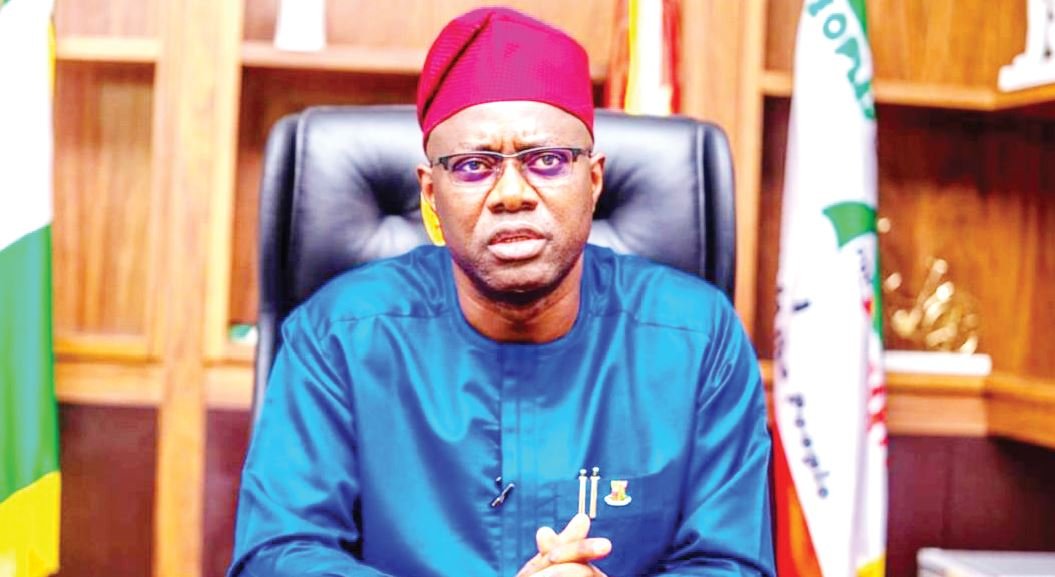
Controversial remarks by Oyo State Governor Seyi Makinde referencing the 1960s “Operation Wetie” crisis have triggered fresh concerns over rising political tension ahead of the 2027 general elections, with stakeholders warning that inflammatory rhetoric and deepening mistrust could endanger Nigeria’s democratic process. ISMAEEL UTHMAN writes
oyo State Governor Seyi Makinde has stirred a hornet’s nest in the country’s political space following his remarks at the Ibadan opposition summit on April 25, where he warned that those acting “as if there’s no tomorrow should remember that ‘Operation Wetie’ started from here. This is the same Wild Wild West.”
The comment, delivered at a gathering designed to strengthen opposition collaboration ahead of the 2027 general elections, has since dominated political discourse, overshadowing the summit’s central objective of forging a united front against President Bola Tinubu and the ruling All Progressives Congress.
The Ibadan summit brought together key opposition figures seeking to explore alliances, coordinate strategies, and possibly agree on a unified presidential candidate capable of challenging the dominance of the APC in 2027.
Yet, beyond the politics of coalition-building, it was Makinde’s reference to one of the country’s most violent political episodes that provoked debate days after the event.
For many observers, the remark encapsulates a deeper anxiety about the country’s political trajectory—one marked by growing desperation across party lines, declining trust in democratic institutions, and rising tension within both ruling and opposition camps.
Operation ‘Wetie’
Makinde’s reference to Operation ‘Wetie’ was not casual. It evoked a period widely regarded as one of the darkest in Nigeria’s democratic evolution.
Eighty-year-old elder statesman and former ambassador to the Philippines, Yemi Farounbi, provided historical context, recalling that Operation ‘Wetie’ crisis did not begin with the 1964 and 1965 elections but had deeper roots.
“The crisis of Nigeria started immediately after independence, arising from the intolerance of the Federal Government,” he said.
According to him, the political leadership at the centre, dominated by the Northern People’s Congress, was determined to weaken the opposition Action Group, which controlled the Western Region.
Farounbi listed a chain of actions that intensified the crisis: the declaration of a state of emergency in the Western Region, the Coker Commission of Inquiry, and the arrest and eventual imprisonment of Chief Obafemi Awolowo on charges of treasonable felony.
He added, “All of that incapacitated the Action Group that was the only opposition party. That action broke the unity that existed within the NCNC and NPC in the Federal Government.”
The ex-diplomat further explained that the 1964 general election “almost ended in a stalemate” due to what he described as a partisan electoral commission, while the 1965 Western Region election deepened the crisis.
“The electoral commission made sure that the opposition were not able to receive nomination papers and ended up declaring candidates of the government in power as unopposed,” he said.
The aftermath was violent and prolonged.
According to Farounbi, the civil uprising was called Operation ‘Wetie’.
“That means ‘wet the houses’ of those either in government or those in electoral management who made it impossible for the opposition to have political space,” he added.
The violence, which involved arson and widespread unrest, lingered even after the military coup of January 1966, leaving a legacy that continues to shape the country’s political consciousness.
Mixed interpretations
Makinde’s remarks have since generated sharply divided reactions.
The APC was quick to condemn the statement, describing it as “reckless” and “incendiary.” The party warned that invoking such a violent historical episode could inflame tensions and destabilise the polity.
It urged political leaders to “refrain from making statements capable of heating up the polity,” stressing that responsible leadership requires restraint, especially as the country approaches another election cycle.
The National Secretary of the APC, Ajibola Basiru, dismissed any comparison between the present situation and the 1965 crisis.
“Wetie crisis occurred in the context of a disputed election. It came after the election had been concluded. Currently, we are in the electioneering process; people are just contesting for power from different political parties. There’s no parallel between what is currently happening in Nigeria now and the ‘wetie’ crisis,” he said.
Basiru attributed Makinde’s statement to political frustration.
“For a governor to be making inciting comment shows frustration and political desperation,” he said.
But not all interpretations align with the APC’s position. Within opposition circles and among some analysts, the remark is seen as a cautionary reference rather than an incitement.
Farounbi, in his interpretation, suggested that current political developments bear resemblance to the patterns that led to the First Republic crisis.
He pointed to what he described as the “destabilisation of opposition parties,” alleging that the federal government has played a role.
“The president himself said he could send the Senate President to the opposition party to destabilise them. That is an indication that the government has hands in the crises rocking all the opposition parties. The political space is being mortgaged and the opposition parties are struggling to operate.”
For him, Makinde’s comment should be understood within this broader context.
“I guess what Governor Makinde was saying was that we have seen the intimidation and the decapitation of the opposition before… and that the result at that time was a civil uprising. We need to avoid the repeat of that situation,” he added.
This perspective underscores a growing concern among sections of the political class that the country’s democratic space may be narrowing, with implications for the credibility of future elections.
The controversy also feeds into a wider debate about the risks of one-party dominance.
A former presidential aide, Reuben Abati, in an article titled “The Ibadan Summit, Opposition Politics and 2027,” warned against the suppression of opposition voices.
“President Tinubu may want the APC to win in all the South-West states in the 2027 elections, but it is not always easy to manipulate the South-West. Yoruba people can be treacherous. There is danger in one-party domination, and the suppression of the opposition,” he wrote.
Abati’s argument resonates with those who see Makinde’s remark as a signal of deeper unease within the opposition about the balance of power heading into 2027.
Defence from Oyo Government
Amid the backlash, the Oyo State Government has moved to clarify the governor’s position.
The Commissioner for Information, Dotun Oyelade, insisted that Makinde’s statement was misinterpreted.
“Governor Makinde is not a violent person; everybody knows that in the past seven years,” he said.
“So, if he speaks to a historical fact by referencing the unfortunate event that happened in 1965, it is just to call the attention of leaders who should be students of history, not to provoke the possibility of that incident,” he said in an interview with Sunday .
Oyelade maintained that the remark was intended as a caution, not a threat.
“It is a fact that it happened. That is exactly what he did. He doesn’t incite violence,” he added.
Afenifere weighs in
The National Publicity Secretary of Afenifere, Jare Ajayi, offered a broader interpretation, framing the remark as a message to the political class.
“It is interesting and perhaps even pertinent to remind us of what happened in 1965–66 with the violence called wetie,” he said.
Ajayi, while speaking with Sunday emphasised that the original crisis was triggered by public anger over perceived electoral injustice.
“People considered the election rigged… the result they were hearing was totally different from the votes they cast,” he noted.
For him, Makinde’s comment serves as a warning that history could repeat itself if political actors fail to act responsibly.
“Politicians should conduct their businesses in a peaceful way and should not encourage thuggery, and do not provoke the people to the extent of going into violence,” he said.
Ajayi added that the warning should be taken seriously by the political elite.
“They should look inward, they should be more circumspect and know when the roof is about to cave in… every step must be taken to ensure that the roof does not fall,” Ajayi cautioned.
Rhetoric and rising tension
Beyond the immediate controversy, Makinde’s remark highlights a broader trend: the increasing intensity of political rhetoric as the 2027 elections approach.
Across party lines, language is becoming more combative, reflecting the high stakes of the next electoral cycle. With opposition parties exploring coalition strategies and the APC seeking to consolidate power, the political environment is becoming more charged.
A week after Makinde’s outburst, the Secretary of the Board of Trustees of the New Nigeria People’s Party, Buba Galadima, on Saturday called for voters to approach polling units with kerosene and bottles to protect their votes in the 2027 elections.
“…………..And during the elections, whether I am alive or dead, go to the polling centres with your bottles and jerry cans of kerosene. Either they do what is right, or we all die there. So there will be no beneficiary,” he said at a stakeholders’ meeting organised by the Obi-Kwankwaso Movement in Abuja.
Analysts warn that such rhetorics, whether intended as metaphor or warning, carry risks in a country with a history of electoral violence.
The line between mobilisation and incitement, they argue, is thin—and easily crossed in a heated political atmosphere.
Lessons from history
The enduring relevance of “Operation Wetie” lies in its lesson: that political exclusion, electoral manipulation, and intolerance can trigger consequences far beyond the control of those who initiate them.
Makinde’s remark, regardless of interpretation, has reopened that conversation—forcing Nigerians to confront uncomfortable questions about the state of their democracy.
Are the conditions that led to the crisis of the 1960s truly absent today, as some argue? Or are there early warning signs that demand attention?
As the country moves closer to 2027, these questions will become increasingly urgent.
For now, the debate sparked by a single remark serves as a reminder that in Nigeria’s politics, history is never too far away—and the future may depend on how well its lessons are heeded.
An American-British poet, T.S. Eliot, in his Burnt Norton poem said, “Time present and time past are both perhaps present in time future, and time future contained in time past.” This means that history has a way of repeating itself if you allow the same circumstances to happen.”