
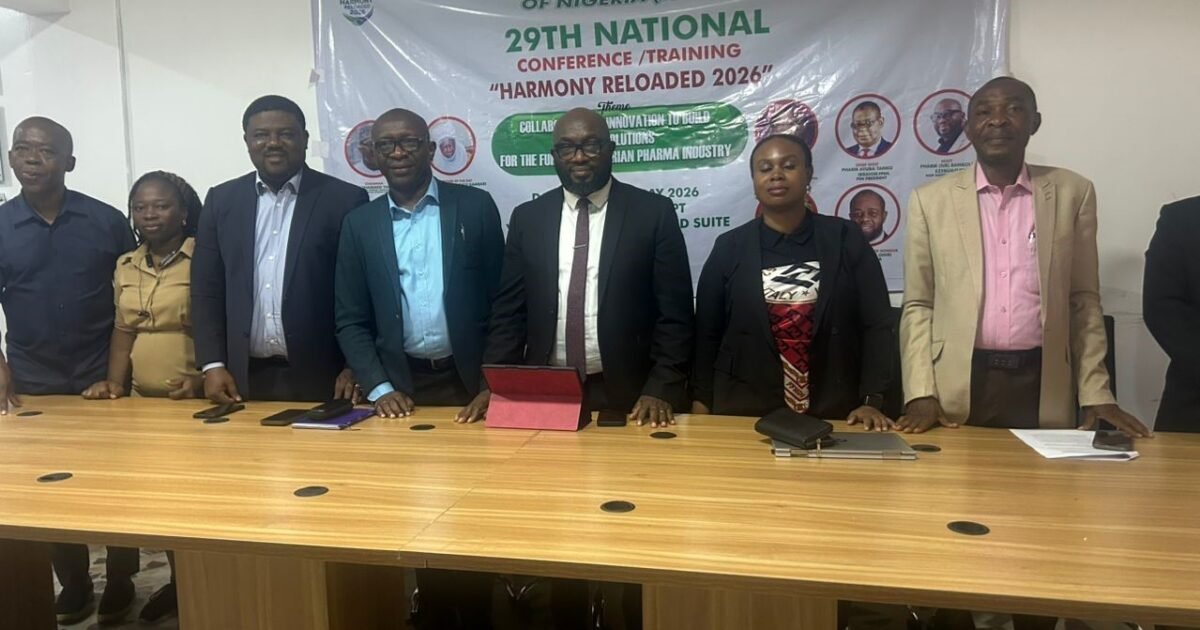
The Association of Industrial Pharmacists of Nigeria has called for deeper collaboration among industry players, regulators and investors to strengthen local pharmaceutical manufacturing and reduce the country’s growing dependence on imported medicines.
The association made this known on Tuesday at a press conference in Lagos, where it announced its 29th Annual National Conference and Training, scheduled to hold in Ilorin, Kwara State.
The chairman of the association, Pharm Bankole Ezebulu, said the four-day event, themed “Collaboration and Innovation: Building Local Solutions for the Future of the Nigerian Pharmaceutical Industry,” would bring together government officials, regulators, investors, academics and pharmaceutical stakeholders from within and outside Nigeria to confront persistent weaknesses in the sector.
He identified import dependence, inadequate local manufacturing capacity and weak research and development as the key challenges requiring urgent collective action.
Ezebulu said the conference was structured to go beyond discussion, with training sessions designed to send delegates back to their companies equipped with skills that could translate into measurable improvements in productivity and compliance.
He stated, “My administration remains firmly committed to building a stronger pharmaceutical workforce by bridging critical knowledge gaps through intentional and sustained capacity building. This is a four-day, training-focused conference designed not just to inform, but to equip.
“We are privileged to host distinguished experts from across the pharmaceutical industry, drawn both locally and from the diaspora. They bring global perspectives and practical experience that will strengthen our collective capacity.”
Asked how the impact of the conference would be measured, particularly given the federal government’s drive to curb pharmaceutical imports and grow regional manufacturing, Ezebulu said outcomes would be visible in workforce competence and productivity levels across member companies.
He said the training effort would not be confined to the annual conference but sustained through continuous professional development tied to mandatory CPD points under the Pharmacy Council of Nigeria.
He added that the association’s regulatory teams conduct routine visits to member factories to identify compliance gaps and assess training outcomes.
Former chairman of the association, Pharm Charles Ajibo, said Nigeria currently produces only about 30 per cent of its pharmaceutical needs locally, but expressed cautious optimism that the figure could climb significantly within five years.
He said nearly 50 companies had in recent years moved from importation into domestic manufacturing and that supporting those operators through their early-stage challenges was central to the conference’s purpose.
“Our conferences are not jamborees. We don’t finish and go. In the past two or three years, the emphasis has been on scaling up and equipping the local industry so we will have pharma sovereignty. Nearly close to 50 groups have transitioned from importation to setting up local manufacturing. This training is to ensure they have the capacity and the team to run those factories successfully,” he said.
The Chairman of the Conference Planning Committee, Pharm Theophilus Adimoha, said the training was particularly timely given the evolving regulatory landscape, noting that the National Agency for Food and Drug Administration and Control was advancing toward higher global regulatory maturity levels that local operators must be prepared to meet.
“The regulatory space is shifting. The idea of this training is to bring global brands and professionals who will show us in Nigeria what the global world is, so that we are matching with where the world is moving,” he said.
The association’s Technical Director, Richard Ladapo, said the body had been working with manufacturers and distributors across the country to improve production processes, warehousing standards, supply chain management and quality assurance protocols.
He said one of the conference sessions would focus specifically on preparing operators for regulatory inspections.
On the sidelines of the conference, the association plans to hold a free medical outreach at the Emir’s Palace in Ilorin, commission a renovated health centre and donate medicines valued at over N5m to the host community.
Nigeria’s pharmaceutical manufacturing sector has faced structural challenges, including inadequate infrastructure, limited access to financing, a shortage of locally sourced active pharmaceutical ingredients and a workforce gap in specialised industrial pharmacy skills.
These constraints have slowed the pace of growth despite growing domestic demand driven by a population of over 200 million people.