
Stakeholders have stressed the need for early cancer detection and prompt treatment, warning that delays in diagnosis and access to care could reduce survival chances and worsen the growing burden of the disease.
They explained that while cancer is not a death sentence, delayed diagnosis and treatment, and inadequate awareness could undermine treatment outcomes and efforts to save lives in Nigeria.
They said preventive healthcare, early detection and timely medical intervention were critical to reducing the country’s growing cancer burden.
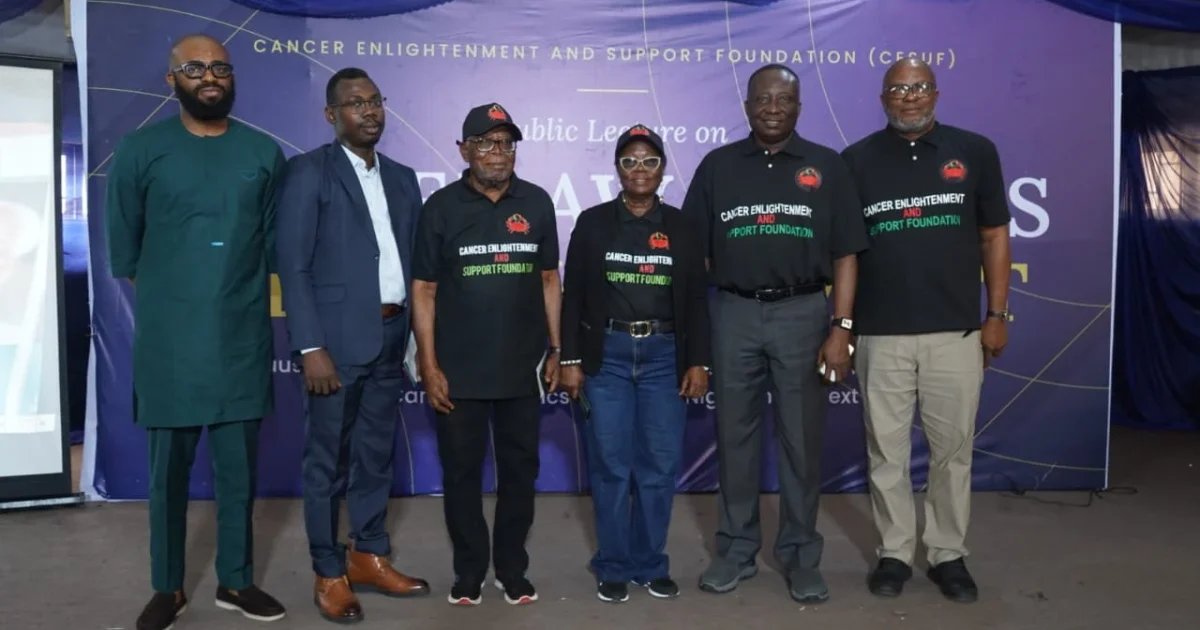
The stakeholders disclosed these at the annual public lecture of the Cancer Enlightenment and Support Group held in Lagos with the theme, ‘Cancer Awareness and Enlightenment: Causes, Prevention, Early Detection and Intervention, with Emphasis on Cancer Statistics within the Nigerian Context.’
According to the Global Cancer Observatory 2022, Nigeria had 127,763 new cancer cases, 79,542 deaths, and 269,109 prevalent cases in five years.
The World Health Organisation says prostate, breast, cervical, colorectal, and liver cancers are the leading cancers among males and females in the country.
Speaking at the event, the Chairman of CESG, Rev. Tony Akinyemi, said ignorance, late detection, and financial constraints were among the major factors contributing to cancer-related deaths in the country.
“People are losing the battle against cancer for two major reasons. Number one, lack of early information and detection, and two, lack of timely intervention or financial access to care,” he said.
“Many Nigerians are simply unaware of preventive lifestyle choices. Many are insensitive to early cancer warning signs, while others hold back because of fear and misconceptions. By the time many seek medical help, the disease has often advanced to late stages, where treatment options become limited, agonisingly expensive and painful,” he added.
Akinyemi, who stressed that cancer education should extend beyond hospitals to homes, workplaces, religious institutions and communities, said CESG was committed to promoting awareness, supporting affected families and advocating improved access to cancer treatment.
In his keynote lecture, a Consultant Radiation and Clinical Oncologist at Lagos State University Teaching Hospital, Ikeja, Dr Ademola Oyekan, said cancer develops when normal cells lose their ability to regulate growth and begin multiplying uncontrollably.
He explained that cancer was not a single disease, noting that different types had different causes, risk factors and treatment approaches.
Oyekan identified breast cancer, prostate cancer, colorectal cancer, cervical cancer and liver cancer among the major cancers affecting Nigerians.
He said cancer development was influenced by a combination of biological, genetic, environmental, infectious and lifestyle factors, warning that the absence of obvious risk factors did not mean an individual was immune to the disease.
“Smoking, whether primary or secondary, increases the risk of cancer. Tobacco contains thousands of cancer-causing substances, and the exposure is harmful even to people who do not smoke directly,” he said.
Oyekan also identified excessive alcohol consumption, obesity, physical inactivity, unhealthy diets and exposure to workplace carcinogens as factors that could increase cancer risks.
The cancer expert called for increased uptake of human papillomavirus vaccination to prevent cervical cancer, as well as hepatitis B vaccination to reduce the risk of liver cancer.
He urged Nigerians to undergo appropriate screening, maintain healthy lifestyles, and seek medical attention whenever they notice unusual changes in their bodies.
Earlier, the founder of CESG, Elder Adegboyega Adepitan, shared his experience as a cancer survivor, recounting how an initial diagnosis of high cholesterol delayed the discovery of his condition.
Adepitan said he eventually sought a second medical opinion following his wife’s intervention, leading to a cancer diagnosis that required him to travel to India for treatment.
He disclosed that he underwent surgery followed by 12 rounds of treatment, describing early intervention, financial support and access to reliable information as critical to surviving the disease.
“People should pay attention to every slight change in their bodies and seek medical attention. If you go somewhere and you are not satisfied, get a second opinion until you receive the correct diagnosis and treatment.
“Cancer is not a death sentence. What causes deaths is delayed treatment,” he said.
He explained that the experience motivated him to establish the organisation to support cancer patients, particularly those unable to afford treatment.
According to him, the foundation has been able to help over 100 people over the years.
“More importantly, people need information. They should know the causes, the risk factors, and where to go when they have problems,” he said.
A cancer survivor, Akintunde Oluwatosin, who said he had lived with the experience for 19 years, also urged Nigerians not to engage in self-diagnosis or self-medication.
He described his recovery journey as difficult but encouraged patients to seek professional medical assistance whenever they noticed unusual symptoms.
The event also featured a panel discussion on ‘Access to Cancer Care in Nigeria: What Is Available, Affordable and Achievable’, which examined treatment options, health insurance coverage and support schemes available to patients.