
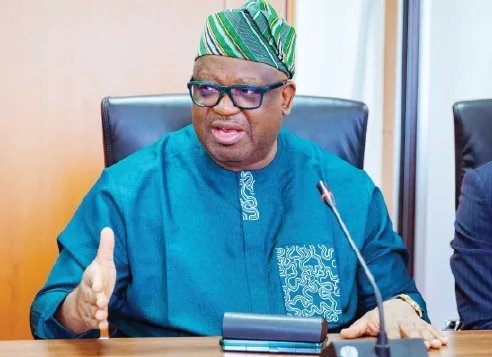
Plateau State Governor, Caleb Mutfwang, on Tuesday received the preliminary report of the 14-member Advisory Committee on State Police at the Rayfield Government House, Jos, expressing confidence that a well-structured state policing system would address the state’s security challenges.
The committee was inaugurated by the governor in March 2026, under the chairmanship of retired Deputy Inspector-General of Police, DIG Habila Joshak, to undertake a comprehensive review of the legal, operational and institutional frameworks necessary for the establishment of a decentralised policing structure in Plateau State, in alignment with ongoing national security reforms.
Receiving the report, the governor, who was represented by his deputy, Josephine Piyo, expressed sincere appreciation to the chairman and members of the committee for the dedication, diligence and sense of responsibility demonstrated in undertaking the assignment.
“The presentation of this preliminary report marks a significant step in our collective determination to strengthen the security architecture of Plateau State.
“We recognise that the security challenges confronting our state require thoughtful, innovative, and sustainable solutions, anchored on effective collaboration between government, security institutions, and the communities we serve,” she said.
She said the decision to establish the committee was informed by the conviction that security must be responsive to local realities.
“We believe that a well-structured, professional, and accountable state policing system, operating within the framework of the constitution and the laws of the Federal Republic of Nigeria, could provide an additional layer of security and improve our capacity to protect lives and property,” she said.
“I wish to emphasise that our interest is not merely in establishing another security institution, but in building a system that commands public trust, respects human rights, promotes professionalism, and remains accountable to the people,” she said.
She assured the committee that the preliminary report would receive the necessary attention and consideration.
“We will carefully examine its recommendations and pursue further consultations with relevant stakeholders to ensure that whatever framework eventually emerges is inclusive, practical, and sustainable,” she said.
She also appreciated traditional institutions, civil society organisations, security agencies and other stakeholders who contributed their perspectives to the process.
“As a government, our commitment to the safety and well-being of every resident of Plateau State remains unwavering. We will continue to explore every legitimate opportunity to strengthen our security institutions and restore lasting peace across our communities.
“Once again, I commend the committee for its work and formally acknowledge the receipt of this preliminary report,” she said.
Presenting the report, the chairman of the committee, DIG Habila Joshak (retd.), said the committee was inaugurated on March 10, 2026, and charged to design a comprehensive, actionable and sustainable framework for a Plateau State Police Service, in anticipation of the ongoing amendment of Sections 214 to 216 of the Constitution.
“On behalf of every member, it is my honour to report that we have discharged that mandate,” Joshak said.
He said the committee worked through seven sub-committees and took consultations to the people, convening town hall meetings in Shendam, Pankshin and Jos. It also consulted the State House of Assembly, all 17 local government chairmen, the Traditional Council, Federal security agencies and development partners.
“The verdict was clear. Stakeholders across the Northern and Central Zones recorded 100% support for a Plateau State Police Service, on the firm condition that it is never used for political intimidation, ethnic or religious bias, or human rights abuse,” he said.
Joshak said the report rests on seven pillars: a ready-to-enact legal framework; a zonal and divisional command structure supported by 24/7 operations; recruitment with a 30 to 40% gender quota; a politically insulated training system; an independent, civilian-majority Police Service Commission for accountability; synergy with the Nigeria Police Force and sister agencies; and a phased implementation roadmap.
“The roadmap proposes the recruitment of 5,000 to 7,000 personnel, with pilots in flashpoint areas before statewide rollout,” he said.
He added that the committee’s work was not yet complete and that it stood ready to continue refining its proposal and the draft legislative instrument as the constitutional amendment process unfolded, so that Plateau State would be prepared when it concluded.
“It is now my distinct honour to formally present the preliminary report and strategic proposal for the establishment of the Plateau State Police Service,” Joshak said.
Addressing journalists after the report presentation, the State Attorney-General and Commissioner for Justice, Philemon Daffi, SAN, said the presentation of the report underscored the landmark significance of the exercise.
“For the government and people of Plateau State, the establishment of State Police is not a theoretical concept. It is a practical, urgent necessity, born out of our local security realities and the present demand for responsive, community-centred policing,” Daffi said.
He said the committee’s mandate included examining Nigeria’s constitutional and legal framework, reviewing national policy proposals, assessing Plateau State’s peculiar security challenges, conducting a feasibility study on the operational viability of a State Police Service, and recommending standards for recruitment, training, discipline and inter-agency coordination with Federal security institutions.
“Through this work, Plateau State stands as the first state in Nigeria to make concrete, structured progress towards operationalising State Police, having already produced preliminary sub-committee findings alongside drafts of the Plateau State Police Service Establishment Law 2026 and the Plateau State Police Service Regulation 2026,” Daffi said.
He said the milestone was anchored in an inclusive, wide-ranging consultative process involving traditional rulers, the Plateau State House of Assembly, existing security institutions and relevant Federal authorities, with grassroots consultation ongoing across all 17 Local Government Areas.
“This initiative is a core component of Governor Caleb Mutfwang’s vision for effective policing in Plateau State — one aimed at deepening community security, promoting professionalism and neutrality, and guaranteeing lasting peace for socio-economic growth,” he said.
Daffi, however, noted that the state government remained firmly committed to constitutional order and was awaiting the enactment of the enabling constitutional amendment by the National Assembly, as well as the overarching national policing framework, which would determine the exact next steps and rollout by the state.
He encouraged citizens, civil society organisations, traditional institutions and community leaders across the 17 Local Government Areas to continue participating constructively as the consultative process advanced.