
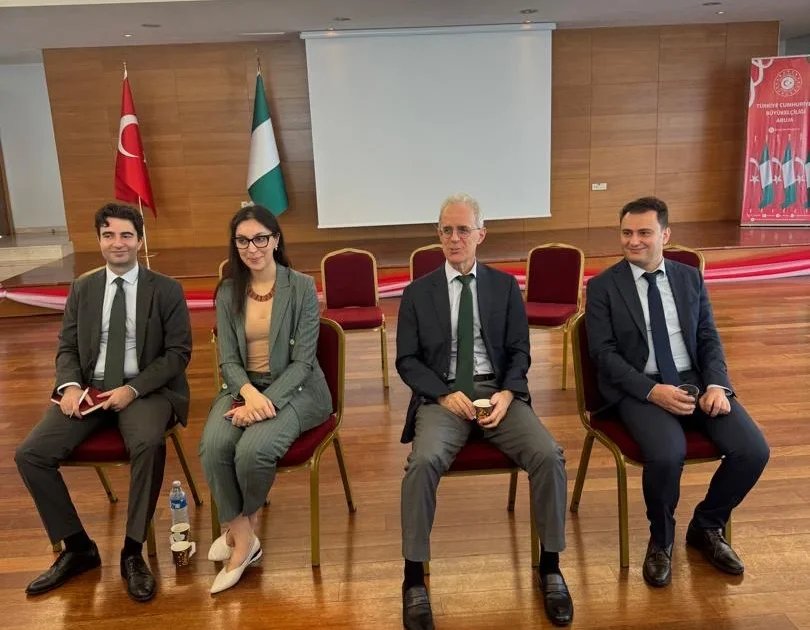
Turkiye is planning to establish local defence production facilities and military training centres in Nigeria as part of efforts to strengthen security cooperation and increase bilateral trade from its current $2bn to $5bn.
The Turkish Ambassador to Nigeria, Mehmet Poroy, disclosed this on Monday in Abuja during a press briefing to commemorate the 66th anniversary of diplomatic relations between the two countries.
Poroy said the proposed defence production facilities would enable Turkiye to move beyond supplying military equipment to Nigeria to supporting local manufacturing.
He said the plan formed part of efforts to implement agreements reached during President Bola Tinubu’s visit to Turkiye earlier in the year, which was attended by nine Nigerian ministers and resulted in the signing of nine agreements and memoranda of understanding.
“We are planning to have some local production unit also in that context, not only selling to Nigeria, the tools, equipment, that arms that it needs, but also the possibility of having local production here in Nigeria,” he said.
On military training, the ambassador disclosed that 200 Nigerian special forces personnel were undergoing a two-month training programme in Turkiye, adding that plans were underway to establish a training facility in Nigeria.
“Actually, 200 Nigerian special forces personnel are in Turkey. They are finalising their two months’ training activity there.
“And after that, as the Honourable Minister of Defence already made it public, we are planning also to have a local training facility here in Nigeria. Not all the military people will be carried to Turkey, but in the presence of some Turkish officers to train them, we will have a continuous training activity for the Nigerian Army,” he stated.
Poroy said Turkiye was willing to share its experience in combating terrorism with Nigeria, noting that his country had lost more than 40,000 people in its 40-year fight against terrorism and spent billions of dollars tackling the menace.
He said terrorism required more than military solutions because of its economic and religious dimensions.
“We have lost more than 40,000 people and have spent billions of dollars in our fight against terrorism. So, we know how difficult this is, to tackle all this issue. It’s very complicated, not only a military issue; there are other aspects, economic or religious. So, we are in consultations with the Nigerian side in order to share our expertise on the issue,” he said.
The envoy identified defence cooperation as a major area of bilateral relations, noting that the Nigerian military was already using Turkish attack helicopters and drones in operations against insecurity, particularly in northern Nigeria.
On economic relations, Poroy said both countries were targeting $5bn in bilateral trade, compared with the current volume of approximately $2bn, including oil and gas.
He described the existing trade volume as inadequate, considering Nigeria’s economic potential, adding that Turkiye’s total trade with African countries stood at about $37bn.
“The instruction is the goal is to have $5bn bilateral trade. So far, it is around $2bn, including oil and gas. When you see the huge Nigerian economy, $2bn is not something so important,” he said.
Poroy further disclosed that Turkish investments across Africa exceeded $10bn, while investments in Nigeria remained below $1bn, highlighting the need to attract more Turkish businesses into the country.
He said he visited the Abuja Chamber of Commerce and Industry on Monday alongside the Turkish Commercial Counsellor to discuss ways of expanding trade and investment.
He added that he had held similar engagements with chambers of commerce in Kano, Kaduna and Lagos.
The ambassador said the embassy was also facilitating visa procedures for Nigerian businesspeople to encourage direct business engagements between the private sectors of both countries.
“From our side, we also facilitate the visa procedures for businesspeople because without B2B contact, you cannot increase all these relations,” he said.
On humanitarian cooperation, Poroy disclosed that the Turkish Government had provided food assistance to 3,000 internally displaced families in Adamawa State.
He also said Turkish non-governmental organisations, including the Turkish Religious Affairs Foundation, spent about $5m on humanitarian interventions in Nigeria within the last year, particularly food donations and meat distribution during Ramadan and Eid-el-Adha.
“Last year, this foundation and other NGOs in total, I’m talking about the last year, they spent $5m for the donation or the sacrifices, you know, during the Ramadan or after Eid-el-Adha, for meat. They were distributing meat to the people in need,” he said.
The ambassador said Turkiye would continue its humanitarian interventions, possibly through a more structured arrangement with Nigerian authorities to improve coordination.
Earlier, Poroy traced the historical ties between both countries to the 16th century, when the Ottoman Empire maintained diplomatic correspondence with the Kanem-Borno Sultanate.
He said historical documents retrieved from Ottoman archives showed that the Ottoman Sultan recognised the sovereignty of the Kanem-Borno Sultanate and directed officials to treat its representatives as friends and protect delegations travelling to Istanbul and those undertaking pilgrimages.
He also cited the Shitta-Bey Mosque in Lagos as another historical connection, saying the Ottoman Sultan sent a representative to its opening ceremony towards the end of the 19th century and conferred the title of Bey on its owner, Shitta.
Poroy clarified that November 9, 1960, marked the elevation of diplomatic relations between Turkiye and Nigeria to ambassadorial level, barely a month after Nigeria gained independence on October 1, 1960.
He said Turkiye had established a Consulate-General in Lagos on April 19, 1959, while Nigeria was still under British colonial administration, but the first Turkish ambassador arrived in 1962.
The envoy described Nigeria as a strategic partner because of its importance to security, stability and economic development in West Africa and across the continent.
He, however, acknowledged the need to strengthen cultural cooperation, announcing that an art exhibition titled In Nature, featuring works by his wife, would open at the Ministry of Foreign Affairs’ Atrium Art Gallery on November 20.
He said both countries needed to deepen cultural exchanges alongside their growing security and economic partnerships.