
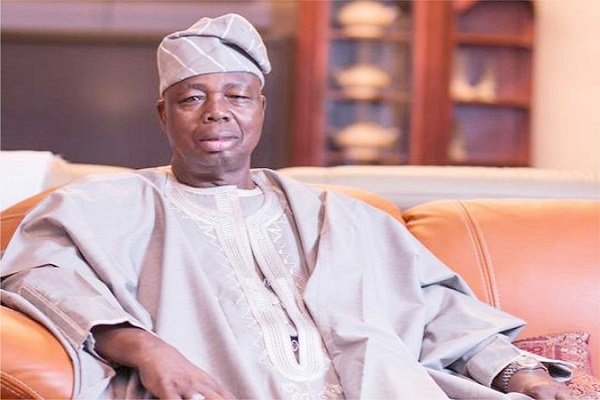
Asiwaju Musulumi of South-West, Edo and Delta states, Alhaji Olatunde Badmus, who recently turned 80 today, shares with BOLA BAMIGBOLA his journey through journalism, business, among other issues.
How was growing up like?
When I was growing up, I thank God that my father had travelled outside Nigeria to Ghana, where I was born, and he was able to realise that education remains an important legacy. So, as moderate as he was in terms of the resources available to him, he was able to make sure that all his children were educated.
I got to know my date of birth through my father. He was living in Ghana, and he kept records of all his children. The name of my father is Alhaji Adekilekun Badmus. In his lifetime, he was the Olori Alalahaji of Osogbo (the leader of Hajj pilgrims in Osogbo). He was a prominent personality in the Muslim community back then.
My mother is Munirat Badmus from the Ogboriefon family in Ibadan, Oyo State. She was a big businesswoman in Osogbo in those days. My father was a cleric and a produce buyer. I am from Ayiogun’s compound in Osogbo.
Did you learn business from either of them?
No, they didn’t expose their children to their businesses. Education was very important to my father. There are not many of his children who were graduates, but at least he was able to educate us to a certain level to prove to us that education is very important.
How well did you utilise that opportunity given to you by your dad to acquire a Western education?
I took that opportunity up. As fate would have it, I was initially thinking of going into the civil service, where I could put on my tie, but I realised that I had to move forward with my education.
Even after leaving secondary school, I felt that the next stage for me was to find a way to university or a higher institution. I came back to Osogbo, my hometown, and there was an incident then that made us go to the police station, and the DPO then, and CSP Iyamu, found some qualities in me and said I should join the police.
Did you accept the offer?
At that time, there were Cadet Inspector positions that School Certificate holders could apply for. He made me join the police force. After three years in the police force, I was also discovered to be someone very intelligent and drafted to the intelligence unit, which was known as the Special Branch at that time.
So, it was there that I developed a flair for journalism because I saw the way journalists were moving around. Eventually, I was employed as a reporter in the old Western Nigeria Broadcasting Service.
What memorable incident can you recall in your years working as a police operative?
As I said earlier, I was posted to the Intelligence Branch. It was a good experience for me. That is all I can tell you about it. You learn more about how to deal with people, and the most important thing is, you learn how to relate with people. Our orientation then was to focus on what the people were saying about the government.
You put what people are saying into writing so that it will guide the government in doing the right thing, or whatever it feels should be done.
At WNBS, who were your contemporaries?
My contemporaries were Onigbogi, Osungbohun, and Sanya Fadipe. I was working directly under Chief Kunle Adeleke at that time. He happened to be our Director of News and Current Affairs. He was my mentor. He was the one who actually got me employed at the WNBS. There was also someone we called Dodo, who was a technical engineer.
How many years were you there?
I was there for about six years or thereabouts. I cannot recollect, but it is all in my book.
How was it like working as a journalist, having first experienced life in the police force?
At the WNBS, I was posted to the Lagos office and was under one Mr Alawiye as our City Editor before he was posted back to Ibadan as Director of News and Current Affairs after Chief Adeleke became the Permanent Secretary and General Manager of the station.
In Lagos, where I was posted, my first duty was to move around. We had a weekly programme called ‘Issues of the Day.’ I was also reporting sports. So, every weekend, I had to make sure that the materials were available because at that time, Lagos happened to be the centre of sporting activities in Nigeria. All major football events happened in Lagos. I had to make sure that the clips got to Ibadan.
The most important turning point happened to be the ‘Issues of the Day’ weekly programme. My duty was to source important personalities to be interviewed by Chief Kunle Adeleke. Ex-President Shehu Shagari and many personalities featured on the programme.
How financially rewarding was it working as a journalist back then?
At that time, I didn’t know anything about brown envelopes. My joy was just about the personalities I brought to take part in the programme, and WNTV was so popular at that time that everybody tuned in. It happened to be the best and only TV station in Nigeria then.
Can you recall any encounter with one of those guests that you didn’t like?
No, the one that actually made me to be whatever Almighty Allah destined me to be happened to be Chief J.S. Saka. When I arranged the interview, he invited me to lunch. So, I went to his house. At that time, he was in the Unity Party of Nigeria, and he was one of the people that Chief Awolowo depended on.
But he switched to Shehu Shagari’s party, and they gave him a ministerial appointment. He asked me what I wanted. I told him that what I wanted was to go for a pilgrimage in Mecca. He immediately called a travel agency, and I was given a ticket to Mecca. He also gave me about 1,500 pounds to spend during the trip.
It was when I got to Mecca that I realised that they were more advanced in reporting than us because in those days, what we normally did was carry something called a midget around to record. But when I got to Mecca, I saw camcorders. I felt they would help our people in Nigeria. I bought about 20 pieces and brought them back.
It was those 20 pieces that I sold, and it was very easy for me to sell them. Then, I had to look for the next Hajj trip. The late Oba Ogunleye, who happened to work with the Nigeria Airways at that time, was the one who arranged the next visit to Mecca for me.
I was able to buy more quantities, and I started supplying other stations around the Western Region and parts of the northern zones. So, that was the beginning of my venture into the electronics business.
While doing that, were you still in the employment of WNTV?
We had a way of reporting ourselves. So, people must have notified my employers that I was involved in business in Lagos. I was eventually transferred to Ibadan. When I got to Ibadan, I resigned from the job. Before then, I attended the Times Institute of Journalism. That was where we had advanced-level training for people in journalism.
After resigning, I continued with the business. I supplied NTA Lagos, NTA Channel 7, Oyo, and Abuja. I supplied Suleja; I was able to supply most of this broadcasting equipment to about 10 or 12 stations.
That was the level the business grew into, but my leaving the station allowed me to move around other stations.
You started with electronics. What other things did you venture into?
Electronics was booming for me, but it got to a stage where they said the Federal Government had to issue you a licence before you could bring in electronics or any other product you wanted to import. So, it was then that I applied for an import licence to bring in studio equipment, but they gave me an import licence to bring in agricultural-related items.
Can you recall the military government that gave you that licence?
It was the Ibrahim Babangida government. Back then, one of the conditions for getting an import licence was that you must have farmland. What they gave me then was permission to bring in Izal and concentrates for mixing animal feed.
I was advised to utilise the import licence, or else I would not be qualified the next time. The Izal licence came when there was a cholera outbreak in Oyo State, and unfortunately, the person who was supposed to help me make the government buy Izal from me did not do that. I had to sell it in the open market. So, I lost some money there.
I had already started maize farming, and every time I cultivated maize, the price was not always competitive with the maize that would be brought from the North. So, I then decided that instead of selling the maize at a loss, I would rather use it to prepare animal feed. I started with animal feed, but it also had challenges.
From there, I moved on and established my own poultry business. I started with a layer farm, using the feed I produced. From there, I moved to meat production. This was what made me know everywhere in the country.
Looking back at about 40 years of being a poultry farmer, how would you describe the business?
The business is okay because I went through the hard way, but eventually, it gave me a name. I became the National President of the Poultry Association of Nigeria. I was involved in many multi-company projects created by the Federal Government.
I was the chairman of one of them during the Olusegun Obasanjo administration. The joy I have today is that every poultry farmer in the country knows that I happened to be one of those who revived poultry businesses in Nigeria, and I was able to achieve that by having somebody who understands agriculture, which is President Olusegun Obasanjo.
The poultry business was killed in the past. The poultry business in Nigeria can produce three-quarters of the African continent’s needs. We also have the capacity to produce day-old chicks and supply three-quarters of Africa with our products. We also have breeder farms that can also produce enough breeding pens for us in Nigeria.
But why were these not done?
Well, we are not up to date. We have the equipment because people invested, due to the opportunity given to us by the Obasanjo regime. A lot of investment has gone into poultry production. You know that poultry production also depends on the price of maize and the price of soya. This is the advantage that foreign farmers and producers have.
In Nigeria, the maize we grow is not mechanised. The yield per hectare in our own place here is about two, whereas in Southern Africa, they have about 3.5 or four. So, you can know that the price of their maize will be lower, and maize constitutes about 65 per cent of what is used to feed animals.
That is why their chicken is cheaper when compared to ours. The price per kilogramme of chicken in America is about $1.50, whereas chicken here is about N4,000. Can you see the difference?
Also, in other advanced countries, their machines can slaughter about one million birds per hour, but what we have here is about 10,000 per hour.
Our challenge is not about government policy. I think Brazilians are smuggling their chicken into Nigeria through Cotonou, and those brought in through illegal routes are dangerous to our health because most of these chickens being imported are preserved with formalin, which is dangerous to our health.
These are some of the things NAFDAC needs to work on because there is no way you can bring chicken from Brazil, and the ship will not spend a minimum of 21 to 28 days before it gets here.
In all these years of being in business, what will you consider the lowest moment?
The lowest period was during the EndSARS protest. The protesters vandalised the farm and destroyed many things there. We are just reviving it now, and the government at that time seemed not to be interested because I don’t know anybody who lost money and had been compensated.
During that period, we lost a lot here. We had to go back to the drawing board to start the farm all over again. It was massive. I think we were the greatest losers in Osun. We lost a lot during that period, but we thank God.
We thank God that the EndSARS protesters’ destruction of properties brought this mosque here (pointing to a newly constructed mosque). We had six warehouses here, and they vandalised everywhere, and two of the houses. I had to pull them down and build a mosque as a sort of gratitude to Almighty Allah.
To be specific, I was thinking that I had to set up many businesses. I set up the Biro Manufacturing Company, and it is well known around here and beyond. We are there selling biros.
What would you consider your biggest fulfilment at 80?
The biggest fulfilment is the building of this mosque. I would have regretted it if I didn’t have this to show Almighty Allah that, after spending, sponsoring people, doing this and that, I have not been able to dedicate a place to Allah.
How do you keep active at 80?
I keep active by playing golf. That is all that I do. I have a swimming pool in my house, and occasionally, I go there to swim. I also have a gym in the house, which I visit occasionally. I have table tennis in my compound, but golf is the major one. I play golf for a minimum of four hours every week. It all depends on the number of people. If three of us are playing, that’s three and a half hours. If we are four, that’s about four hours.
But usually, at times, I want to play for five or six hours. Most of the time, we brag about winning, and that gives us extra motivation to beat our opponents.
There is a belief that golfing is for big men. How true is that?
It is a lie. It is not correct. Golfing is for everyone. I don’t think it is for big men. What people normally talk about is the cost of the bag itself, but we have some small children who are now involved in golfing. It is not for big men alone.
Well, in America, I would say yes, golf is for big men. But if you look at what Tiger Woods has become now, he was just a caddie boy, picking balls. Most of the professionals in golf today are more or less former ball boys who started by picking balls for golfers. I have about 10 graduates who have benefited, and I sponsored them. I met them through golf.
You have been involved in philanthropy over the years, especially within Osogbo and Osun State. What is the motivation behind it?
It goes everywhere and not just in Osogbo, my hometown alone. I don’t want to say my philanthropy is only for the Osogbo people. It is anywhere I feel I need to give. For about 20 years or so, we ran a scholarship programme where we sponsored people for higher education every year, and we don’t know where the students came from. Their hometown was not part of the conditions for eligibility. I cannot begin to mention names because they are all big men now.
Do you still go to work as you used to in the past?
You have to go to work. It is not that I have to be physically present, but there are certain things I must attend to. For instance, in my business, they write reports to me daily. I look at them, and where I need to comment, I comment and give them back.
Physical presence nowadays is not necessary in business; you can run the business without going there, but at least I go to the farm twice a week.
What advice would you give to someone who wants to go into farming, especially the poultry business?
Well, based on my experience, you just have to be focused and determined because business is up and down, and it is never straightforward. Even the government itself is not stable. Nothing is stable, but you must have focus and determination.
Any unfulfilled dreams at 80?
What would have been an unfulfilled dream is not having this mosque. Other things are okay. The children are okay, and the business is also going well. At least, we are weathering the storm of the economy. There is no unfulfilled dream.
Any regrets?
The only regret, as I mentioned earlier, was when the EndSARS protesters vandalised this place and we did not receive any form of support except that the state government came later and, having lost about half a billion naira, the state government supported us with N50m, thinking that through the palliative of the Federal Government at that time, assistance would come to us.
But we thank God, and with the way the present government is going with its determination to stabilise the economy, the exchange rate for the past two years has been stable. It is not as volatile as it used to be. The government is building the economy. The only thing that remains is for politicians to applaud and stop this destructive criticism.
Do you recall some of the schools that you attended, particularly primary and secondary schools?
I started primary school in Ikare, Ondo State, at Muslim Primary School. From there, I moved to Osogbo to complete my primary school at Laro in Isale Osun.
After that, I went back to Ikare and attended Anglican Commercial Modern School, and I went to Oke Ibadan to complete my secondary education.
After that, I was able to enrol online at Rapid Results College, and this gave me an A-Level certificate. It was this A-Level certificate that made me go to The Times Training School for a diploma in journalism.