
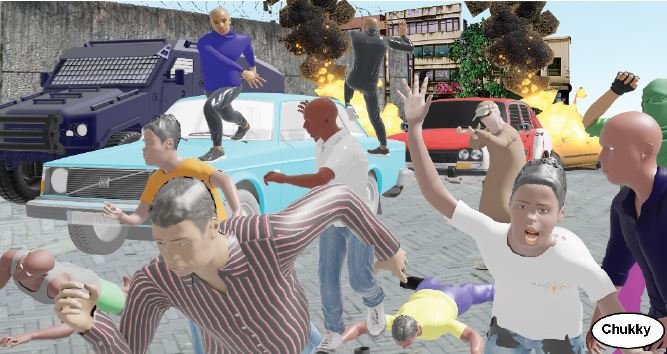
For many Nigerians living in South Africa, each new wave of xenophobic unrest revives an unsettling reality; the fear that their nationality alone could make them targets of mob violence, looting, or intimidation.
Although attacks against foreign nationals in South Africa are not new, the recurring hostility towards Nigerians has continued to raise difficult questions about migration, economic frustration, and the fragile state of African solidarity decades after the end of apartheid.
The attacks on Nigerians in South Africa can be traced back to the early 2000s, when xenophobic violence on the Cape Flats resulted in the deaths of two Nigerians and seven other Africans.
However, the incidents did not stop, as they continued to worsen over the years. For instance, in 2008, Johannesburg turned into what many described as a “war zone” when riots led to the killing of at least 62 people, while about 6,000 others were displaced.
In April 2015 alone, attacks on Nigerian-owned property caused damage estimated at N21m, while roughly 20 Nigerians were reportedly killed in 2016, including Tochukwu Nnamdi, who was allegedly shot extrajudicially by the police.
Barely a year later, Nigerians in Pretoria West reported that five buildings, a garage containing 28 cars, and a church were looted and burnt.
More coordinated attacks on Nigerians across Johannesburg and Pretoria followed in 2019. During the attacks, natives allegedly singled out Nigerian-owned businesses.
In a report referenced by the House of Representatives, it was disclosed that 116 Nigerians were killed in South Africa within two years, while between 1999 and 2018, an estimated 118 Nigerians reportedly lost their lives to xenophobic violence.
According to a 2018 Pew Research Centre poll, 62 per cent of South Africans believed immigrants were a burden and linked them to crime. Nigerians, who are among the most visible African migrant communities in the country, are therefore often targeted as scapegoats during periods of social unrest.
Recently, anti-immigrant violence in parts of Johannesburg, Durban, and Pretoria destroyed businesses, displaced families, and heightened diplomatic tensions between Nigeria and South Africa, the continent’s two biggest economies.
Many of the attacks were reportedly carried out by South Africans who blamed migrants for worsening unemployment, crime, and pressure on public services.
In late April 2026, for instance, anti-immigrant groups such as Operation Dudula intensified attacks on foreigners and fellow black Africans in Johannesburg, Pretoria, and other communities and allegedly hunted them on the streets like common criminals.
Shops owned by migrants were looted, buildings burnt, and vehicles destroyed.
Two Nigerians identified as Nnaemeka Matthew Andrew Ekpeyong reportedly died in police custody, while Kelvin Chidiebere Amaramiro died from injuries allegedly inflicted by personnel of the South African National Defence Force.
During the period, African migrants were allegedly asked to produce identification documents at schools, hospitals, and business premises.
In KuGompo City alone, some protesters allegedly burnt properties linked to foreigners over claims that the Igbo community crowned an Igbo king, Solomon Eziko, in the Eastern Cape Province.
However, the House of Representatives expressed displeasure over the renewed wave of xenophobic attacks against Nigerians in South Africa and urged the Federal Government to take urgent diplomatic and protective action.
The resolution followed the adoption of a motion of urgent public importance moved by a lawmaker, Donald Ojogo, and seconded by Billy Osawaru. Both lawmakers called for immediate evacuation plans for Nigerians willing to return home and also recommended a review of bilateral relations between the two countries, including a possible temporary suspension of business permits for South African companies operating in Nigeria.
Fearing that tensions in South Africa could escalate further, the Federal Government began a voluntary repatriation programme for its citizens.
The Minister of Foreign Affairs, Bianca Odumegwu-Ojukwu, disclosed that at least 130 Nigerians in South Africa requested to be flown home following the protests.
Condemning the incidents, President Bola Tinubu, through the ministry, directed Nigerian missions in South Africa to “immediately establish a crisis notification unit for Nigerians affected by the xenophobic attacks and anti-foreigner sentiments in the country.”
The minister also advised Nigerians in South Africa to promptly contact South African security authorities whenever they faced threats or dangerous situations.
Meanwhile, South African President, Cyril Ramaphosa, in a public address, condemned the violent protests and attacks, describing those behind the unrest as “opportunists” exploiting legitimate socio-economic grievances.
Ramaphosa criticised the violent acts recorded in some communities, saying they did not represent the South African government or the majority of its citizens.
According to him, individuals who stopped people, conducted searches, or checked identities without legal authority were engaging in unlawful conduct.
As tensions persisted, the Senator representing Edo North, Adams Oshiomhole, called for the nationalisation of MTN and other South African companies operating in Nigeria, insisting that Nigerian lives must take precedence over foreign investment amid the renewed xenophobic attacks in South Africa.
He argued that Nigeria should take stronger economic action against South African interests in response to repeated attacks on Nigerians abroad.
The leadership of the Nigeria Labour Congress also called on the Congress of South African Trade Unions, on May 7, 2026, to lend its voice “without equivocation and condemn these xenophobic attacks in the strongest terms, not as a mere press release but as a mass mobilisation, so that every trade union hall, every shop floor, and every picket line carries the message that an injury to one is an injury to all.”
In a letter signed by its President, Joe Ajaero, the NLC urged COSATU to use its influence to pressure the South African government to take robust and immediate steps to address the situation.
The statement partly read, “It is failed government policies that have failed to address the needs of workers and the people but instead pander to profit. We therefore call upon you, our sister labour centre, to lend your powerful voice without equivocation and condemn these xenophobic attacks in the strongest terms, not as a mere press release but as a mass mobilisation, so that every trade union hall, every shop floor, and every picket line carries the message that an injury to one is an injury to all.”
Speaking on the matter, a former Nigerian Consul to Cameroon, Ambassador Rasheed Akinkuolie, described the xenophobic attacks on Nigerians and other Africans in South Africa as misplaced aggression rooted in deep socio-economic frustrations among sections of the black population.
According to him, many black South Africans had expected to automatically gain control of businesses and economic opportunities after the end of apartheid, despite lacking the education and technical expertise required to manage such enterprises.
However, past attempts by mobs to attack mines and businesses owned by wealthy white South Africans and influential black elites were reportedly met with strong resistance, forcing some of the attackers to shift their focus to what he described as “soft targets,” particularly black African migrants living in the country.
“If Nigerians and others should leave the country, black South Africans will not be able to manage the targeted businesses because of their incompetence and lack of experience in enterprise management. After apartheid, the government should have embarked on massive educational programmes, which the apartheid government deliberately denied the majority of the black population in order to subdue and suppress them, “Akinkuolie.
He argued that frustration over unemployment, poor living conditions, and limited opportunities has continued to fuel the anger and violence.
Akinkuolie said successive South African governments should have invested massively in education, technical training, entrepreneurship, agriculture, and social housing for the black majority instead of allowing poverty and inequality to widen.
“The call for South African businesses in Nigeria to be nationalised may be necessary since this problem has persisted without the South African government taking any decisive action to stop it. This measure, although tough, may be the ultimate solution.
“This will force the South African government to take direct action against the mobs while addressing the root causes of xenophobia at home. The black South Africans in Nigeria are very few, and any retaliatory action against them will have little effect,” he stressed.
Meanwhile, the Director-General of the Nigerian Institute of International Affairs, Prof Eghosa Osaghae, explained that the xenophobic attacks on Nigerians in South Africa should not be viewed solely as a Nigerian problem.
According to him, although Nigerians appear more visible because of their large population in the country, several other African nationals are also affected by the attacks.
The don added that regional and international bodies, including the African Union, the Southern African Development Community, and the United Nations, should pay closer attention to the situation because it poses a threat to peace and security across Africa.
He stressed that while countries reserve the right to regulate migration, individuals are also entitled to lawful movement under established international rules and regulations.
Osaghae said, “The Southern African Development Community, the AU, and even the United Nations should begin to address these kinds of issues that are endangering peace and security. In theory, people are allowed free movement around the world in accordance with state-held rules and regulations, so that point should be emphasised.
“In essence, we should not make it an explicitly Nigerian matter alone. It is an issue that deserves the attention of all well-meaning Africans across the continent. The good thing is that Nigeria and South Africa have a bi-national commission, which provides a platform for the two countries to meet and seek diplomatic solutions to these problems.”
He also noted that the Nigerian and South African governments should ensure a level playing field through diplomatic structures in addressing issues affecting their citizens.
“The good thing is that Nigeria and South Africa have a bi-national commission, which provides a platform for the two countries to meet and seek diplomatic solutions to these problems. Oshiomhole’s call is merely a suggestion. It is the government’s prerogative to decide what options are available to us as a country, but there is a platform that affords Nigeria the opportunity to make these determinations. The other day, the South African High Commissioner was summoned by the Nigerian government to register Nigeria’s concern.
“We have our mission in South Africa and the Nigerians in Diaspora Commission. These bodies are responsible for managing Nigeria’s external affairs. The right statements have been made. In addition to all that, we have the Nigeria-South Africa Bi-National Commission, which is the statutory body that can help in addressing these issues.”