
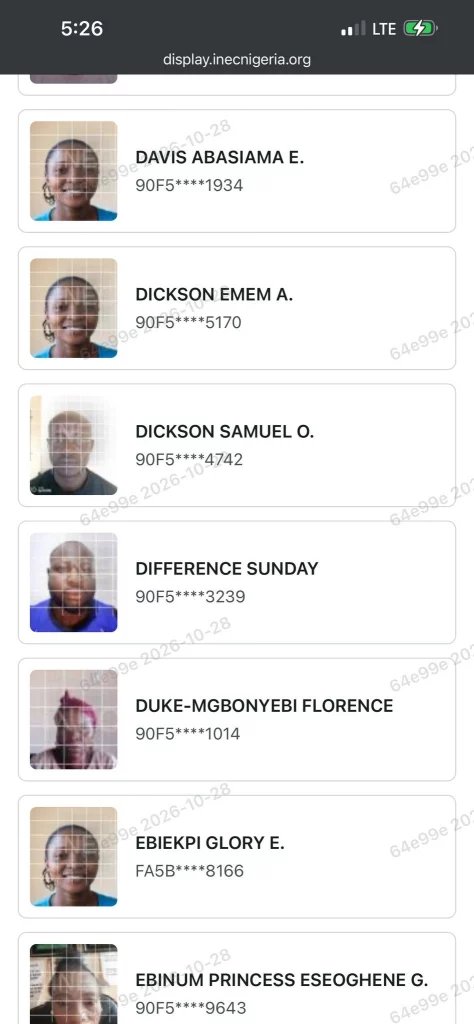
AI-generated photographs in Nigeria’s preliminary voter register raise a question that goes beyond the technology used to create them: how did suspicious entries get into a database meant to establish who can vote? Ahead of the 2027 general election, the controversy puts the Independent National Electoral Commission’s (INEC) verification procedures, access controls, and accountability under scrutiny—not simply its ability to detect synthetic images.
The preliminary register lists more than 103 million voters, up from approximately 93 million in 2023. While INEC attributes this surge to new registrations, persistent questions surrounding anomalous records have intensified demands for a clearer accounting of how raw records are checked—and who bears responsibility when systemic irregularities slip through.
Speaking on ARISE News, Clement Nwankwo, director of the Policy and Legal Advocacy Centre (PLAC), challenged the register’s credibility, pointing to alleged AI-generated photographs and unexplained statistical surges in registered voters. His concerns underscore a broader institutional test for INEC: removing dubious entries is only a starting point; the commission must demonstrate that its entire pipeline for collecting, verifying, and auditing electoral data is robust and trustworthy.
Responding to these criticisms on 30 October, Lawrence Bayode, INEC’s director of information and communication technology (ICT), stated that the commission was working to address irregularities ahead of releasing the final register on 15 December 2026.
However, Bayode’s explanation exposed a deeper operational vulnerability: some suspicious entries were inserted directly by registration officers holding authorised access to INEC’s core database.
Bayode acknowledged that registration officers across multiple states introduced irregularities into the system, encompassing both AI-generated imagery and flawed registration conduct.
“They have access to register people,” Bayode said, noting that the commission flagged these discrepancies during automated biometric identification system (ABIS) checks.
This admission complicates the narrative that generative technology is the primary culprit behind vulnerabilities in voter lists. While generative AI simplifies the creation of synthetic visuals, the core issue identified by INEC stems from insider privileges—the individuals authorised to operate registration terminals and the governance controls surrounding their access.
This breakdown raises critical questions regarding internal oversight: how are registration officers monitored in real time, what validation rules are run before data is committed to the master database, and why were suspicious records not quarantined before reaching the public preliminary register?
The incident also highlights the boundaries of automated safeguards. While biometric algorithms can detect duplicate prints or abnormal features, their efficacy depends on the integrity of the submitted data, effective workflow design, and rigorous follow-through on flagged anomalies.
INEC has yet to specify how many AI-generated photos or invalid entries were detected, how many officers were implicated, or what disciplinary or legal actions have been initiated. Without these details, public stakeholders cannot accurately gauge the scale of the compromise or evaluate whether existing safeguards are sufficient to restore trust.
A bigger register and a transparency problem
INEC reported registering over 11 million individuals during its Continuous Voter Registration (CVR) drive for the 2027 polls. Automated biometric checks subsequently purged roughly 1.2 million invalid entries, thereby adding over 9 million voters to the 93 million recorded in 2023.
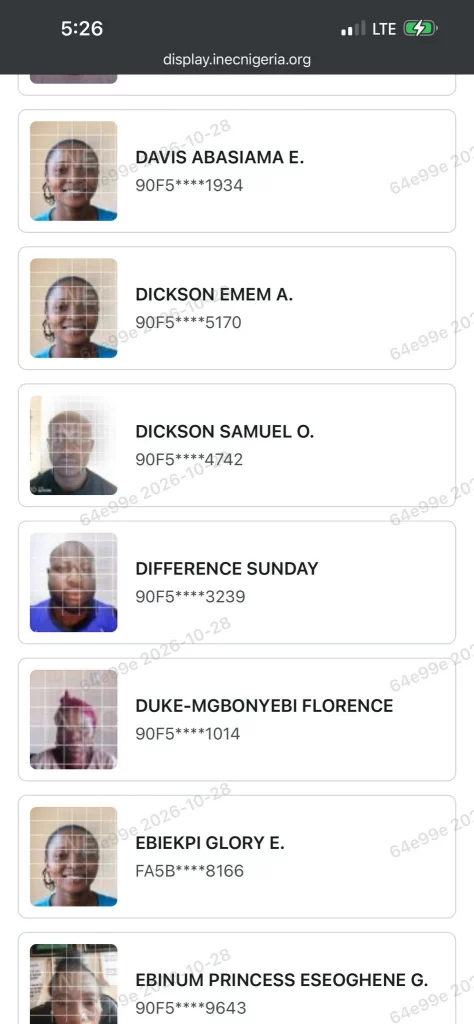
According to Bayode, the automated filtering yielded the preliminary total of more than 103 million voters.
Yet the significant expansion has fueled public concern, particularly because observers and electors continue to identify glaring errors within the published rolls.
The issue extends beyond numerical growth to whether citizens can independently scrutinise data updates and verify INEC’s methodologies. Public transparency is paramount given statutory publishing mandates and the discrepancies already uncovered.
Under Section 19(1) of the Electoral Act, INEC is required to publish and display the preliminary voter register on its website and at every registration ward and local government office at least 90 days prior to an election. With Presidential and National Assembly elections set for 16 January 2027, the statutory deadline fell on 18 October 2026. Section 20 further obligates the commission to publish the final register at least 30 days before polling, following the claims, objections, and de-duplication process—establishing a mid-December 2026 deadline.
INEC missed the 18 October digital publishing deadline, making the preliminary register available online on 26 October—just 81 days before the election. While the commission argued that physical displays at ward centres from 9 to 15 October satisfied its obligations, physical displays alone fail to fulfil Section 19(1), which explicitly mandates both physical and online availability. This delay compressed the window for public audit and raised valid questions regarding statutory compliance.
The public review phase has further highlighted system discrepancies. Bayode acknowledged receiving complaints concerning missing voter records, clerical errors, and unreflected address transfers. While INEC assured the public that these issues are under review prior to the final publication, resolving individual claims solves only part of the problem. Voters also require transparency around investigation workflows, verification standards, and audit trails.
This scenario illustrates a fundamental principle of digital election management: external crowdsourcing can surface defects, but it cannot replace institutional internal controls. Nor can public scrutiny restore faith without clear visibility into how errors are rectified and prevented.
INEC’s AI ambitions face a governance test
These developments unfold as INEC expands its technological footprint and formulates policies to govern artificial intelligence across its operations.
Bayode stated that the commission currently limits AI deployment to low-risk functions, such as public-query chatbots and logistics planning for election materials, emphasising that these tools do not affect core electoral results.
INEC is also finalising a formal AI governance framework ahead of the 2027 polls to establish operational boundaries for automated tools and ensure human oversight over sensitive decisions.
Additionally, the commission established a specialised AI division within its ICT department and engaged with regional initiatives focused on the responsible deployment of AI in elections.
While these steps indicate awareness of technical risks, the voter register controversy highlights why governance cannot focus exclusively on software tools. Governance must address how human operators interact with systems, how user privileges are audited, and how accountability is enforced when internal controls fail.
Bayode pledged to release the AI policy guidelines publicly. Publishing these rules would enable political parties, civil society organisations, and voters to independently evaluate INEC’s operational safeguards.
Trust will depend on what INEC fixes
INEC’s commitment to purge synthetic imagery and resolve data discrepancies before 15 December represents a critical test of its operational responsiveness ahead of 2027.
Yet cleansing the register addresses only the symptom. To rebuild lasting trust, the commission must disclose how rogue data bypassed system checks, identify the institutional vulnerabilities, and detail the technical mechanisms implemented to prevent recurring compromises.
The ongoing dispute reinforces a key reality of digital governance: digitising processes does not inherently guarantee credibility. While technology can streamline administration and flag anomalies, weak access governance and inadequate oversight risk replicating—and amplifying—the very flaws digital tools were deployed to solve.
For INEC, the imperative ahead of 2027 is not merely deploying sophisticated software but proving that the human and technical systems safeguarding Nigeria’s elections are secure, transparent, and fully accountable.
Ultimately, electoral integrity rests not just on the volume of corrupt entries removed, but on whether citizens can trust the pipeline through which their data is collected, verified, and secured.