
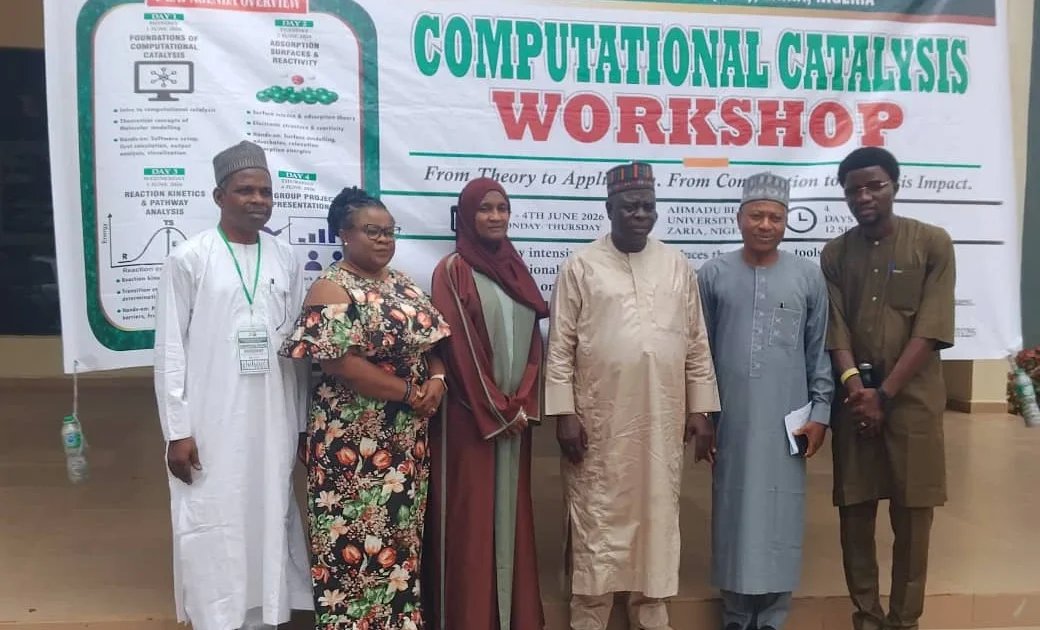
The Vice-Chancellor of Ahmadu Bello University, Zaria, Prof. Adamu Ahmed, has lamented Nigeria’s continued dependence on foreign technical expertise despite being Africa’s largest oil-producing nation.
Ahmed spoke at the opening of a Petroleum Technology Development Fund-sponsored training on computational catalysis for 35 researchers held at the university.
The training was organised by the Petroleum Technology Development Fund in collaboration with ABU and themed, “Why It Matters: Opportunities for Research, Industry, and National Development in Nigeria.”
Represented by the Deputy Vice-Chancellor (Administration), Prof. Bello Sabo, the vice-chancellor said Nigeria’s quest for technological and economic sovereignty depends largely on its ability to develop indigenous expertise and research capacity.
He noted that while the country occupies a strategic position in Africa’s energy sector, it still relies heavily on foreign specialists for catalyst design, process modelling and computational optimisation.
Ahmed said, “Nigeria is the largest oil-producing nation on the continent. Yet, we remain dependent on foreign technical expertise for catalyst design, process modelling and computational optimisation.
“This is not a statement of failure; it is an opportunity. It is precisely this opportunity that the PTDF Chair in Chemical Engineering was established to address.”
According to him, universities have a critical role to play in building local capacity capable of driving innovation and supporting national development.
“The institution is more than a place of learning; it is a national institution built on the conviction that indigenous knowledge and homegrown expertise are the foundation of a truly sovereign nation.
“This workshop embodies that conviction. It is a deliberate investment in Nigeria’s capacity to understand, design and optimise the catalytic systems that underpin our petroleum industry, petrochemical sector and emerging clean energy ambitions using computational tools developed and applied in Nigeria by Nigerian scientists,” he added.
Speaking, the PTDF Executive Secretary, Prof. Shu’aibu Shehu-Aliyu, said the training was designed to strengthen Nigeria’s industrial capacity, reduce dependence on foreign expertise and accelerate technological innovation in the energy sector.
Represented by the General Manager, Education and Training, Rabi Waziri, Shehu-Aliyu described computational catalysis as a critical tool for advancing research and innovation in the petroleum, petrochemical and energy sectors.
“For a country like Nigeria, where energy resources are central to economic growth and sustainability, building capacity in advanced and specialised fields is critical.
“Computational catalysis improves efficiency and accelerates innovation. This workshop is designed to drive industrial growth and development by empowering researchers with the tools needed to solve real-world challenges,” he said.
The PTDF boss reaffirmed the fund’s commitment to developing indigenous human capacity and promoting research and technological advancement in Nigeria’s oil, gas and energy industries.
According to him, the fund has established a PTDF Professorial Chair Programme at Ahmadu Bello University and five other universities across the country to address critical industry challenges and support national development.
Earlier, the PTDF Chair Professor in Chemical Engineering at ABU, Prof. Abdulazeez Yusuf-Atta, said the participants were selected through a competitive process based on their research achievements, innovative capacity and commitment to advancing science in Nigeria.
He explained that computational catalysis enables researchers to predict chemical reactions and identify optimal pathways before conducting laboratory experiments, thereby reducing costs and improving efficiency.
“A molecule, under the right conditions on the right catalyst surface, can be transformed into propylene—a building block for plastics, fibres and industrial chemicals worth billions of dollars,” Yusuf-Atta said.
He disclosed that the participants were drawn from different parts of Nigeria, while one participant came from the Republic of Chad.
According to him, the workshop seeks to build a critical mass of experts capable of deploying computational catalysis to solve industrial and energy-related problems.
“It guides you to a more specific area before you go into the lab. So, it saves cost, time and energy for a country like Nigeria.
“We have started now. Participants are drawn from various parts of the country. They will return home and cascade the knowledge. They will be like trainers of trainers,” he added.