
Google’s first half of 2026 has been defined by one word: agents.
From new Gemini models and an upgraded Search experience to AI-powered shopping tools, Google has spent the first half of the year weaving artificial intelligence into nearly every product it makes.
The message from Google’s annual I/O developer conference and other announcements is clear: the company wants Gemini to become the connective tissue across its ecosystem, helping users search, shop, work, create, and complete tasks on their behalf.
If you missed the barrage of announcements, here’s everything Google has unveiled in 2026 so far.
1. Gemini models: Google’s biggest announcements of 2026
Google’s AI ambitions took centre stage this year, with the company unveiling new Gemini models built around reasoning, speed, and action.
I. Gemini 3.5 Flash
Gemini 3.5 Flash is Google’s new default AI model across the Gemini app and AI-powered Search experiences. According to Google, Gemini 3.5 Flash combines frontier-level intelligence with the ability to take action across complex workflows.
The company says the model outperforms Gemini 3.1 Pro on coding, multimodal and agentic benchmarks while operating at a significantly lower cost. Google also claims it generates outputs four times faster than comparable frontier models. For users, this could mean faster responses and improved performance on multi-step tasks.
The company announced the model on May 19 at its I/O 2026 developer conference and was rolled out the same day.
II. Gemini 3.5 Pro
Google also previewed Gemini 3.5 Pro, which it positions as the most capable model in the Gemini 3.5 family. While Gemini 3.5 Flash is optimised for speed and everyday use, Gemini 3.5 Pro is designed for advanced reasoning, complex coding, research-intensive tasks and sophisticated agentic workflows. At Google I/O 2026, CEO Sundar Pichai said the model was expected to become available in June 2026.
III. Gemini Omni
Gemini Omni represents Google’s next step in multimodal AI. Unlike traditional AI models that primarily process text, Gemini Omni can accept images, audio, video and text as input. Google says the model can generate videos grounded in real-world understanding and edit them through natural-language conversations.
The company describes Gemini Omni as a system that can “create anything from any input,” starting with video. The first model in the Gemini Omni family, Gemini Omni Flash, is being rolled out through Google’s video creation ecosystem. Google says the model powers video generation and editing experiences in the Gemini app and Google Flow, with the broader goal of making high-quality video creation accessible to users without professional editing skills.
2. Gemini app: From chatbot to personal agent
The Gemini app is evolving beyond a simple AI assistant.
Google says the app is becoming more agentic, with new capabilities that can use context, learn user preferences over time, and help complete multi-step tasks across Google services. At Google I/O 2026, the company announced new agents and automation features designed to provide more personalised assistance, organise information, and proactively help users accomplish everyday tasks.
Gemini Spark
Google introduced Gemini Spark, a personal agent designed to complete tasks on users’ behalf. It is currently rolling out to AI Ultra subscribers in the US, with a broader rollout planned for later in the year.
Spark can:
- Work across Google services
- Continue tasks in the background
- Handle recurring workflows
- Personalise assistance based on user context.
Daily Brief
Daily Brief is Gemini’s personalised morning digest. Drawing on information from Gmail, Google Calendar, tasks, and connected Gemini context, it organises and prioritises the day’s most important items. Beyond summarising information, Daily Brief suggests next steps and actions, helping users stay on top of their schedule and responsibilities. Over time, it can adapt to user preferences to deliver more relevant briefings.
Gemini Live upgrades
Gemini Live received major updates designed to make interactions more fluid and conversational. Users can switch seamlessly between typing and speaking without losing context, while a redesigned voice experience enables more natural conversations. Google also announced support for regional dialects and deeper integration of Gemini Live across the Gemini app.
A redesigned Gemini experience
Google introduced Neural Expressive, a new design language for the Gemini app. The refresh brings:
- Fluid animations
- Updated typography
- Improved haptic feedback
- A more visual interface across Android, iOS, and the web
3. Google Search: The biggest upgrade in years
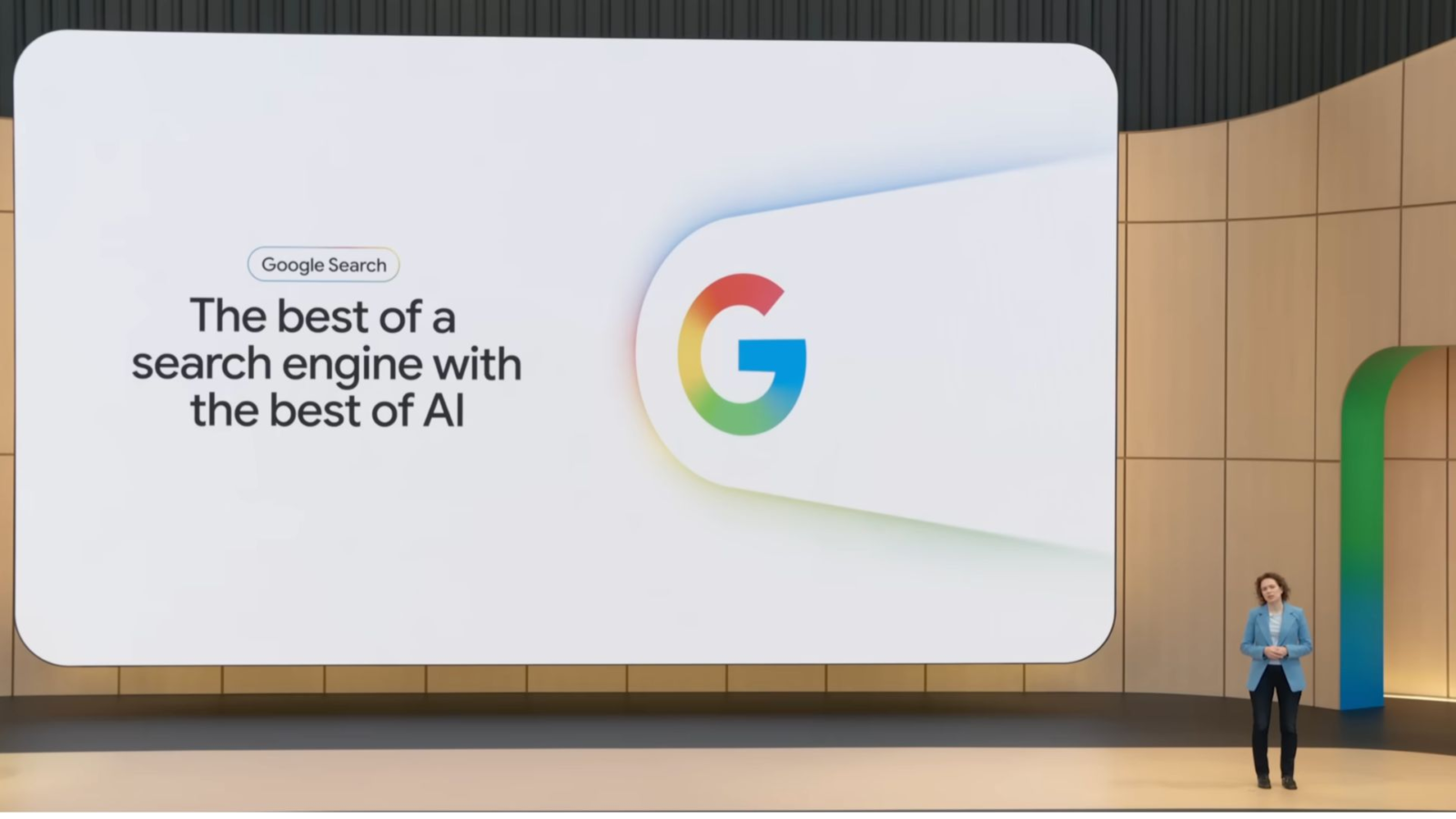
Google Search is evolving from a list of links into an AI-powered assistant. With new capabilities announced at Google I/O 2026, Google Search can answer complex questions, reason across multiple sources, and help users complete tasks directly from the search experience.
Search powered by Gemini 3.5 Flash
Google has integrated Gemini 3.5 Flash into its AI-powered Search experiences, including AI Mode and AI Overviews. This upgrade enables more complex queries and more comprehensive, context-aware responses across Search.
Interactive answers
Search will increasingly present AI-generated responses alongside traditional results, with more interactive and visually rich formats. Depending on the query, users may see dynamic layouts, visual elements such as charts or images, and explanations tailored to the context of their question.
Long-running tasks
Google is introducing agent-like capabilities in Search that support multi-step and ongoing tasks, allowing users to continue and track certain workflows over time. Search is increasingly designed to help users complete tasks as well as find information.
Shopping is also receiving the AI treatment.
Google wants to help users move from discovery to purchase with minimal friction.
Universal Cart
Universal Cart is one of the biggest new Shopping announcements. It is a Gemini-powered shopping cart and agentic hub available across Google Search, Gemini, YouTube, and Gmail (with integrations rolling out progressively).
Once you add a product, Google can proactively:
- Monitor price drops
- Track price history insights
- Surface deals automatically
- Alert users about stock availability
- Recommend alternative or similar products
- It is also designed to better understand shopping context, including:
- Relevant merchant offers and promotions
- Payment-related incentives within Google’s ecosystem
- Shopping intent across multiple Google surfaces
Rather than acting as a traditional product catalogue, Shopping is evolving into a buying assistant that helps users make decisions and take action.
5. Google Workspace: AI enters the workplace
Google continues to embed Gemini throughout Workspace. The company has steadily integrated Gemini into its productivity ecosystem, turning Workspace into an AI-assisted environment across core applications.
Key capabilities include:
- Gmail – AI-powered email drafting, summarisation, and smart reply suggestions
- Google Docs – Writing assistance, content rewriting, and document summarisation
- Google Sheets – Natural language analysis, formula generation, and data insights
- Google Slides – AI-generated presentations and design support
- Google Meet – Meeting summaries, transcription, and automated action item extraction
Across these tools, Gemini acts as an embedded assistant that helps users generate, refine, and interpret work content directly inside Workspace apps. The broader direction of Workspace is shifting toward an AI-first productivity model, where Gemini functions as a cross-app intelligence layer supporting writing, analysis, communication, and collaboration.
Google Pics
Google Pics is a generative AI design and image creation tool introduced at Google I/O 2026 and integrated into Google Workspace. It allows users to create and edit images using natural language prompts, including modifying or repositioning specific objects within an image through AI-powered segmentation. The tool is designed for creating visuals such as posters, presentations, and marketing assets directly inside apps like Google Slides and Drive. Google has also incorporated its SynthID watermarking system to support AI content provenance across generated media.
6. YouTube: AI-powered discovery and creation
The YouTube app received several updates focused on helping viewers and creators.
YouTube conversational AI search
YouTube is introducing conversational AI-powered discovery features that allow users to ask natural-language questions and receive curated video recommendations and summaries. Instead of relying solely on scrolling or keyword-based search, users can explore topics through AI-generated responses that synthesise information from multiple videos and surface relevant clips.
Shorts gets Gemini Omni
Creators can now use Gemini Omni-powered tools in YouTube Shorts to generate and edit videos using natural language prompts, including AI-assisted remixing of existing clips into new short-form content.
Google Flow Music
On April 17, 2026, Google unveiled Google Flow Music, a creative AI music platform that allows users to upload audio or start from simple melodies and use natural language prompts to generate, expand, and remix full musical compositions.
The platform was a rebrand of ProducerAI, the AI music creation startup formerly known as Riffusion. Google acquired ProducerAI and brought the team into Google Labs in February 2026 before rebranding the service as Google Flow Music in April 2026. Powered by Google’s Lyria 3 Pro music model and Gemini-based systems, the tool can transform basic recordings into fully arranged tracks with multiple instruments, styles, and production layers. It is part of Google’s broader Flow creative suite aimed at democratising professional-grade music and media creation.
7. Android: Smarter experiences across devices
Google’s Android announcements this year centred on Android 17, previewed at The Android Show on May 12, 2026, and expanded on at Google I/O the following week.
Gemini Intelligence
At its Android 17 launch in 2026, Google unveiled Gemini Intelligence, a new AI layer designed to work across apps and handle tasks based on on-screen context. The feature requires Gemini Nano v3-compatible hardware and is initially available on select flagship devices, including Google’s Pixel 10 series and Samsung’s Galaxy S26 lineup, with a wider rollout expected later in the year.
Android Halo
Announced alongside Gemini Spark at Google I/O 2026, Android Halo provides at-a-glance visibility into what AI agents are doing in the background. It surfaces status updates at the top of the screen, allowing users to track an agent’s progress without interrupting their current activity. Google says Halo is designed to work with agents such as Gemini Spark, making their actions more transparent as they complete tasks on a user’s behalf.
Cross-device and productivity features
Android 17 introduces App Bubbles, a new multitasking feature that lets users run apps in movable floating windows for quick access while working in another app. The update also adds Screen Reactions, allowing users to record themselves with the front-facing camera while simultaneously capturing their screen. Google says the release includes broader improvements to cross-device experiences and sharing features, alongside updates to Android Auto.
Security enhancements
Android 17 expands Advanced Protection with stronger safeguards against scams, malware, and unauthorised access. The update blocks accessibility access for apps that are not legitimate accessibility tools, disables device-to-device unlocking, and restricts Chrome WebGPU support when Advanced Protection is enabled. It also adds AI-powered scam detection for chat notifications and introduces more granular contact-sharing controls, allowing users to choose specific contacts rather than granting apps access to their entire address book.
8. Android XR and Intelligent Eyewear: Google’s return to wearables
More than a decade after Google Glass failed to gain mainstream adoption, Google is making another push into smart eyewear, this time with Gemini AI at the centre of the experience and Samsung serving as a key hardware partner.
Android XR
Android XR is Google’s platform for extended reality devices, developed in partnership with Samsung and Qualcomm. The platform is designed to power AI-driven experiences across headsets and smart glasses, with Gemini providing real-time assistance and contextual information.
Intelligent Eyewear
At I/O 2026, Samsung and Google unveiled Intelligent Eyewear — the official product name for their AI smart glasses. Developed in collaboration with eyewear brands Gentle Monster and Warby Parker, the glasses are designed as a companion device to a mobile phone and will work with both Android and iOS.
There are two types of Intelligent Eyewear:
- Audio glasses: Provide spoken AI assistance in the wearer’s ear. Launching first, coming in autumn 2026.
- Display glasses: Show information overlaid on the wearer’s sightline, creating an extended reality (XR) experience. Launching at a later date.
Potential use cases include:
- Navigation
- Translation
- Information retrieval
- Everyday assistance
Google’s message to developers is straightforward: build agents, not just apps.
Google Antigravity
At I/O 2026, Google expanded Antigravity, the agent-first development platform it launched in November 2025, into a full platform called Antigravity 2.0. The update added a standalone desktop app, a new command-line interface, a software development kit, and enterprise deployment through the Gemini Enterprise Agent Platform. Developers can now run multiple agents in parallel, schedule background tasks, and issue commands by voice. Google also introduced a new AI Ultra subscription tier at $100 a month, offering five times the usage limits of the existing Google AI Pro plan, alongside an Ultra Premium tier at $200 a month for twenty times the limits.
Gemini API updates
The Gemini API gained Managed Agents, a feature that removes the need for separate infrastructure setup by provisioning a fully running agent with its own remote sandbox through a single API call. Gemini 3.5 Flash also became available through the API, along with native voice support for Gemini’s audio models.
Google AI Studio
Google AI Studio added native Android app generation, letting developers describe an app in natural language and receive a working Kotlin and Jetpack Compose project, previewable in a browser-based emulator and exportable to Android Studio or Play Store internal testing. The update also introduced Google Workspace integration, one-click deployment to Cloud Run, support for Firebase services, a dedicated AI Studio mobile app, and an export path into Antigravity.
Android Studio enhancements
Android Studio’s I/O 2026 update gave developers on Google AI Pro or Ultra plans dedicated capacity and higher rate limits for Gemini. Google also added a new Android Emulator networking stack that enables zero-configuration peer-to-peer connections between virtual devices, removing the need for manual port forwarding in multi-device testing, along with a LeakCanary profiler task for diagnosing memory leaks directly within the desktop environment.
The rise of agentic development
Across its developer announcements, Google repeatedly emphasised agents that can perform tasks independently.
This philosophy appears set to shape the next generation of software.
SynthID: Watermarking AI-generated content
Google expanded its digital watermarking initiative with SynthID at I/O 2026. The technology embeds imperceptible watermarks in AI-generated media, allowing tools to flag when content has been created or altered using AI.
Google also rolled out verification for C2PA Content Credentials, a content authenticity standard that records a file’s origin and edit history, in the Gemini app and Search, with Chrome support coming in the following weeks. The company is working with partners including OpenAI, Kakao, and ElevenLabs to bring SynthID technology to more AI-generated content across the web.
The bigger picture
Google’s 2026 announcements reveal a company betting heavily on AI agents. Whether you’re searching the web, drafting an email, editing a video, shopping online, or building software, Gemini is increasingly becoming the layer connecting Google’s products together.
The next stretch of the year will test how far that bet extends, as Gemini Intelligence reaches more devices through the summer, Intelligent Eyewear ships its first units in the fall, and Android 17 rolls out beyond Pixel.