
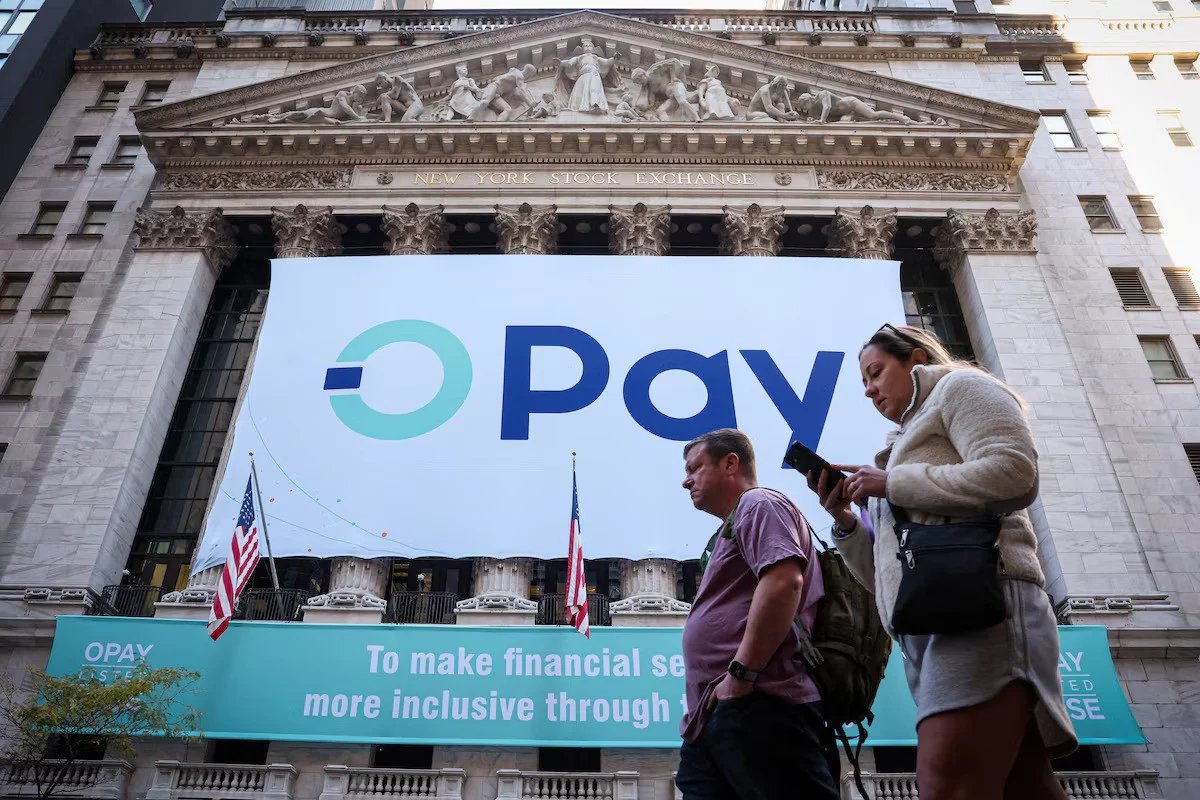
OPay’s rise to one of Nigeria’s largest fintechs came after a series of regulatory hurdles. Now, the latest—an inquiry from Chinese regulators—led it to withdraw its $304 million New York listing on October 30. How the company handled the earlier hurdles best guides what it might do now.
Last week, as OPay’s executives rang the opening bell at the New York Stock Exchange, it was supposed to symbolise the final step in the company’s long journey from a small mobile money operator in Nigeria to a global fintech.
Instead, it was another in a long series of hurdles the fintech has endured as the company suspended the listing after a regulatory inquiry from China, its founder Zhou Yahui’s home country.
Since Opera, the browser company owned by a consortium led by Zhou, acquired a controlling stake in Paycom, a mobile-money operator, in 2018, a mix of luck, almost endless capital, and a willingness to start afresh has created a fintech with 50 million users.
A hyperfocus on payments after it ditched its super app play meant OPay was prepared when Nigeria’s 2023 cash crisis broke commercial banks’ apps, and it emerged alongside other fintechs as a trusted digital payment option. Then it turned profitable in 2025 after rapid growth in its lending business.
External events and policy decisions beyond its control have shaped almost every phase of the company’s journey. To pass this latest hurdle, the company will need to revisit its previous attempts that have brought it success.
How OPay got here
In 2018, a Central Bank of Nigeria (CBN) capital rule set a ₦2 billion ($1.4 million) minimum capital for mobile money operators, which made institutions that could not meet the requirements cheap to buy. Paycom was one of those institutions. By July, OPay, with Opera’s backing, launched mobile payments in Nigeria, built on an agent banking model that reached unbanked people. The agent network remains part of its moat.
It also sold OKash, its lending product, to Opera for $9.5 million in December 2018. This sale would be important later, as lending grew to OPay’s largest revenue driver.
By May 2019, it launched ORide, a motorcycle-hailing business in Lagos, that brought visibility and app downloads. Other verticals, like OFood, a food delivery service, and OBus, a bus-sharing service, deepened the company’s relationship with the country’s informal sector.
By July 2019, OPay had raised $50 million from investors like Sequoia China, Source Code Capital, and Meituan-Dianping in the largest Nigerian startup round of 2019, until it raised a $120 million Series B round in November. Most of its investors were Chinese platform builders that helped push the super-app playbook that became successful in Asian markets.
By the end of 2019, OPay claimed to have over 140,000 agents and over $10m in daily transaction volume. Its revenue was $16.7 million for the 2019 financial year—almost 20x growth. It lost $71.5 million that year, with almost half, $36 million, going to scaling ORide.
This was the peak of OPay’s blitzscaling era, where it threw a lot of capital into creating a super app that served Nigerians at different points in their daily lives. This super app approach drew users to its payment service. By launching different verticals that Nigerians interacted with at various points, the idea was that it would create stickiness with OPay, the long-term play.
The super app falls apart
In January 2020, OPay got its first reputational shock when Hindenburg Research, the investigative short-seller publication, published a report that alleged Opera, its parent company, was targeting Nigeria’s poor population with predatory loans as its browser margins disappeared and it pursued revenue growth.
The report showed how Opera launched a series of short-term lending businesses—OKash, OPesa, OPay, and CashBean—in Kenya, Nigeria, and India that violated major Google Play Store short-term lending policies by providing an inaccurate description of its loan businesses.
OPay responded by denying the allegations and taking the lending product off its app.
While it was recovering from the shock of the Hindenburg report, a February ban on commercial motorcycles and tricycles in Lagos State, its biggest state in Nigeria, effectively ended ORide, its most visible product and biggest customer acquirer. It sold some bikes and transferred others to OExpress, a delivery product that was soon shut down. In April 2020, Yahui Zhou, OPay’s founder, officially resigned as Chairman of Beijing Kunlun to become full-time CEO of OPay, a move that showed how OPay’s decision-making power did not reside in its biggest market, Nigeria.
While its super app play was falling apart, OPay told TechCabal at the time that it was having its best year ever, claiming 5 million users and over 60% of mobile money transactions in Nigeria. This would be the moment that birthed today’s OPay, as the company focused on becoming a payments and agent-banking company.
By the end of the year, Opera reported that OPay’s monthly transaction value was over $2 billion, a 4.5x growth.
Unicorn status
When OPay raised $400 million in an August 2021 funding round led by SoftBank Vision Fund, the venture capital arm of Japanese conglomerate SoftBank, it achieved a $2 billion valuation, becoming Africa’s third-largest startup worth over $1 billion. It is still the single-largest investment round secured by an African-based startup.
It also hired Olu Akanmu, a former executive director for retail banking at FCMB, a Nigerian commercial bank, as President and co-CEO of OPay Nigeria. It also acquired a microfinance bank licence from the CBN, allowing it to give out loans, which a mobile money licence does not.
Then, by December 2022, OPay got its single biggest gift when the CBN released redesigned naira notes and set an expiry date for the new ones at the end of January 2023. Cash, the backbone of Nigeria’s economy, became scarce, and the apps of several commercial banks failed.
OPay and other fintechs like PalmPay and Moniepoint benefited from this policy as customers opened accounts and began transacting with them because they worked while banks failed, and their agent networks brought banking to doorsteps.
Akanmu, OPay’s former co-CEO, stepped down in January 2024 after almost two years at the company due to a clash of vision between the former banker and the rest of the company’s leadership based outside Nigeria.
Reckoning
By the second half of 2023, OPay had become a mainstay in the fabric of Nigerian life. By October 2023, OPay was the country’s most-downloaded app. But with scale comes regulatory oversight.
Nigeria’s Data Protection Commission (NDPC) investigated OPay over claims that it opened accounts for people without their consent, which the company denied after an internal investigation. No outcome has been made public after NDPC’s investigation.
OPay’s next interaction with regulators was not that smooth. In April 2024, TechCabal broke the news that the CBN barred OPay from opening accounts for new customers. That ban lasted for six weeks, and the fintech, among other fintechs, had to block P2P crypto transfers, verify physical addresses for all account tiers, and update facial verification.
Then, the CBN fined OPay ₦1 billion ($742,991) in the second quarter of 2024 after a routine CBN audit of the fintech sector revealed compliance issues.
It did not end there. An August 2025 CBN circular ordered every PoS terminal to be geo-tagged within 60 days and locked to within 10 metres of the merchant’s registered address, directly limiting OPay’s agent network business. That same month, the CBN capped PoS agents’ daily cash-outs at ₦1.2 million ($930) and individual customers’ at ₦100,000 ($70), another shock to its agent network.
These policy shocks might have shuttered the growth of most businesses, but OPay weathered these storms and drew 88% of its $536 million revenue from Nigeria.
OPay’s road to the shuttered IPO
On February 12, OPay confidentially submitted a draft registration statement, which became public only in October. In April, Opera, which holds 8.6% of OPay, told investors in a securities filing that it saw an 85% chance of an OPay listing within two years.
Opera was confident because OPay had made a sharp turnaround after losing $50.8 million in 2024. The following year, it made a $72.5 million profit on $536.3 million in revenue, up 161%, as new loans grew 285% to $938.3 million.
On May 1, Bloomberg reported that OPay had hired Citigroup, Deutsche Bank and JPMorgan to prepare a U.S. listing that could value it at about $4 billion, double the $2 billion SoftBank’s Vision Fund 2 set in 2021. With these backers, news about OPay’s IPO picked up pace, and what initially sounded like a pipe dream quickly got credibility.
OPay made its filing public on October 9. It showed first-half 2026 revenue of $467.1 million, up 136.5%, and net income of $90.9 million. Lending, at $236.1 million, had overtaken payments as its biggest business, and Nigeria supplied 89.5% of revenue.
The filing listed the risks that came with OPay’s listing: rising provisions for credit losses as lending grew, heavy dependence on Nigeria, and an Indonesian lending arm that OPay controls through contractual arrangements Indonesia does not expressly recognise.
However, one risk it dismissed in its IPO prospectus came back to prevent its listing. In the prospectus, OPay said it was not required to obtain approval from the China Securities Regulatory Commission (CSRC) or complete its filing procedures under China’s 2023 overseas listing rules.
But, according to Bloomberg, a Chinese regulatory inquiry prompted the Nigeria-focused payments company to halt its IPO just hours after setting the price. OPay said it was confident the inquiry would be resolved satisfactorily “in the near future.”
The redemption deadline gives OPay until the end of 2027 to try again, about 14 months. To scale its second IPO attempt, the company will need to revisit how well it bounced back from inquiries by Nigerian policymakers.