

For four years, Segun Olaiya worked in local search engine optimisation (SEO) in the United States, helping large operations, including AT&T and businesses in San Diego and Texas, improve their visibility in online searches.
But he observed that marketing technology largely catered to organisations with multiple locations, leaving smaller businesses overlooked.
“Most of this kind of industry, which is marketing technology, is usually focused around big organisations that have multiple locations across cities and states that want to be as visible as possible. But small businesses are not always really paid attention to,” Olaiya told TechCabal in an interview.
He began helping small business owners manually optimise their Google Business Profiles. Some reported receiving more calls from customers who found them through organic search rather than paid advertisements. “They were like, ‘Oh, now I get more calls,’” he recalled.
“Maybe I can actually just make this into a proper thing and then automate it,” Olaiya said.
That idea led to Massive in 2026, an AI-powered local SEO platform that helps businesses like restaurants, clinics, salons and home-service providers improve their visibility on Google. It combines automated optimisation with human account managers who monitor search rankings and review business profiles.
Why being on Google is not enough
Being listed on Google does not guarantee a business will appear prominently when potential customers search for its services. Google says local search results are mainly based on three factors: relevance, distance, and prominence.
Relevance measures how closely a business profile matches a search; distance considers how far the business is from the person searching. Prominence reflects how well-known it is online, including through customer reviews and links from other websites.
Olaiya says businesses can improve their visibility by ensuring their Google Business Profiles accurately describe their services, keeping their business information consistent across online platforms, and encouraging customers to leave reviews.
For many Nigerian microenterprises, establishing an online presence remains a challenge. A 2024 Research ICT Africa report, based on a survey of 718 Nigerian microenterprises, found that only 13% used the internet for business activities. Just 0.3% had their own websites, while 6.7% had a social media presence. The report also found that 37% lacked the digital skills to use the internet productively for their businesses.
Yet online search can be an important source of customers. A study commissioned by Google and conducted by Public First found that, on average, businesses surveyed in Nigeria reported that around 11% to 20% of their new customers found them through Google Search. The survey covered 140 business leaders from small, medium, and large online businesses.
For business owners already occupied with running their operations, keeping their online profiles competitive adds another responsibility. Olaiya says Google’s frequent changes to its local search priorities make it difficult for businesses to know what to update or improve.
“Typically, the problem is that Google usually changes the rules. More often than not, they usually change what they really care about,” he said.
He said many business owners lack the time to keep up with these changes and work out how to improve their visibility, so some outsource the task to specialists to focus on running their businesses.
He believes this makes services like Massive more appealing to businesses that would rather focus on their daily operations.
How Massive manages local search for businesses
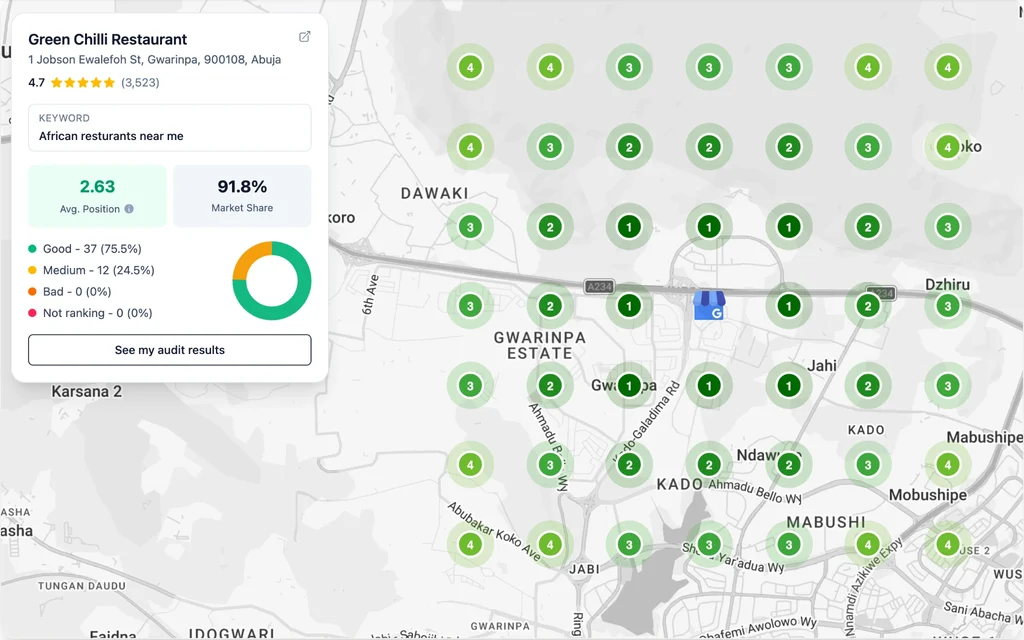
Massive’s process begins with a free visibility scan on its website, TryMassive.ai. Business owners enter their business name and a search term potential customers might use, such as “barber near me.” The platform then generates a map showing where the business appears in Google Maps search results across the surrounding area.
Olaiya said the scan simulates searches from 49 points around a business by default, showing how its ranking changes depending on where a potential customer is searching.
He said the system uses Google data to estimate what someone searching from each location would see.
“The Massive system goes and simulates that search across, by default, 49 points in the city,” he said. “We simulate it as if somebody physically went to that physical location and then opened their phones and they search for that keyword.”
Businesses looking to assess a wider area can increase the number of points to 81 or 100. Massive also calculates an average ranking across the locations, giving business owners an overview of their visibility in the area.
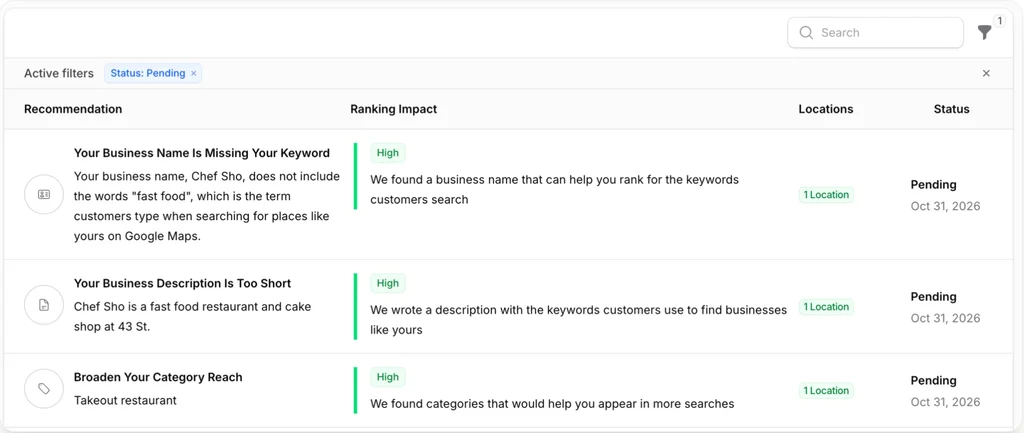
Those who want to improve their rankings can subscribe to the platform and book a 30-minute call with a member of Massive’s team. During the call, an account manager reviews their existing results and business profile, discusses their goals and explains the changes Massive recommends. Olaiya describes the arrangement as a “done-for-you experience”, adding that “we literally do everything for you”.
The platform uses AI to analyse business profiles and identify areas for improvement. It reviews a business’s existing description and recommends changes that could help Google better understand its services and the customers it wants to reach.
“Once a business is imported to Massive, the system itself automatically reviews the existing description and then recommends the proper description,” Olaiya said.
Massive also checks for inconsistencies in a business’s online information, such as differences between the descriptions on its website and social media pages. For businesses without websites, Olaiya said the platform can automatically generate one using their business information and update it as changes are made. It also recommends changes to ensure that the business presents consistent information across its online platforms.
Some tasks run automatically without requiring the business owner or an account manager to intervene. When a customer leaves a Google review, Massive analyses it, considers the business’s services and communication style, and drafts a response. Olaiya said the system can then publish the response directly on Google without the business owner having to log in and reply.
However, account managers remain involved in reviewing recommendations and handling issues that require human judgement. Olaiya said some businesses upload images or other content that Google may not accept. When the system flags such material, an account manager can contact the business owner, explain the problem, and advise them on what to change.
“We believe that a person should talk to another person instead of us just running a system that AI is talking to the person,” he said.
Massive runs visibility scans every two weeks to track changes in a business’s rankings. If rankings do not improve after two weeks, Olaiya said the team changes its strategy. Subsequent scans can also reveal declines, allowing the team to identify changes that may have affected a business’s position and reverse them where necessary.
Olaiya said that after three to four months of optimisation, once a business’s profile is stable, the system becomes largely autonomous and continues monitoring its visibility with less direct intervention from the team.
Who Massive is building for
Massive targets businesses whose customers need to find them in a particular location. Olaiya identified four main categories.
The first is businesses with physical outlets, including restaurants, gyms, salons, spas, and law firms. The second is service-area businesses, such as electricians and lawn-care companies, which travel to customers rather than operate from a fixed location. The third is multi-location businesses that want customers searching for their services to find the outlet closest to them. The fourth is new businesses entering an established market and trying to attract local customers alongside existing competitors.
Olaiya said businesses in less populated areas could have an advantage because they face fewer competitors and can serve a wider area.
“For places that are not very dense, the businesses there who happen to find Massive, for example, are at a good advantage because they have fewer competitors and they can cover even a bigger area,” he said.
However, not every business needs local SEO. Olaiya said Massive is not designed for online-only businesses, software companies, newsrooms or blogs whose customers do not need to find a physical location or service provider nearby.
Massive earns revenue through monthly and annual subscriptions. Its website lists the service at ₦18,000 ($13.37) a month per business location, or ₦216,000 ($160.47) for a year. The subscription includes profile optimisation, weekly Google Business Profile updates, review management, map-rank tracking and a dedicated account manager. Businesses can also try the full service free for 14 days before subscribing. Olaiya said the company has more than 20 active customers.
Olaiya said many small businesses rely on social media to reach customers without fully exploring how Google Search can help them attract new ones. He
sees educating business owners about local SEO as an important part of growing Massive’s customer base.
“One of the things that can drive the product is to educate business owners to say, ‘ You need this,” he said. “We are currently bootstrapping, and it is quite limiting how far we can go in terms of reaching out to the business owners. But we are on it.”
Building Massive’s next phase
Massive is entering a market with established international platforms offering similar local SEO and location-marketing services. Olaiya identified Polish platform Localo, San Diego-based SOCi, a]nd New York-headquartered Yext as competitors.
He said Massive is cheaper than competitors outside Africa, which he believes allows it to serve African businesses and small businesses in other markets. Massive’s published monthly price is lower than Localo’s $49 Single Business plan, which falls to $39 per month with annual billing.
However, the two platforms offer different service models. Localo provides software tools for businesses to manage their own Google Business Profiles. Massive offers a done-for-you service with an account manager. SOCi and Yext do not display comparable prices on their enterprise pricing pages, instead directing prospective customers to request customised information or a demo.
However, the company still has to convince business owners that local search visibility is worth paying for and expand its reach beyond its current customer base. Olaiya said he wants Massive to demonstrate its value through the business decisions customers make after improving their visibility.
“Over the next year, I need to have at least 100 businesses who can attest to the fact that Massive has helped them expand their businesses,” he said.
For him, that would mean more than businesses appearing higher in Google Maps results. He wants customers to use the visibility insights to make decisions such as opening another outlet or moving into a new area. He said such expansion would show that Massive had made a significant impact on their businesses.