
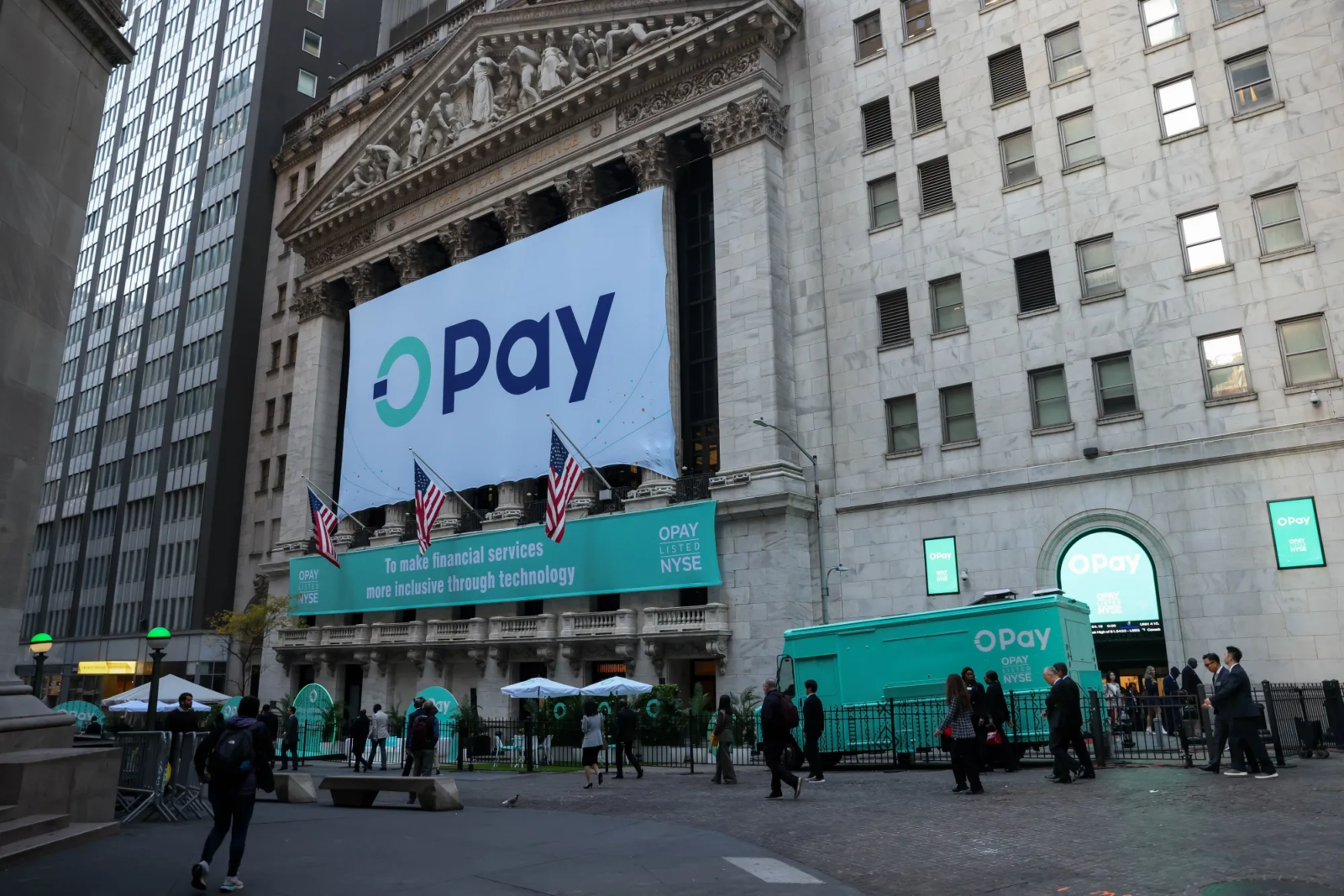
OPay’s October 9 Initial Public Offering (IPO) prospectus suggested that the company did not expect to require approval from Chinese regulators to list on the New York Stock Exchange. But a last-minute regulatory inquiry from China, shortly before its planned $304 million public offering, has raised questions about whether the fintech company underestimated its exposure to Beijing’s securities rules.
On October 30, 2026, OPay decided not to complete its much-anticipated IPO following a regulatory inquiry involving a jurisdiction it described as immaterial to its business operations. The company had priced 16 million American Depositary Shares (ADSs) at $19 each, valuing it at approximately $4 billion.
On Wednesday, Bloomberg reported that a Chinese regulator’s inquiry prompted the Nigeria-focused payments company to halt its IPO just hours after setting the price. OPay said in an earlier statement it was confident the inquiry would be resolved satisfactorily “in the near future” but did not identify the regulator or disclose the nature of the inquiry.
However, in its IPO prospectus first released on October 9 and amended on the 23, OPay said it was not required to obtain approval from the China Securities Regulatory Commission (CSRC) or complete its filing procedures under China’s 2023 overseas listing rules.
“We are not required to obtain regulatory approval from the CSRC or go through the filing procedures under the CSRC Filing Rules before ADSs can be listed or offered in the United States because we did not generate any revenues within mainland China in 2025, being the most recent accounting year, and all of our operating assets are located outside of mainland China, our business activities are conducted outside mainland China, and our places of business are located outside mainland China, and our senior managers in charge of our business operation and management are predominantly non-PRC citizens or not domiciled in mainland China,” the company said in its prospectus.
China’s Trial Administrative Measures of Overseas Securities Offering and Listing by Domestic Companies, introduced in February 2023 and effective from March 31 that year, require domestic companies seeking to list overseas to complete filing procedures with the CSRC. The rules also cover certain offshore-incorporated companies whose underlying businesses are substantially connected to mainland China.
Opay did not respond to a request for comments.
The OPay Chinese connection
OPay’s connection to China is largely through Zhou Yahui, its Chinese founder. The fintech is incorporated in the Cayman Islands and headquartered in Singapore, while Nigeria accounts for most of its business. According to its prospectus, Nigeria generated 88.1% of its revenue in 2025 and 89.5% in the first half of 2026.
Under Article 15 of China’s Trial Administrative Measures, an offshore company can fall within the rules’ scope if at least 50% of its operating revenue, total profit, assets, or net assets comes from mainland Chinese companies and it meets specified operational or management criteria. The regulation requires the determination to be made on a “substance over form basis”, meaning regulators can look beyond an offshore corporate structure to examine where a company’s business actually operates.
OPay argued in its prospectus that it did not meet these conditions because it generated no revenue in mainland China in 2025, held no operating assets there, and conducted its business activities and management predominantly outside the country. However, the company acknowledged that uncertainty remained over how the rules would be interpreted and implemented.
“We cannot assure you that we are not, or will not be, subject to such filing requirements for this contemplated offering and listing in the United States and our securities offering in the future, in which case we may not be able to get clearance from the CSRC in a timely manner, or at all,” the company said.
The Chinese regulatory connection also extended to OPay’s underwriting arrangements. In its prospectus, the company named China International Capital Corporation (CICC) Hong Kong Securities Limited as one of four representatives of its underwriting syndicate, alongside Citigroup, Deutsche Bank and Standard Bank.
Article 21 of China’s overseas listing rules requires an overseas securities company acting as a sponsor or lead underwriter for a qualifying overseas offering by a domestic company to file with the CSRC within 10 working days of signing its first engagement agreement. The firm must also submit an annual report detailing its previous year’s business activities relating to such listings.
However, CICC was absent from OPay’s October 30 IPO pricing announcement, which named Citigroup, Deutsche Bank and Standard Bank as joint book-running managers, alongside B. Riley Securities and Needham & Company as co-managers. Bloomberg subsequently reported that CICC had been taken off the deal.
In a factsheet shared with TechCabal on Monday, OPay still listed CICC as part of its underwriters.
“JPMorgan Chase was part of the advisory team in the early planning stages earlier in the year. However, the actual lead underwriters managing the active NYSE registration and pricing were Citigroup, Deutsche Bank, Standard Bank, and CICC,” the factsheet read.
The regulation also places responsibilities on securities companies and law firms involved in overseas listing transactions. Article 20 requires them to thoroughly examine and verify filing documents, including ensuring that they establish whether an issuer meets the conditions for an indirect overseas listing under Article 15. Where the filing rules apply, this makes the issuer’s regulatory assessment relevant not only to the company but also to the intermediaries facilitating the transaction.
It remains unclear whether CICC’s removal from the underwriting syndicate was connected to the Chinese regulatory inquiry or whether the bank’s role triggered any filing obligations under Article 21.
OPay has yet to publicly identify the regulator behind the inquiry or confirm that it concerned China’s 2023 overseas listing rules.
“Furthermore, changing regulatory requirements and any failure of us to fully comply with new regulatory requirements may significantly limit or completely hinder our ability to offer or continue to offer the ADSs,” the company said in its prospectus.
Whether the inquiry was connected to those rules remains unclear. However, it has left unanswered questions about the regulatory risks OPay could face in its next attempt to access US capital markets.