
A jump in traffic is forcing MTN to spend faster than planned. Getting customers onto 5G will take more than building the network.
MTN Benin has a problem that most telecom operators would welcome: people are using its network more, and keeping up is proving expensive. But that extra usage has not brought a comparable jump in revenue.
The company’s third-quarter service revenue rose to R1.592 billion (~$91m) in 2026, from R1.562 billion (~$89m) a year earlier—an increase of R30 million, or about 1.9%. The longer view was less encouraging: service revenue for the nine months to September fell 6.1% in reported rand terms to R4.42 billion. Stripping out currency movements, the decline was 0.3%.
Those figures point to a business still working to turn growing network usage into sustained revenue growth. They do not establish how much additional revenue came directly from the traffic increase Ofodile described.
In January 2024, MTN Group pledged $215 million for infrastructure in Benin over three years. Now, chief executive Uche Ofodile expects the local operation to exceed that budget by early 2027, as demand forces it to bring spending forward.
The commitment is substantial for one market, though only a fraction of MTN’s wider investment bill. The group spent R38.5 billion (~$2.2bn) on capital expenditure, excluding leases, in 2025, equivalent to about $2.15 billion at its average exchange rate for that year. Benin’s entire three-year pledge is therefore roughly one-tenth of a single year’s group-wide spending.
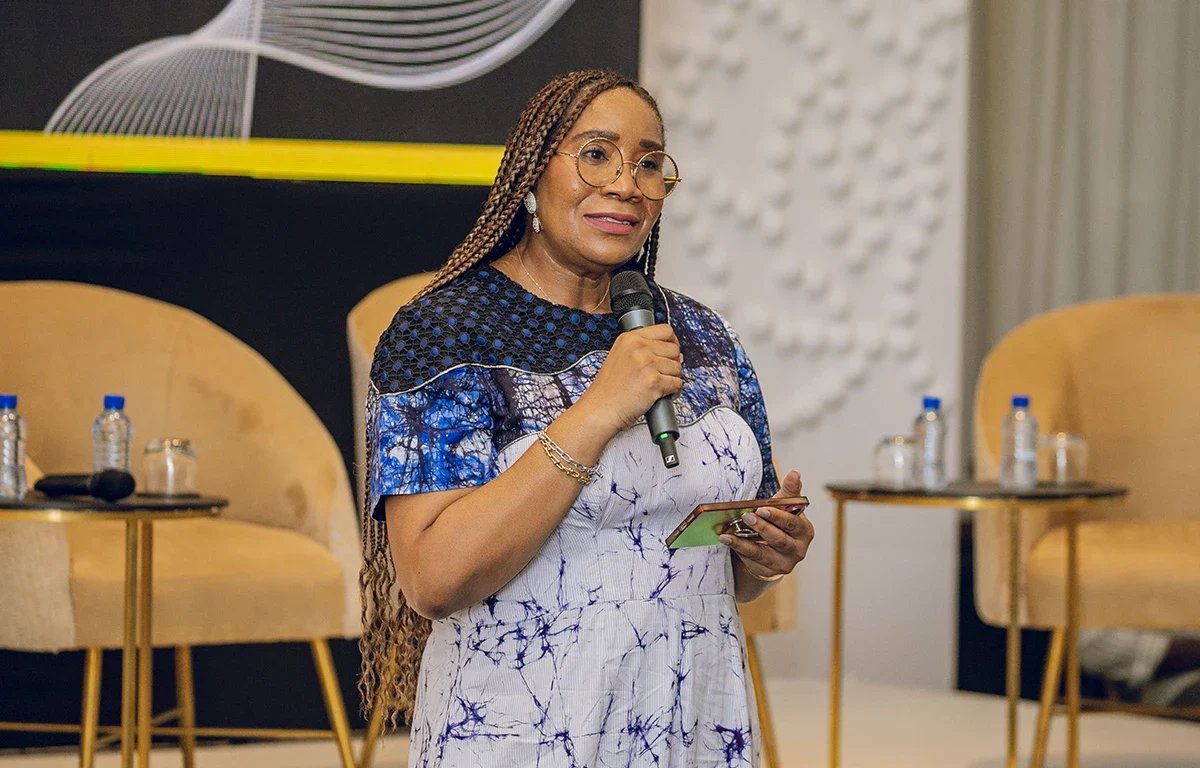
“We’re probably going to outspend that,” Ofodile said in an interview with TechCabal on the sidelines of the Cyber Africa Forum, held between November 16 and 17, 2026, in Cotonou, the Republic of Benin.
Ofodile linked the spending pressure to a regulatory change in February, after which, she said, traffic grew by 100 per cent. She did not specify the comparison period or disclose how much of the investment pledge MTN has spent.
Her account highlights the difficult economics of cheaper connectivity: customers can consume more data without the operator earning proportionately more revenue, even as the operator needs additional capacity to serve them.
The original investment announcement also included a new office for MTN Benin. But Ofodile said unexpected demand had already pushed the company beyond its 2026 spending plans.
There is more to accommodate than heavier usage. Cotonou is growing, nearby communities are expanding, and MTN wants stronger coverage in the north. The question is where to build next, what customers can afford once the network arrives, and whether their spending can justify the investment.
The phones have to follow
MTN launched commercial 5G in Benin in November 2024, six years after Africa’s first commercial deployment in Lesotho, later followed by South Africa (2019), Seychelles (2020), Togo (2020), Mauritius (2021), and Botswana (2022).
Benin’s market shows why introducing a newer network does not immediately displace older technology. Regulatory figures for September 2026 show that 2G still held a narrow lead, accounting for 44% of mobile subscriptions, compared with 43.6% for 4G. Specifically for internet access, however, 4G accounted for 58% of mobile internet subscriptions in 2025. The September 2026 figures do not separately identify 5G subscriptions.
Ofodile expects MTN’s 5G network to expand beyond Cotonou in early 2027. She is, however, less interested in putting coverage everywhere before enough people have the devices to use it.
“I can have all the desire in the world to expand,” she said. “But if we don’t have enough devices, then… it makes it a bit difficult.”
It is an unglamorous hurdle for a technology usually sold on speed. A faster network does little for someone whose phone cannot connect to it.
Nigeria offers a cautionary example. By September 2026, 5G accounted for 5.05 per cent of mobile subscriptions, up from 2.81 per cent in April 2025, but still a small share of the market. High device costs have been a barrier to adoption. Nigeria’s figures do not describe Benin’s market, but they illustrate why building a network does not automatically bring customers onto it.
Ofodile said MTN Benin allows customers to pay a deposit for a phone and then clear the balance daily or weekly. Benin’s mobile penetration stood at 78.1 per cent at the end of 2025, representing about 10.3 million unique subscribers, although this measure reflects access to mobile services rather than smartphone ownership.
Elsewhere, MTN’s South African MoMo business introduced rent-to-own smartphones in July 2025, with advertised daily payments starting at R10 (¢57). But those terms apply to South Africa, not Benin.
Splitting a bill into smaller payments can help. It does not necessarily make the phone cheaper or the repayments manageable.
Following the customers
For now, businesses and households offer MTN another route to growing its network.
Ofodile said business customers are increasingly interested in fixed wireless access: broadband delivered over a mobile network, without running a physical connection to every building. It is particularly useful where fibre is unavailable.
New homes around Cotonou and Abomey-Calavi also mean potential customers. MTN wants to follow that growth, rather than expand 5G simply to claim more coverage.
Farther afield, the approach changes. Ofodile cited a rural-site partnership with Africa Mobile Networks Group (AMN) as an example of how to find infrastructure suited to the communities being served.
“I’m going to put the best technology for the environment,” she said. “Rural telephony, rural coverage.”
A rural community and an urban business district do not necessarily need the same setup, or generate enough revenue to justify the same costs.
Data prices, meanwhile, have fallen sharply. Government figures drawn from regulatory data put the average price at CFA995 ($1.66) per gigabyte in 2022 and CFA440 ($0.74) per gigabyte in 2024, down by roughly 56%.
For customers, lower prices mean their money can go further. For MTN, more usage means finding ways to carry the extra traffic while keeping costs down. Neither side of that equation disappears when the company switches on 5G.
The challenge, however, is making those investments pay without asking customers to shoulder prices that put connectivity beyond their financial reach.
The 83% question
Ofodile’s benchmark for success is not another generation of mobile technology. It is mobile money, and how thoroughly it has worked its way into everyday life.
According to the GSMA’s 2026 mobile-money report, global services processed over $2.1 trillion in 2025, driven largely by sub-Saharan Africa. Merchant payments grew fastest, jumping 42% to $155 billion as phones became tools for daily commerce rather than just transfers. Importantly, mobile money functions over USSD on basic phones, meaning deeper digital inclusion does not require 5G or smartphones.
“Mobile Money represents 83 per cent of the value of the transactions in the country,” Ofodile said.
Benin’s 2025 annual report from the Autorité de Régulation des Communications Électroniques et de la Poste (Electronic Communications and Postal Regulatory Authority) (ARCEP) gives MTN Mobile Money approximately 83% of mobile financial services revenue, from a total market of CFA82.5 billion.
Provider revenue is not the money customers transfer or spend. The report confirms MTN’s dominance by revenue; it does not independently establish Ofodile’s claim about transaction value.
Her wider point, though, is about what people do with the service. She remembers early mobile-money advertising that centred on a city worker sending money to a parent in a village. Today, its uses extend well beyond that transaction.
She wants connectivity to follow the same path: from something customers subscribe to, to something they rely on to work, trade, and improve their lives. Subscriber totals alone cannot tell her whether that is happening.
“We can count the customers all we want,” Ofodile said. “At the end of the day, if they’re not using digital services to grow the economy, to improve their own lives, then we haven’t done enough.”